In the infrastructure and construction world, failure is rarely sudden.
It builds slowly—behind Gantt charts, under milestone meetings, and beneath well-intended plans.
You see it in the headlines:
- “Another tunnel project delayed.”
- “Budget blows past $1.2B.”
- “Contract disputes stall completion.”
We shake our heads. We adjust the plan, and then we do it again on the next project.
But here’s the question that rarely gets asked:
Are mega projects failing because they’re hard to execute? Or is it because we’re still managing them with tools built for smaller, simpler systems?
This post explores why applying linear thinking to exponential complexity is the root of recurring issues in large-scale infrastructure projects—and what must change if we want a different outcome.
Because complexity isn’t the enemy. How we manage it is.
Traditional Metrics Miss the Root Causes
Most projects are judged by:
- Contractual compliance
- Schedule and budget targets
- Business case value
- Scope delivery
But these are lagging indicators. They measure what went wrong, not what caused it. By the time your cost curve spikes, it’s too late. If we want to improve project performance, we need to move upstream into systems, controls, and clarity of purpose.
Early Warning Signs Are Always There
No matter the geography or delivery model, struggling projects show familiar symptoms:
- Uncontrolled cost growth
- Shifting or unclear scopes
- Delayed decision-making
- Risk registers that are filled but forgotten
These symptoms point to something deeper, a mismatch between project scale and the management system trying to control it.
The Myth of Risk Transfer: Why Balancing Contractual Models Isn’t Enough in Mega Projects
Here’s where many mega projects go off track: they overestimate the power of contractual frameworks and underestimate the project management capability and competence required to match the project’s complexity on both the client and contractor sides from the very beginning.
The quality of construction is rarely the issue. Most major infrastructure projects are built to exceptional standards. Yet, they still finish late and/or exceed budget.
Even with contract clauses like liquidated damages (LDs) designed to keep delivery on track, delays persist. Despite lessons from past project failures, we continue to rely on the same outdated frameworks, traditional mindsets, and ineffective delivery mechanisms.
Let’s be clear: simply shifting risk between client and #contractor isn’t the solution. It’s not just about who holds the risk, it’s about whether the teams involved have the skills, systems, and strategic alignment needed to manage it effectively.
In mega projects, complexity doesn’t grow linearly, it grows exponentially. And that exponential complexity demands more than just legal safeguards. It requires a fundamentally different approach, one that integrates people, systems, and strategic intent from the ground up.
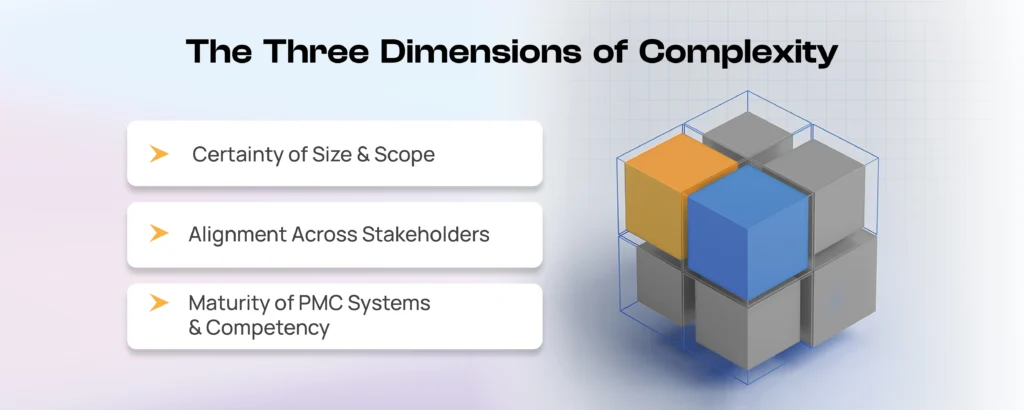
The Three Dimensions of Complexity
Based on Pioticon’s experience across sectors, we’ve found that three dimensions define how complex a project really is:
- Certainty of Size & Scope
When project quantum is unclear or changes frequently, everything downstream becomes harder to plan, measure, or control. - Alignment Across Stakeholders
The more trades, agencies, and layers involved, the more chances for misalignment. Differing goals create friction that cascades across delivery. - Maturity of PMC Systems & Competency
Even if scope and alignment are strong, an immature project control system will eventually break under pressure. The right systems, dashboards, and controls must be in place—and used daily.
When one of these dimensions weakens, the other two are forced to overcompensate.
When all three fail together, even the most promising project will stall.
What We See: A Cycle of Breakdown
Mega project issues aren’t random—they’re part of a repeatable cycle:
- Vague project scopes create uncertainty
- Misaligned teams make reactive decisions
- Ineffective systems delay performance tracking
- Issues escalate while everyone is looking elsewhere
The result? Delays. Disputes. Cost blowouts. Lost stakeholder trust.
The Hidden Drivers of Mega Project Failure
At Pioticon, we’ve identified eight recurring drivers behind time and cost blowouts. The broad theme of those drivers are:
- Poor integration across delivery functions
- Weak performance management frameworks
- Low visibility on early warning indicators
- Incomplete or outdated system adoption
- Skill gaps in key leadership roles
We’ll unpack each of these in future PM² blogs. For now, know this: these factors aren’t isolated, they compound each other.
The Way Forward
It’s not more meetings, and it’s not just another software application, or a few PM experts to write generic processes and procedures, or waiting for artificial intelligence to fix cultural problems.
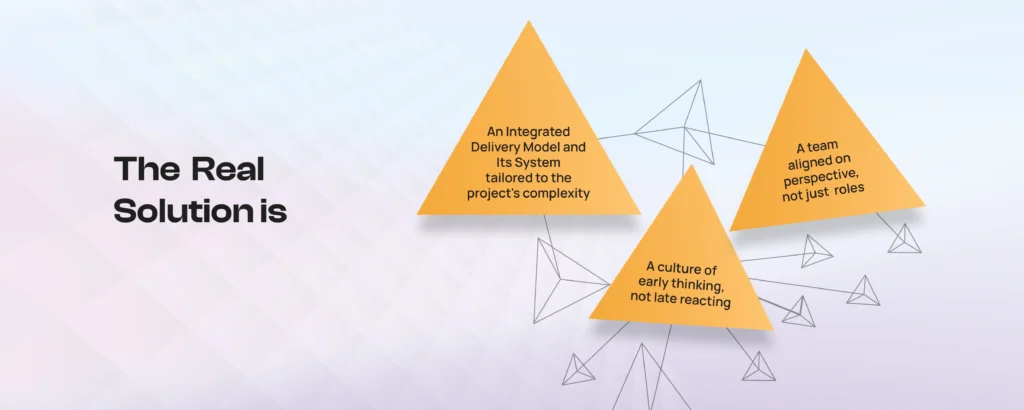
The real solution is:
- An Integrated Delivery Model and Its System tailored to the project’s complexity
- A team aligned on perspective, not just roles
- A culture of early thinking, not late reacting
Performance systems don’t work unless teams use them, and project controls don’t matter unless leaders value them.
Project Failure Is a Systems Issue, Not a Scale or Contractual Issue
Complexity is not a problem. It’s a reality. But treating complexity with static frameworks is what causes failure. At Pioticon, we don’t just bring tools. We build integrated systems that support proactive leadership and cross-functional alignment designed specifically for the reality of mega infrastructure delivery.
That’s the core of our PM² (Project Management Perspective Matters) Series.
Pioticon Blog is proudly powered by WordPress