Blog

  • A Holistic View for the Concept of Project Performance Failure

    A Holistic View for the Concept of Project Performance Failure

    At Pioticon, we don’t just believe in tailored project management, we build for it. Our focus remains on Engineering & Construction projects because they require sector-specific systems, delivery-aligned teams, and capability development rooted in real-world complexity.

    We’re not here to offer templates.

    We’re here to offer purpose-built systems, tools, techniques and thinking built for the job at hand.

    Project failure is often misunderstood. It depends on who looks at it. Success from stakeholder doesn’t mean it is successful from the side of sponsors or owners. The same way, success from owner’s perspective doesn’t mean contractor share the same or vice versa.

    Delays, cost overruns, and stalled approvals are visible symptoms of performance failure, but not the cause. These symptoms are frequently discussed in isolation, yet they stem from one consistent issue observed across the industry: productivity.

    This edition of the PM² Series presents a holistic view of how major project breakdowns occur, drawing on project delivery processes, market behaviors, award mechanisms, and execution realities, especially across Engineering & Construction projects.

    Defining Project Delivery

    Project delivery varies not only by size and scope, but by industry type and delivery model, whether portfolio, program, or project. Each operates under a unique objective, stakeholder framework, and complexity profile.

    Previously in the PM² Series, we explored how delivery structures and project management differ across sectors. That baseline leads to a critical realization: failures don’t stem from poor intentions or low-quality engineering. They stem from delivery mismatches that appear long before problems are visible on the surface.

    Problem occurs depending on decision made at different stages

    STAGE 1 – The Starting Point: An Idea and the Business Case Development

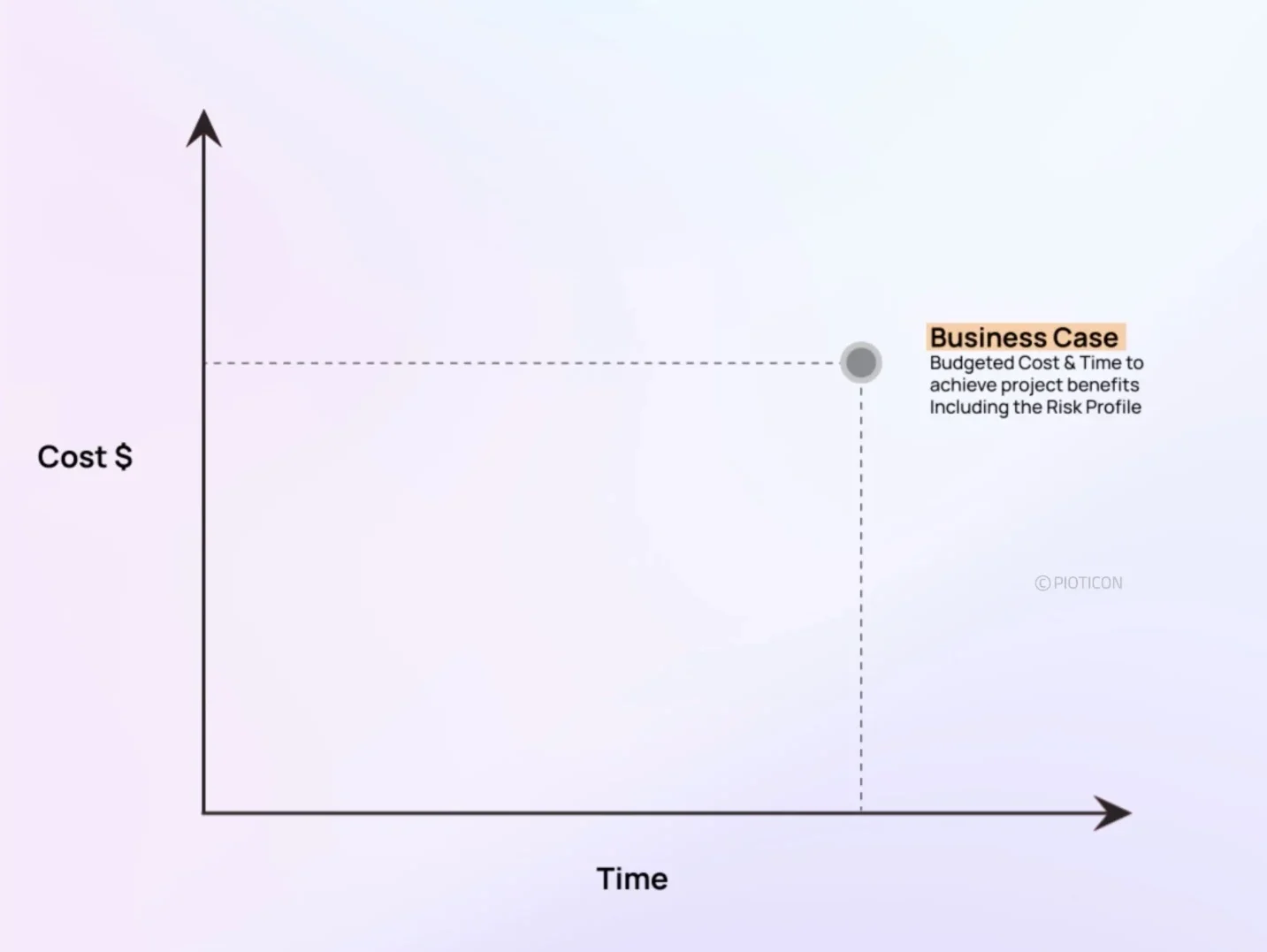
    Most projects begin with a need or an idea, and a well-defined business case along with feasibility study. It estimates time, cost, and risk, typically developed with input from experienced professionals using historical data, risk classification (Class 1–5), and defined benefits.

    This is the point where decision-makers and sponsors sign off based on a projected value case, often optimistic but framed with the assumption that risk-adjusted contingencies can cover variability. The project is assessed as financially and strategically viable at this stage.

    There’s no sign of problem at this stage assuming expert estimate of scope, time, cost & risk is adequate.
    STAGE 2 – Defining Project Delivery Model, Market Engagement & Awarding the Program or Project

    Stage 2A
    This crucial step involves choosing the right delivery model to balance “value for money,” while building an asset that delivers economic benefits. The owner or sponsor decides on Project delivery Model (PMO, Program or Project as one Package or SPV or Integrated Project Delivery) depending on organisation maturity and capability, accordingly project or package of works is broken down suiting the sponsor funding.
    Stage 2B

    Project or Package of works are decided on which Contractual model (Construct only, Design & Construct, EPCM, Alliance or PPP) is right fit to deliver those projects.

    When looked as a combined stakeholder benefits, each contractual model has its own merits and demerits.

    Once the sponsor approves the project to go to market the next phase tests the market through design and construct procurement. Consultants and contractors submit proposals based on scope documents, interpretation, and assumptions, each applying their own risk assessments and pricing models. Procurement teams evaluate offers using both quantitative and qualitative measures. Most organizations follow strict administrative policies and compliance protocols. Often, market pricing returns higher than anticipated in the business case. In such instances, clients and sponsors must reassess and either approve increased costs and timelines or repackage the scope. Once awarded, a mega project is expected to deliver against time and cost agreements, but the foundation of that commitment is already on uncertain ground and won’t be visible.

    The only sign of the problem at this stage is that if the market indicates anything more time, cost and risk of the same scope.
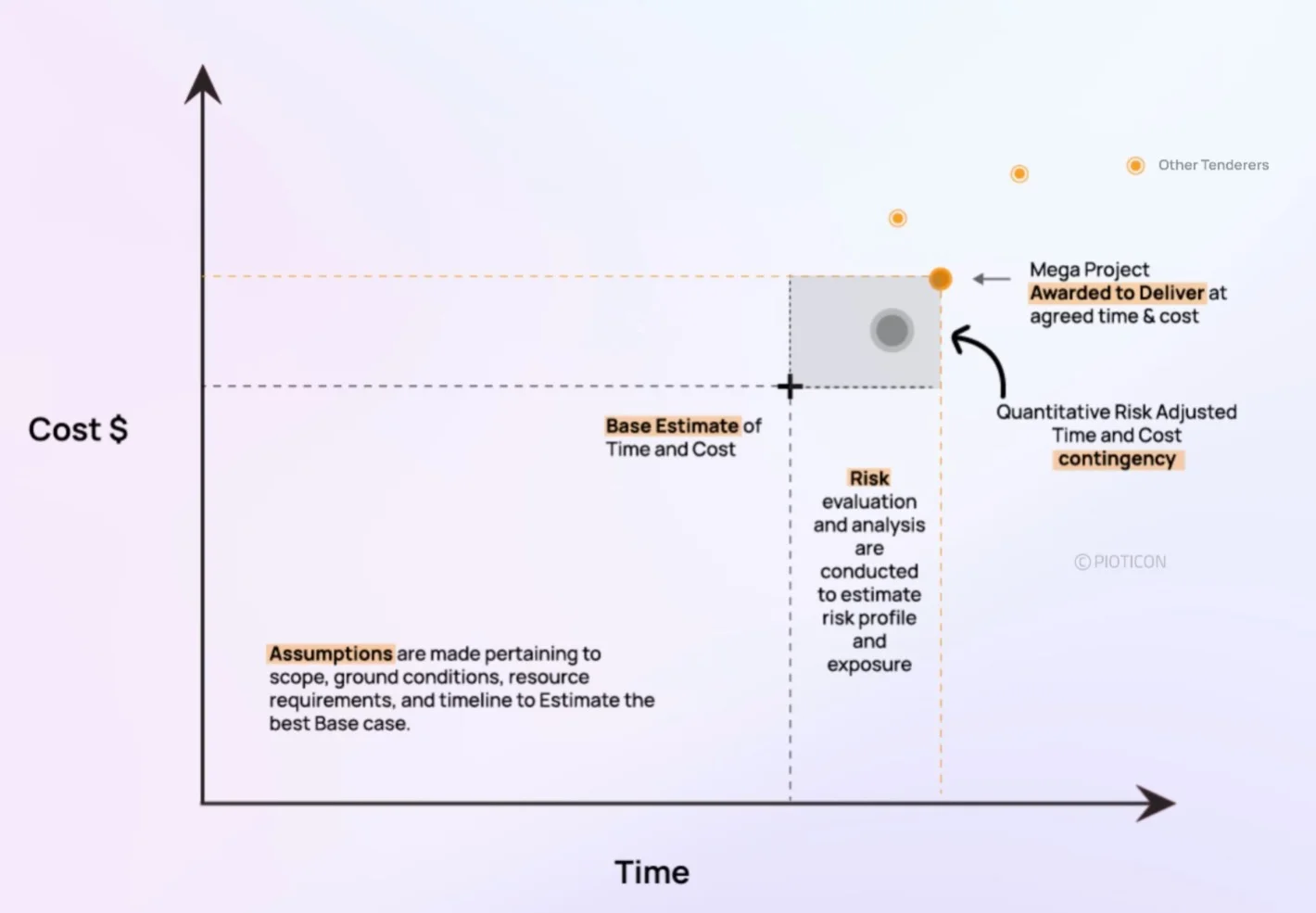
    STAGE 3 – What Happens Post-Award Until Design is Complete

    The concept scope evolves through various engineering and design stages. By the time the design reaches the Issued for Construction (IFC) stage, the original awarded scope has often changed significantly at the detail scope item and its quantum level, requiring adjustments to construction delivery strategy, time and cost. These changes frequently exceed the risk contingency allowance.

    This is the first indication of potential failure stemming from previous stage problems and decisions. Examples include design changes to accommodate ground conditions and specifications, as well as ineffective project management.

    However, Contractor often take an over optimised biased decision to recover in construction methodology and efficiency.

    STAGE 4 – Construction and Handover post IFC

    Classic failure symptoms started coming to the surface at this stage, compounding all the bad decisions made in the earlier stages.

    In failed project cases, depending on contractual model, Principal Contractor marry to the high risk project to deliver committed contract with compressed timeline and cost. This environment automatically creates unrest and unnecessary pressure to the team to perform unrealistic output.

    In many cases, Estimate at Stage 3(above) also further blows out due to many reasons including ineffective project management, procurement or long lead delays, unproductive delivery performance and unforeseen conditions (weather or ground or market or all combined).
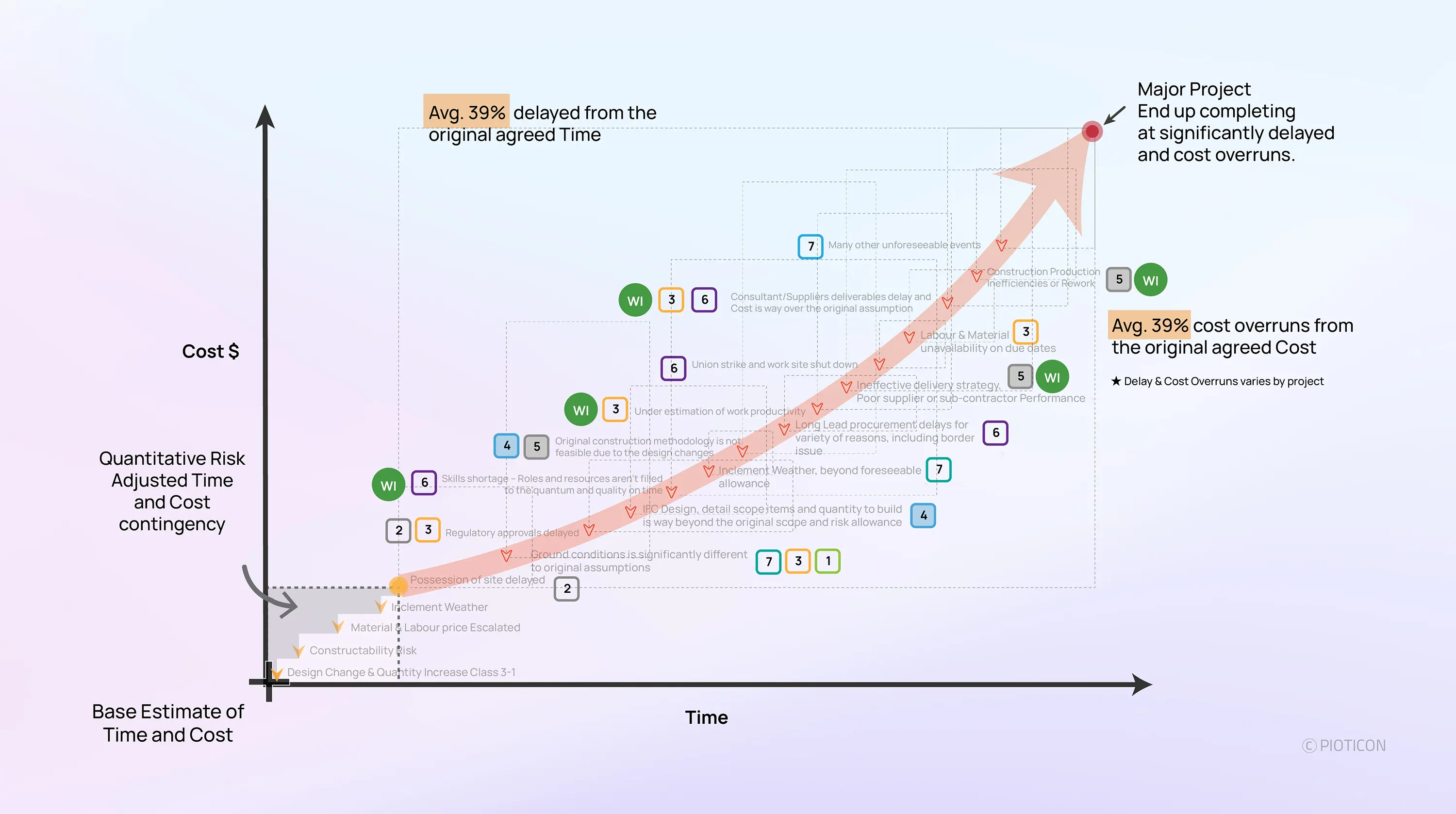
    Significance of the Project Performance Failure

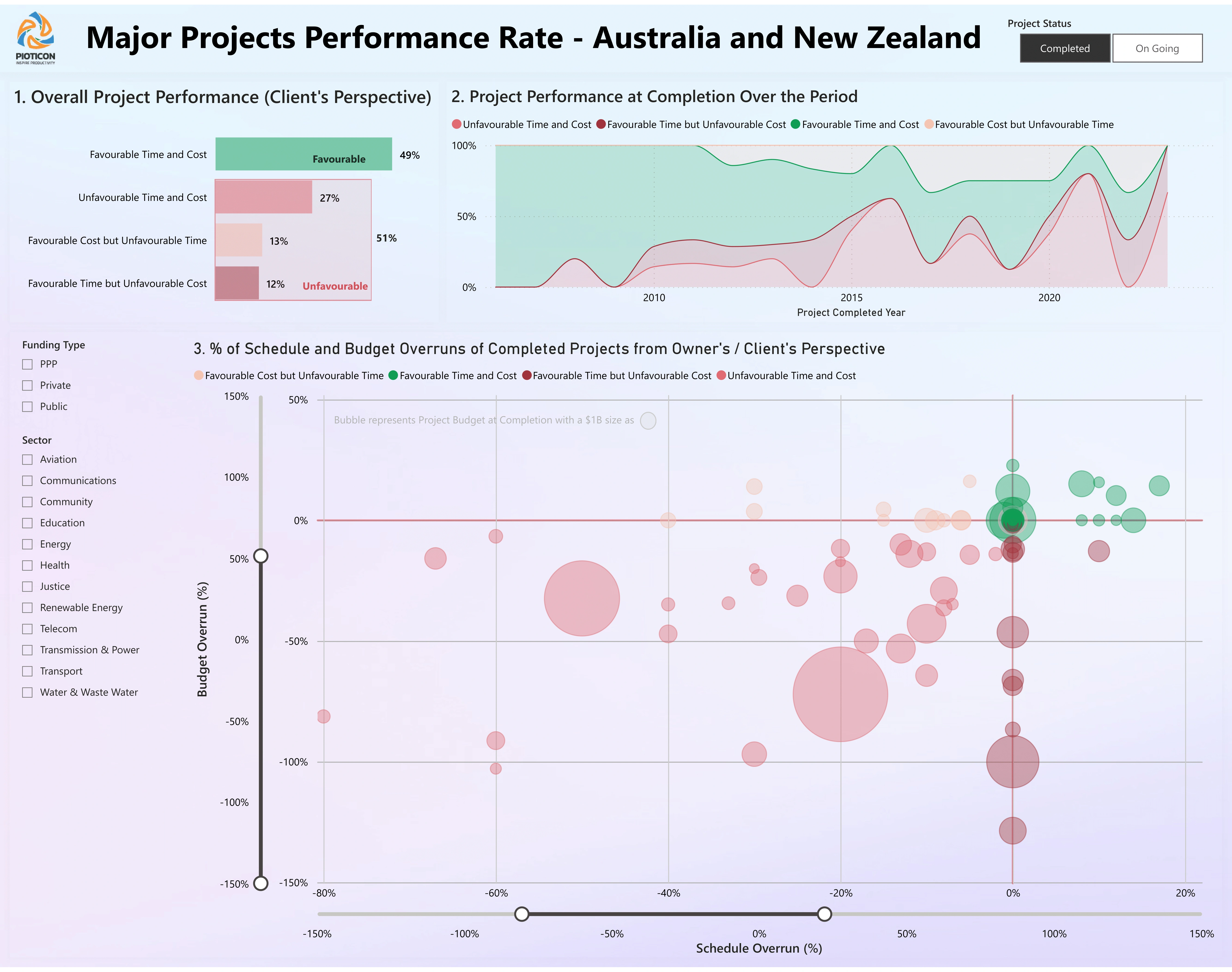
    In the case of major project failures in Australia and New Zealand, a clear pattern is emerging. Data shows that nearly 51% of awarded projects deliver unfavorably to Owners compared to original expectations. Even the favorable projects from client/owner’s perspective, contractor might be facing significant loss and not meeting their financial benefits. That is due to the disparity between the contract amount and the contractors’ actual final cost and time.

    Depending on the contract model and conditions, it often becomes challenging for the Contractor to recover significant losses through forensic delay and disruption claims.

    The full impact on contractors is not always visible publicly, except through insolvency reports or financial disclosures. Big Tier 1 contractors often manage exposures through multi-project cash flow strategies, which mask deeper structural issues in project-by-project reporting. While there are projects that hit targets, those are becoming rare and are mostly legacy examples, not current trends.

    Hence, it is not practical to get accurate data points to get true picture, analyse the real root cause and contributing factors in the right significance order.

    The fundamental reason is that the As-Built Quantity* multiplied by the Unit Rate per Scope Item* has significantly exceeded the original estimate.

    Definitions for Clarity:

    * As-Built Quantity : This includes the total quantity of work actually executed for the scope item — covering not just the permanent work, but also any temporary or remedial works performed as part of delivering the final approved design.

    * Unit Rate per Scope Item : This refers to the actual cost rate to construct one unit of the scope item. It comprises the cost composition of all resource inputs, including labour, materials, plant, and subcontractor services used to deliver the unit quantity.
    Patterns That Point to the Core Issue

    Generally, delays and cost overruns are consistently traced back to three compounding realities:

    • The base assumptions were not realistic for the original scope intended for the project objective
    • Risk was underestimated or transferred without the capability and capacity to manage it
    • Execution systems couldn’t match the complexity

    Every layer adds friction. Individually, they are manageable. Together, they become overwhelming.

    Despite schedule and budget failures, most infrastructure projects still deliver high construction quality. Engineers and builders should be acknowledged for this. Quality proves that capability exists at a technical level.

    The issue isn’t the ability to build, it’s the ability to deliver within what was promised.

    Project failures are rarely caused by one factor. They emerge from highly interconnected issues that influence each other throughout the lifecycle. These include:

    • Shifting scopes
    • Design development lag
    • Market pricing pressures
    • Resource unavailability
    • Delivery model mismatches
    • External events
    • Inflexible systems

    Each factor may seem isolated, but it contributes to overall delivery drift.

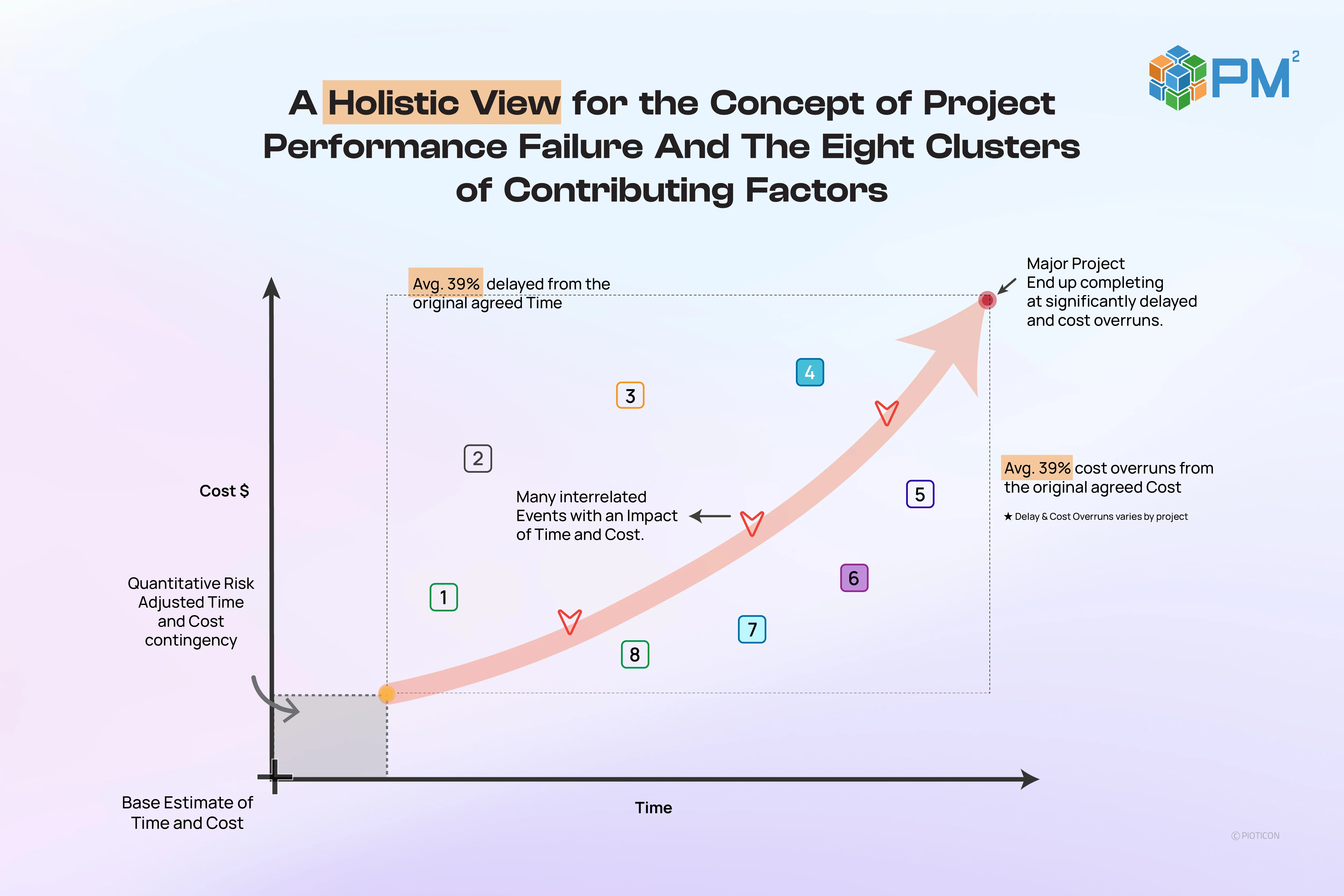
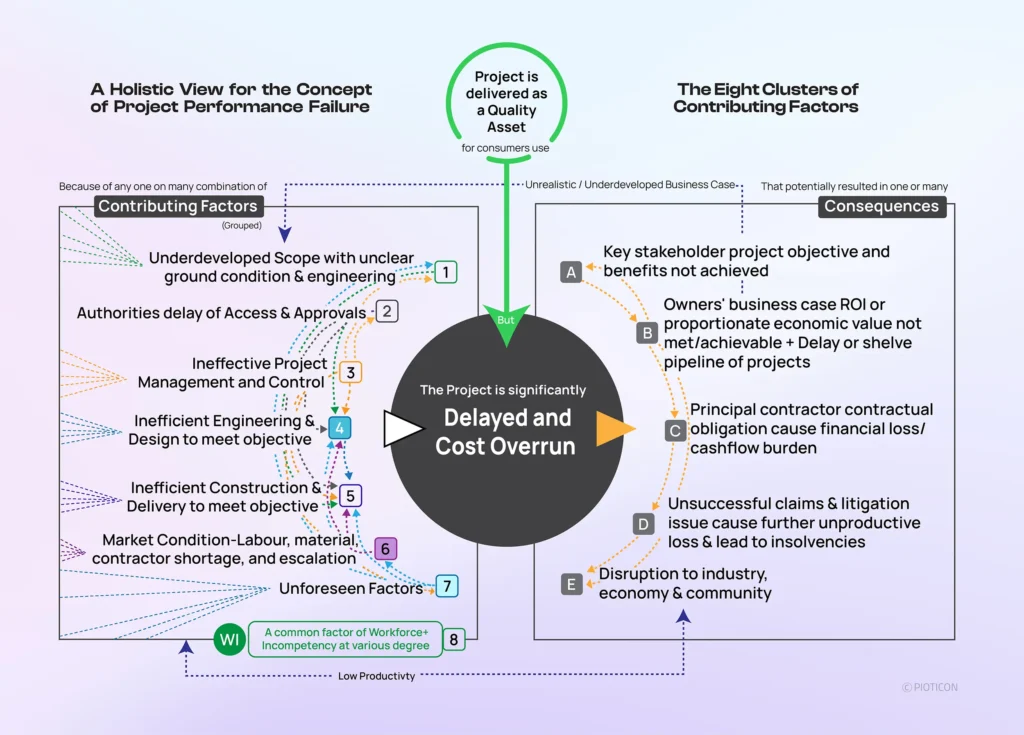
    A Holistic Picture of Project Failure: The Eight Clusters of Contributing Factors

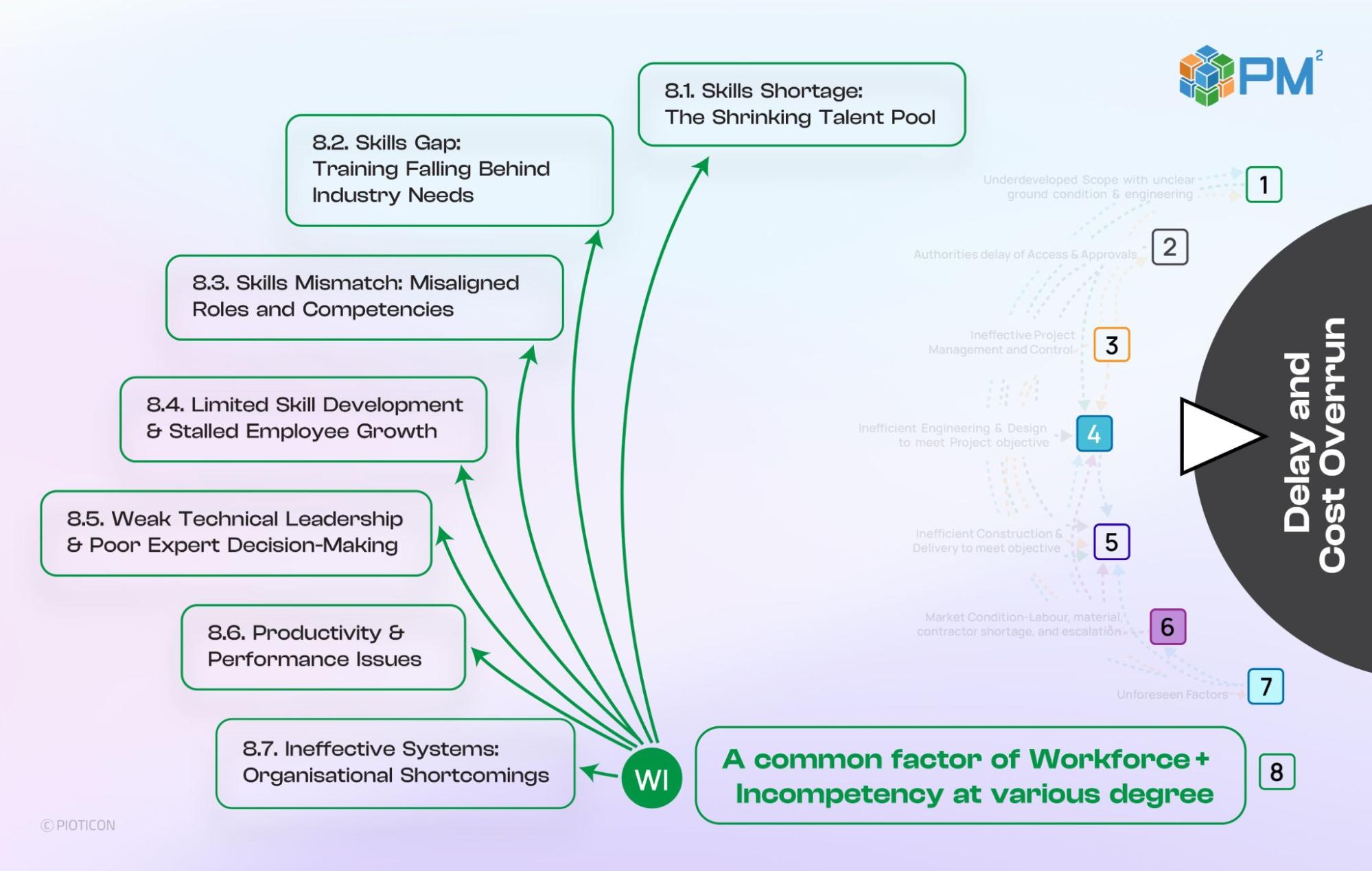
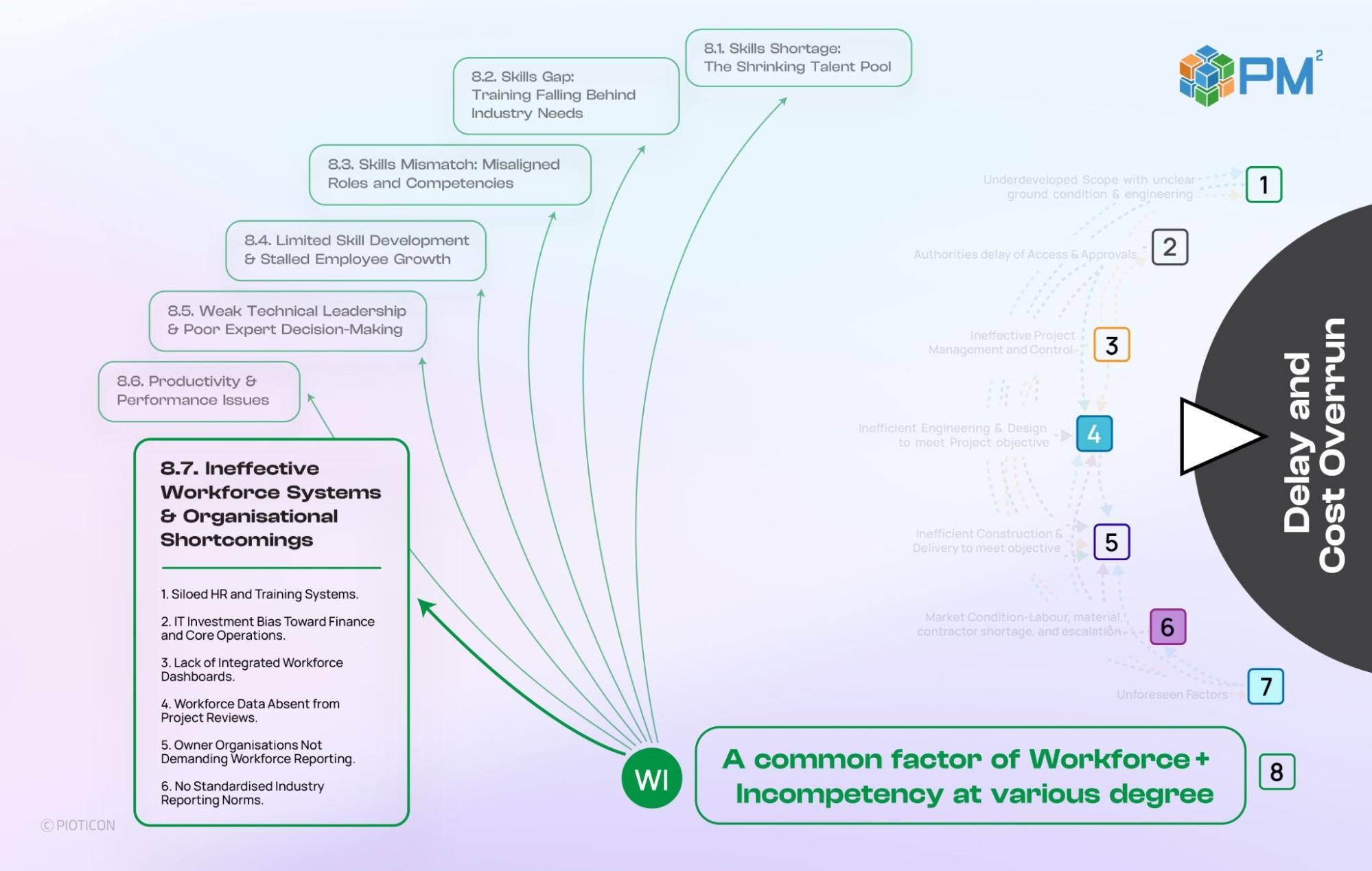
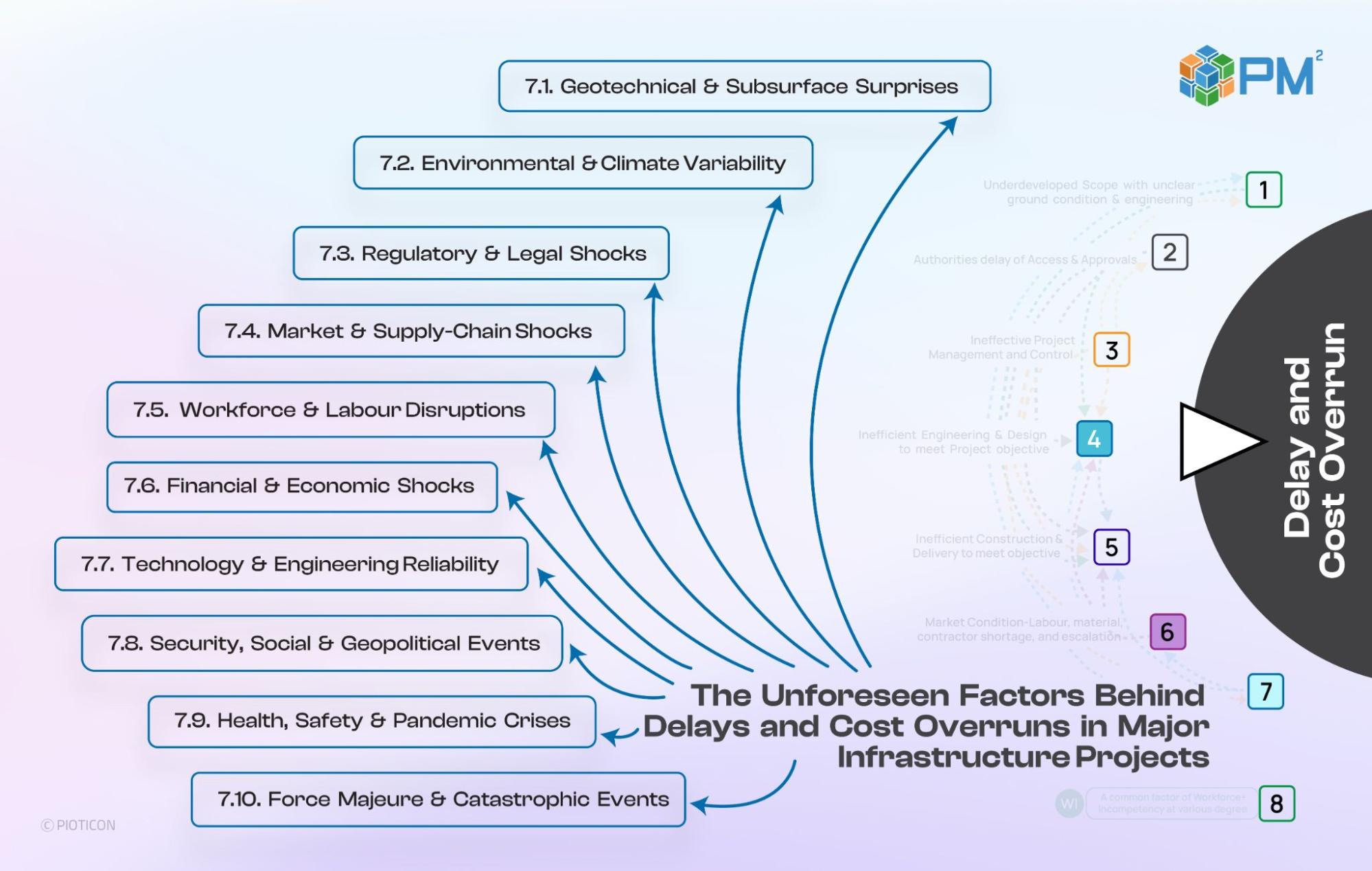
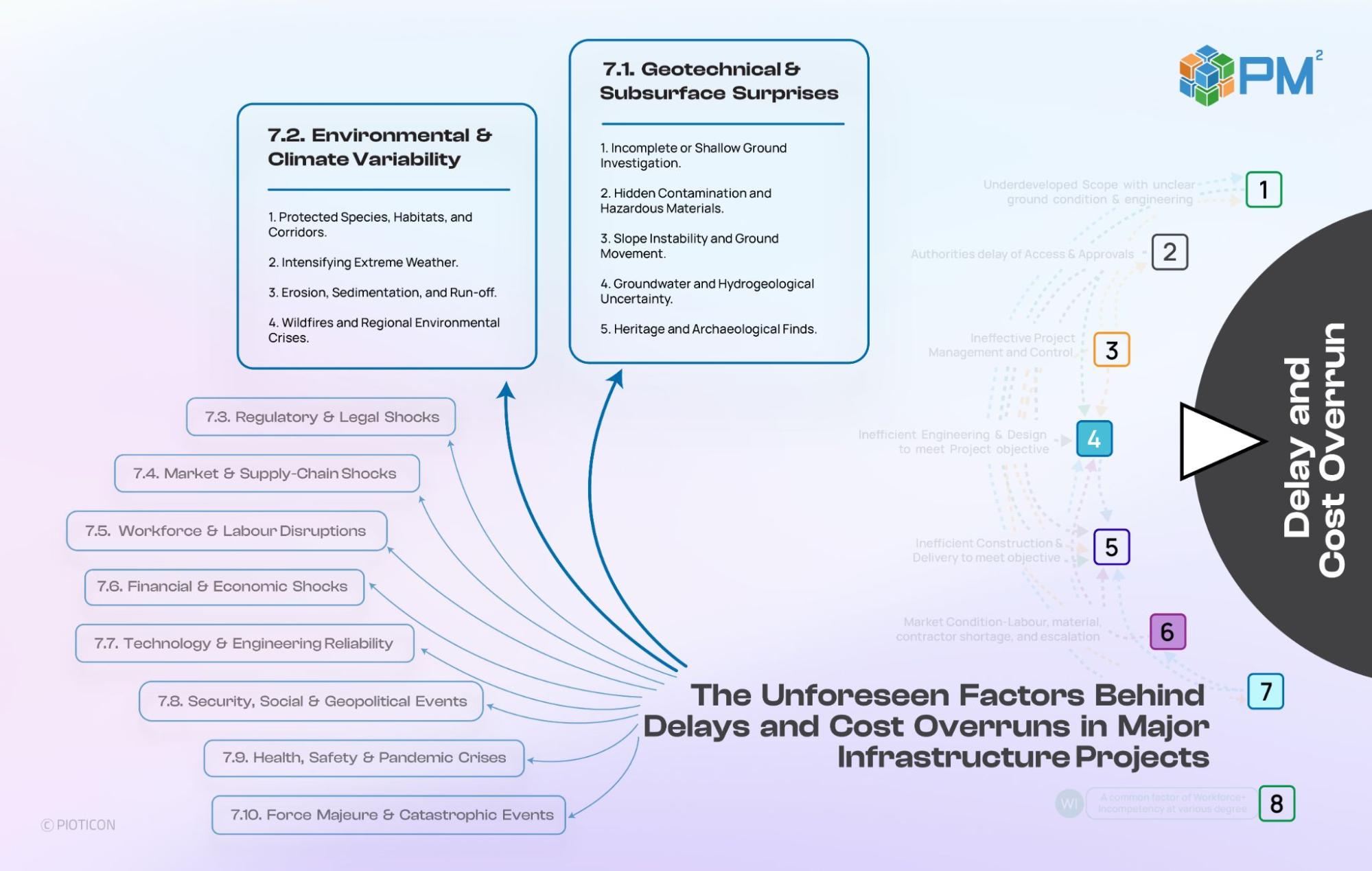
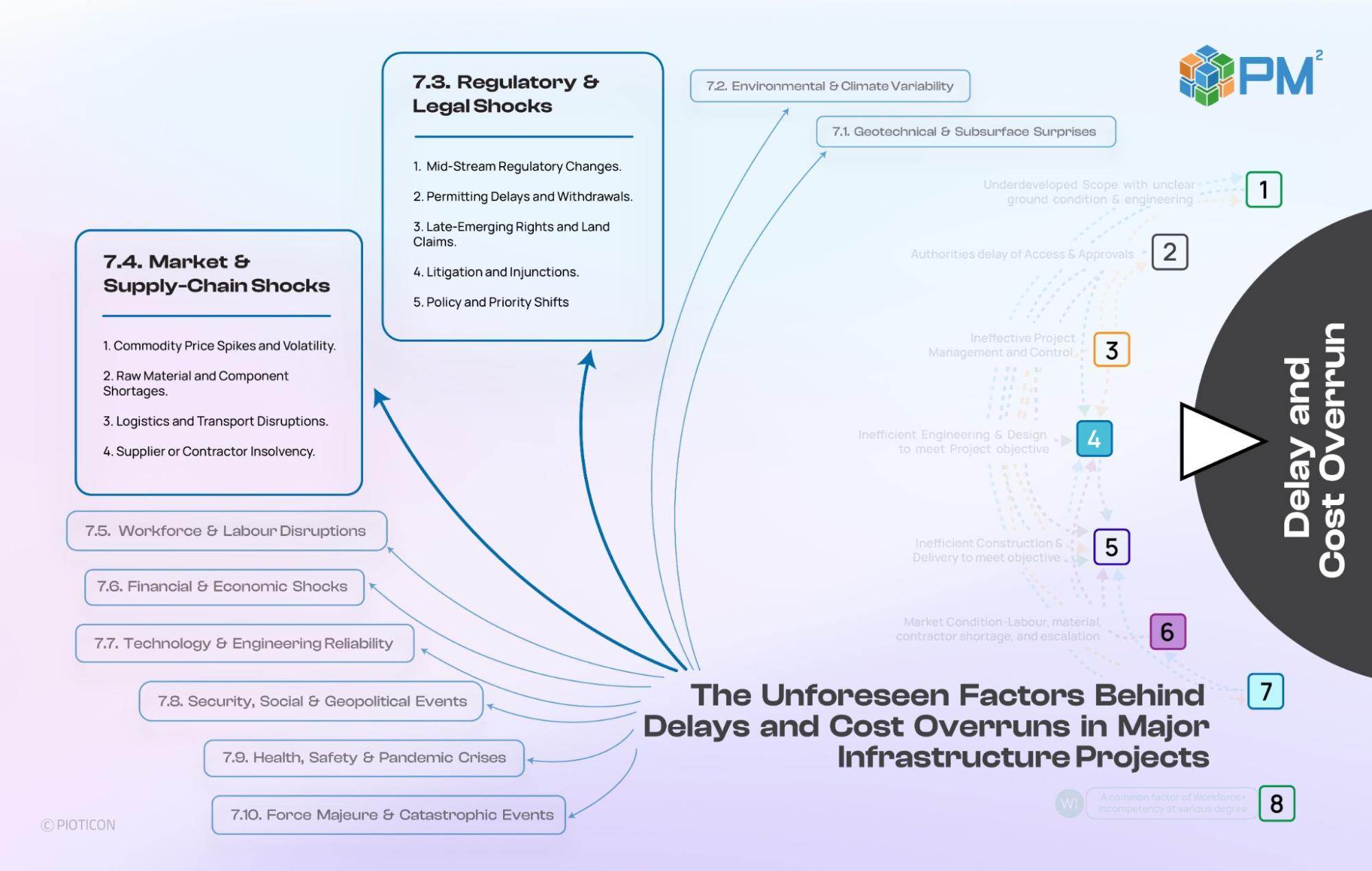
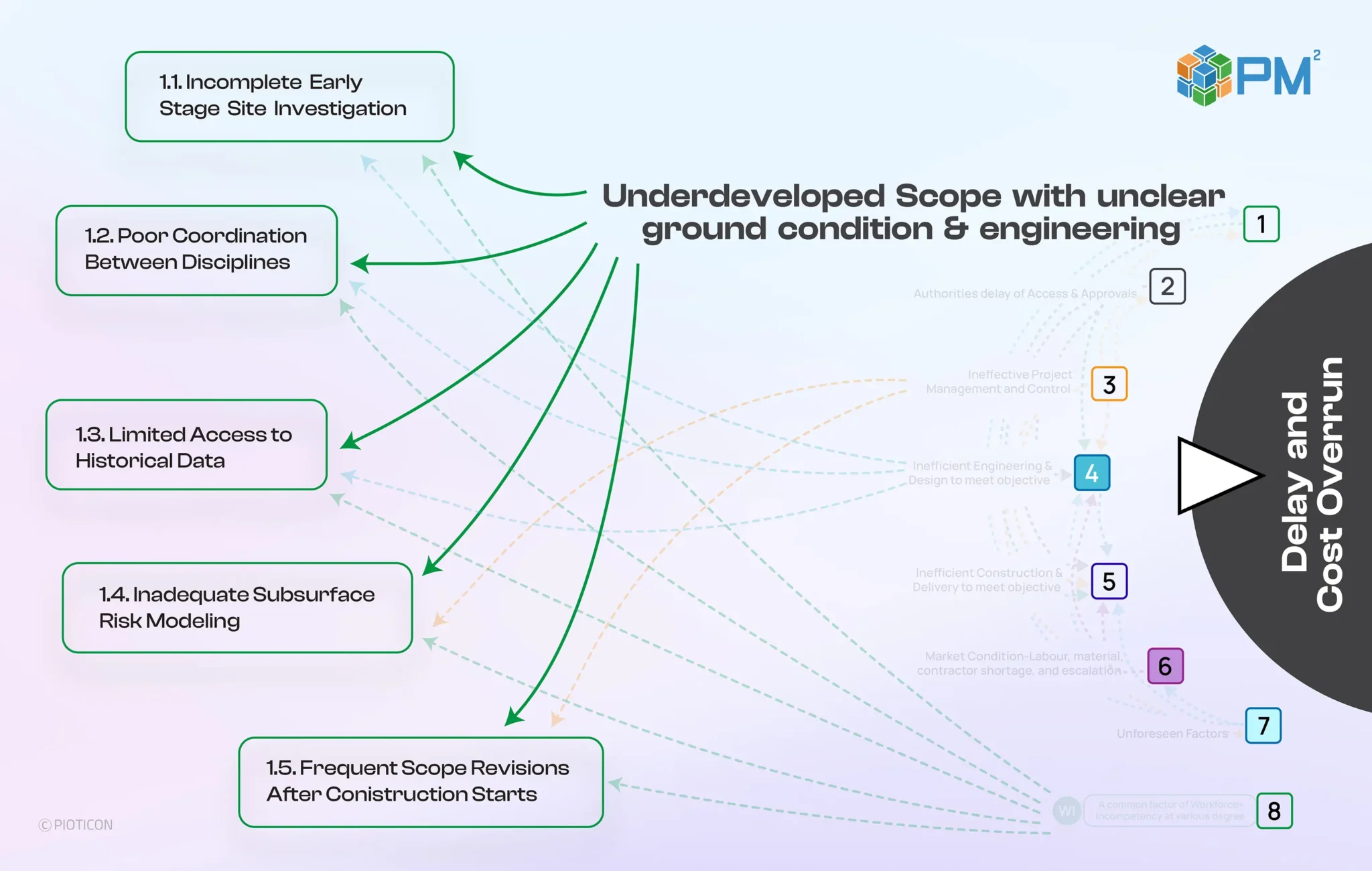
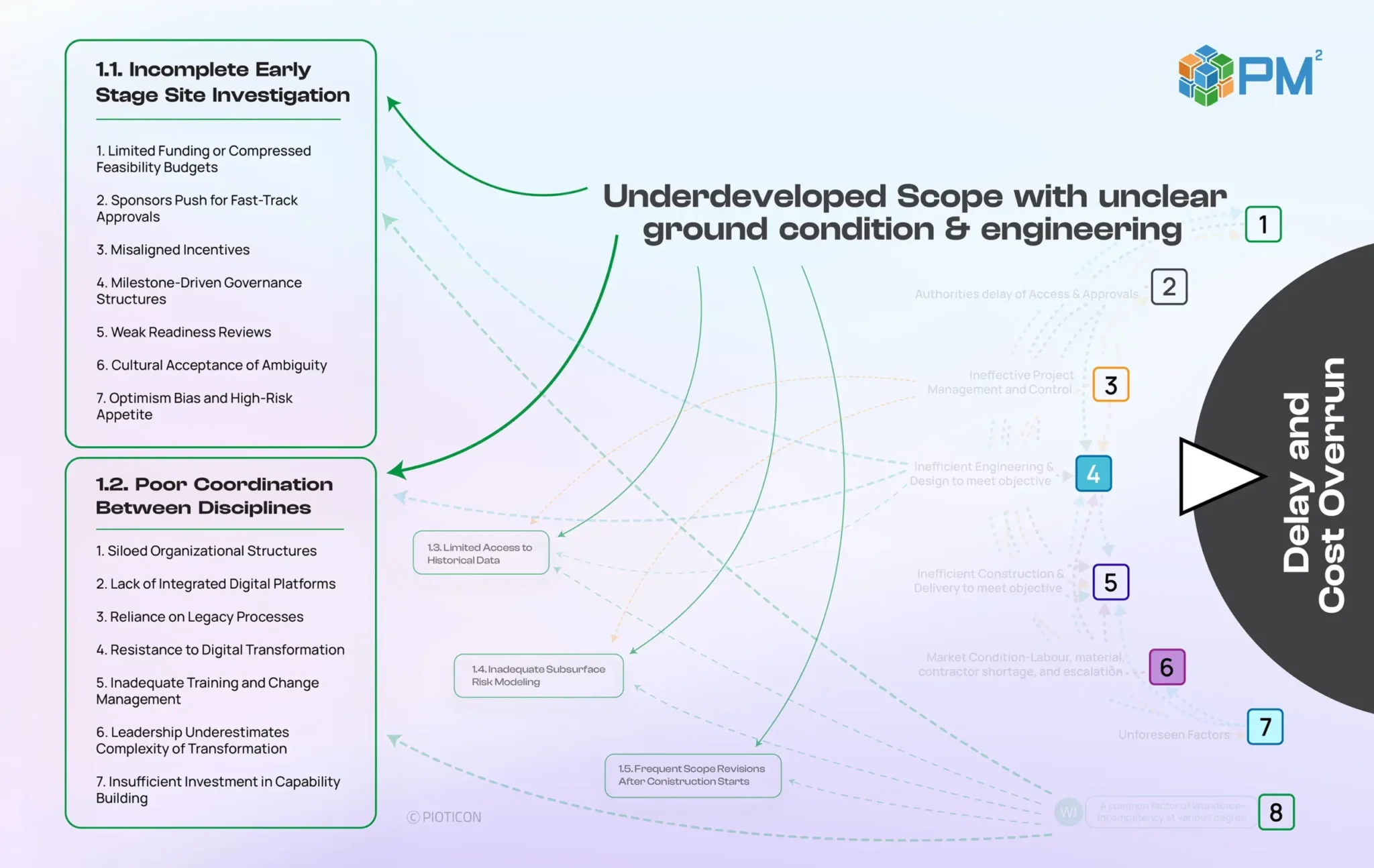
    A review of industry-wide trends shows that challenges group into eight recurring clusters of root issues. These are not fully measurable yet due to data limitations, but they reflect broad causation themes visible across project audits, reports, and real-world execution:


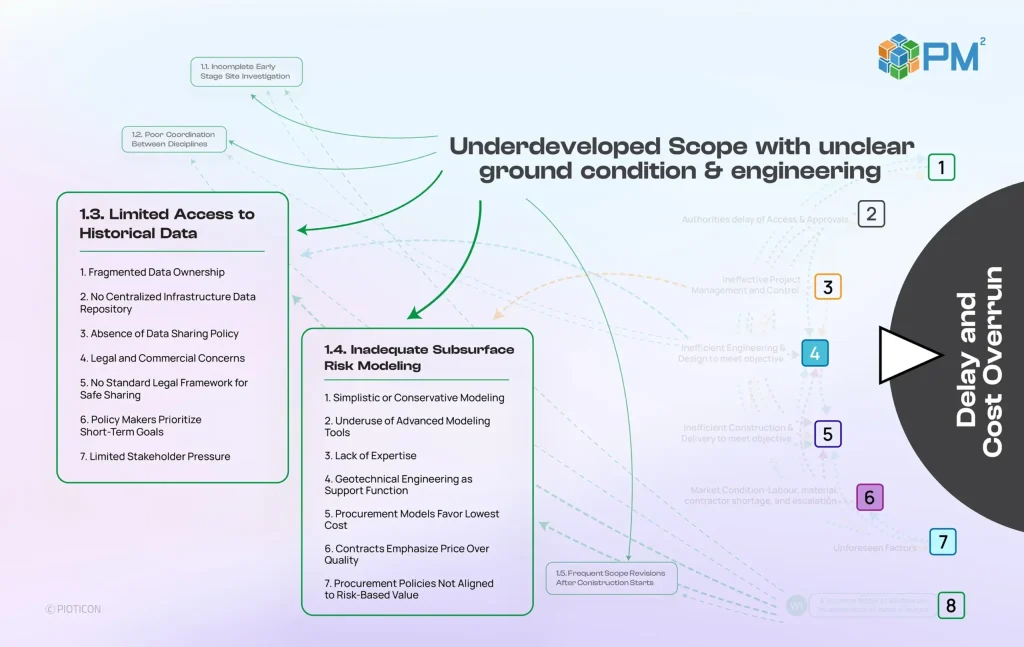
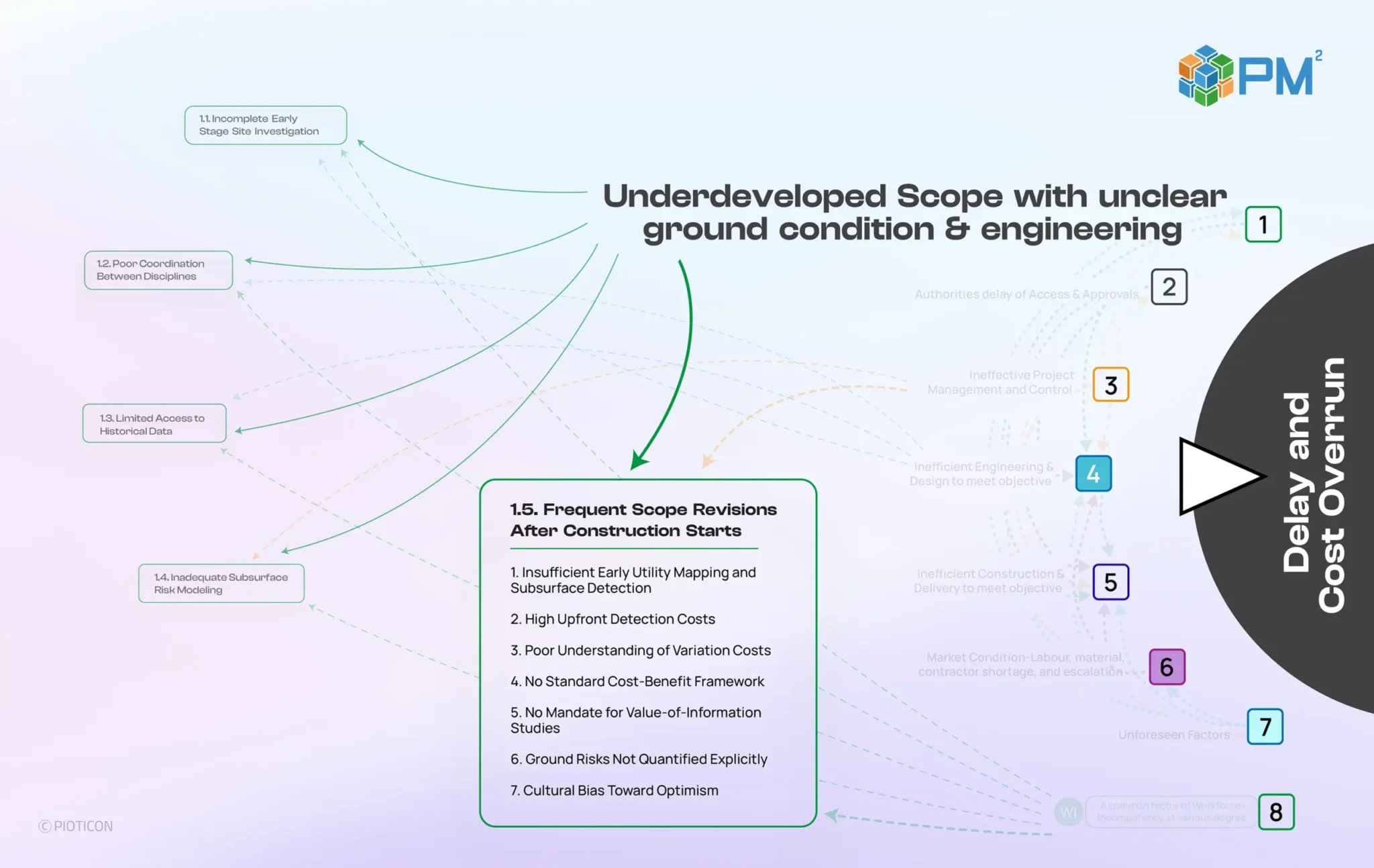
    1. Underdeveloped scope with unclear ground condition and engineering
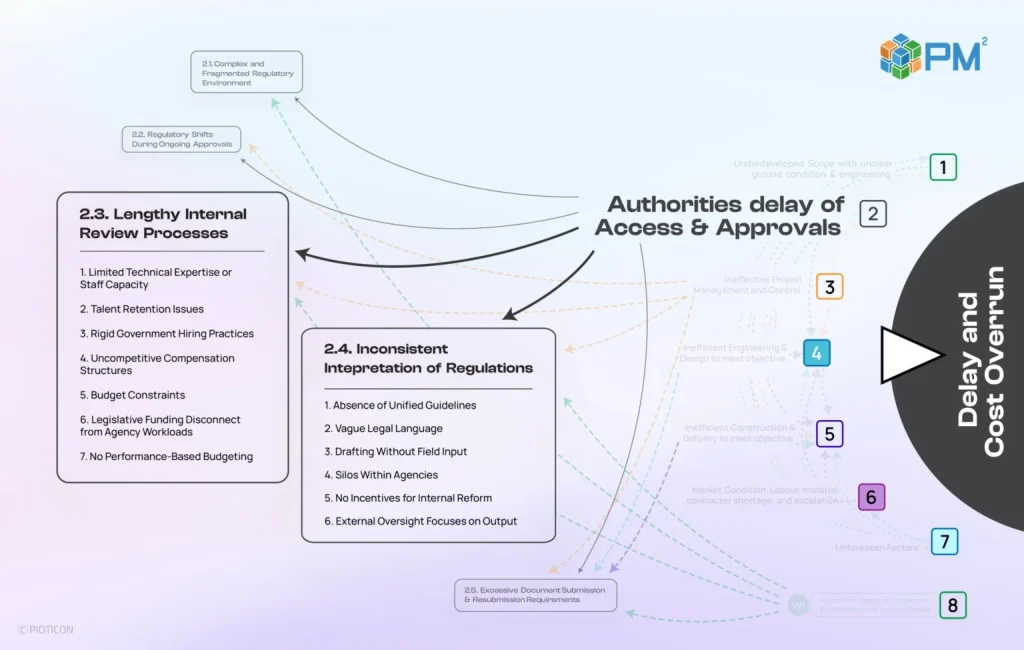
    2. Authorities delay of access & approvals
    3. Ineffective project management & control
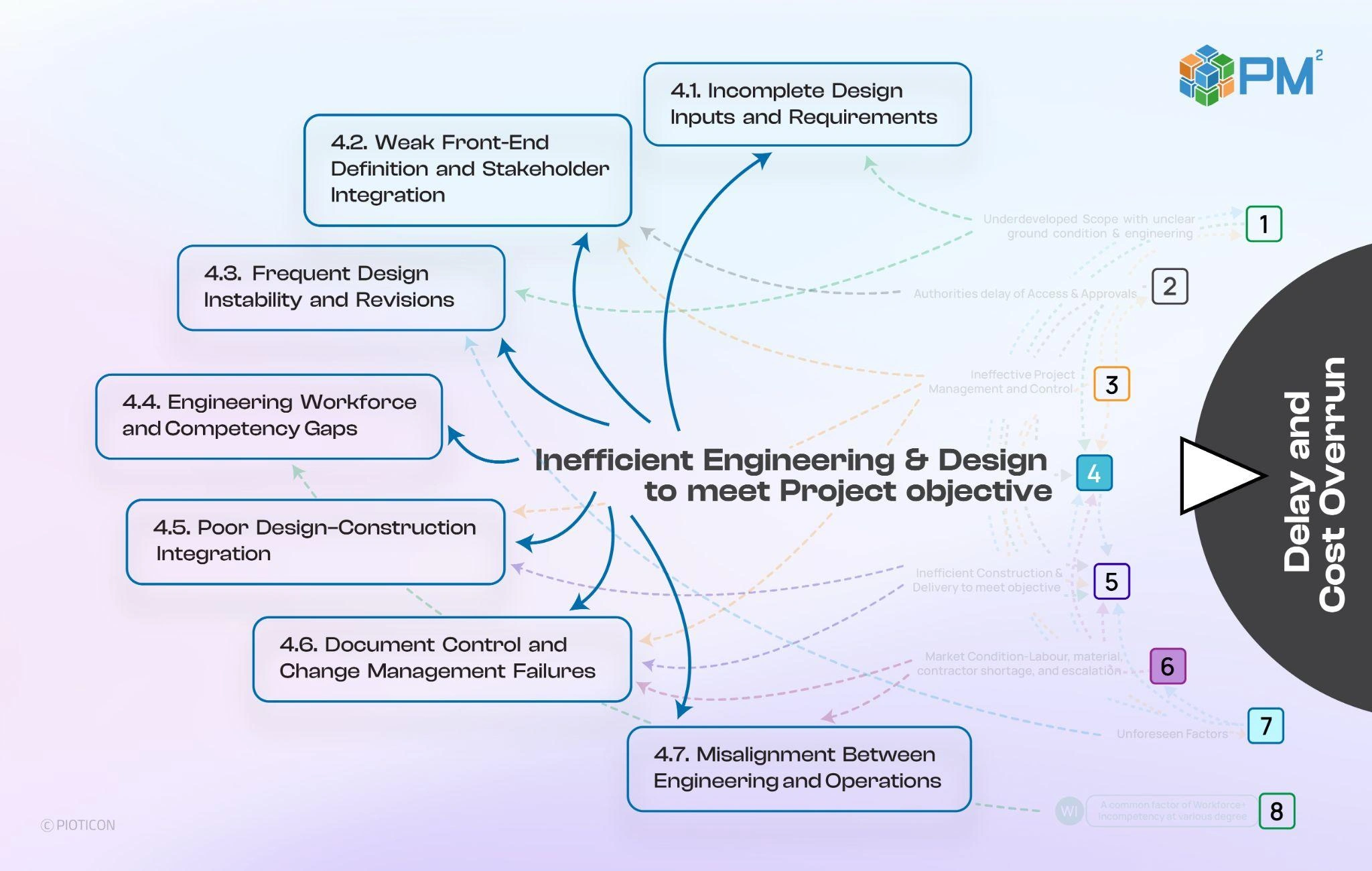
    4. Inefficient engineering & design to meet objective
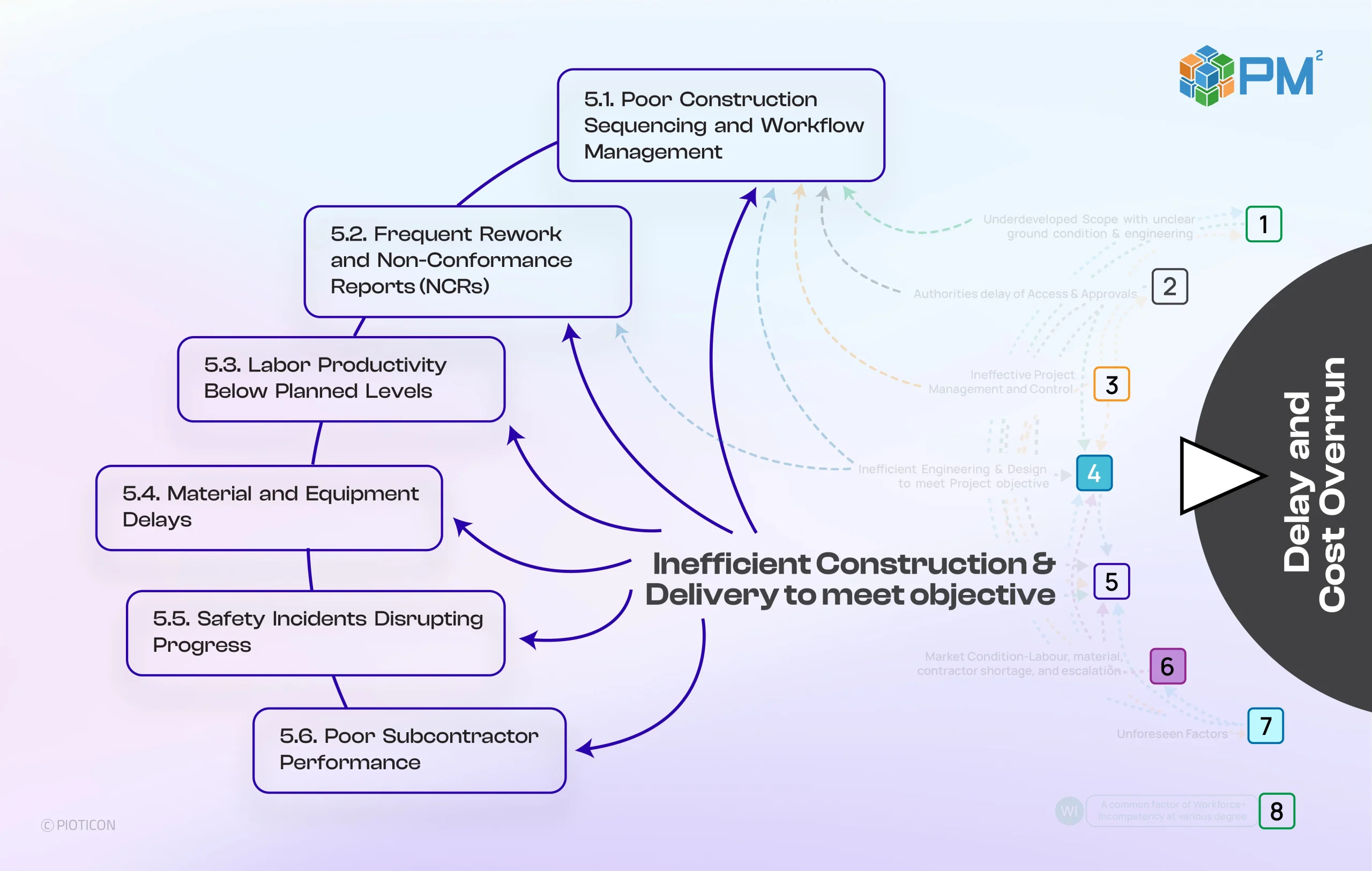
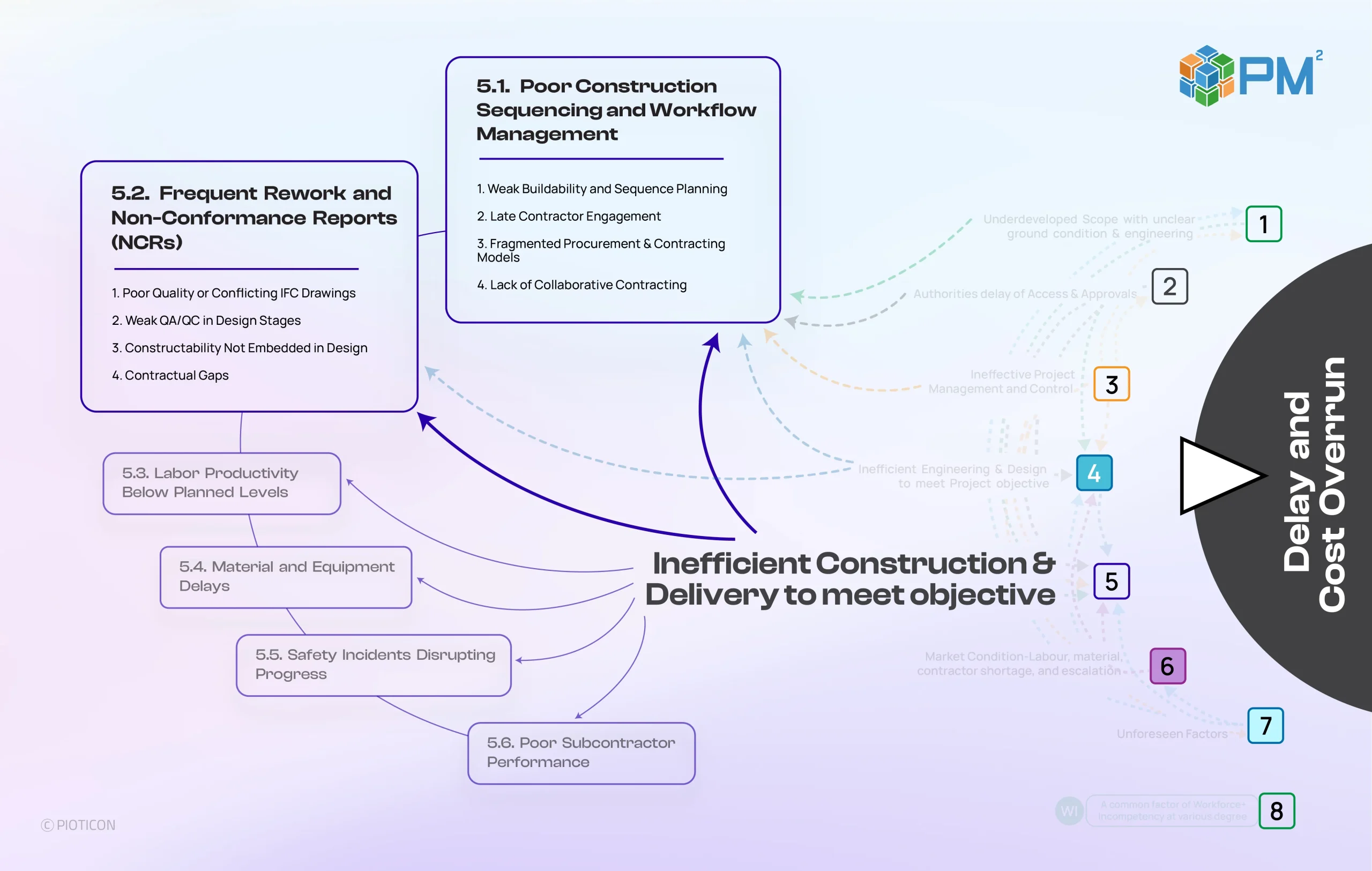
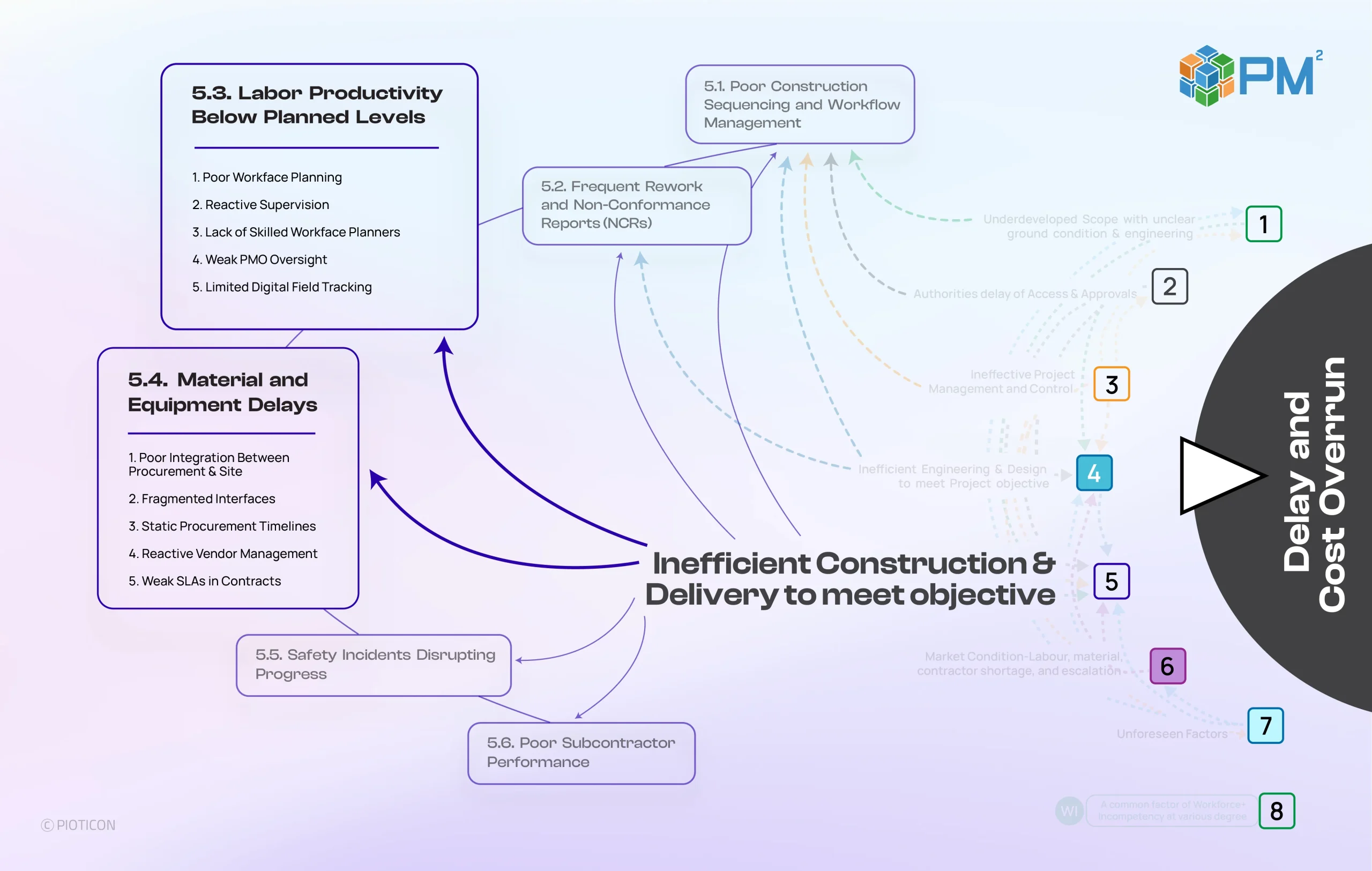
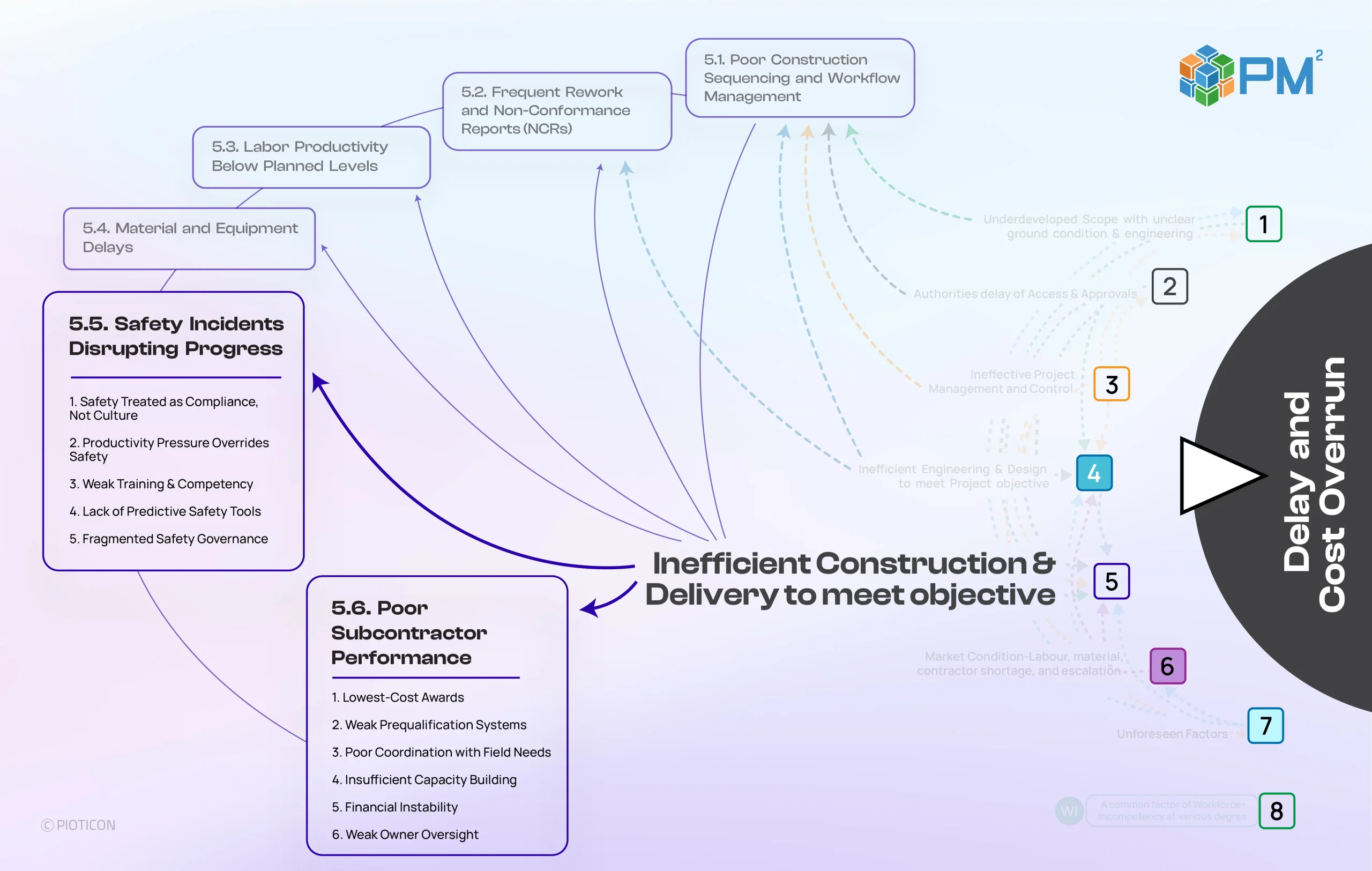
    5. Inefficient construction & delivery to meet objective
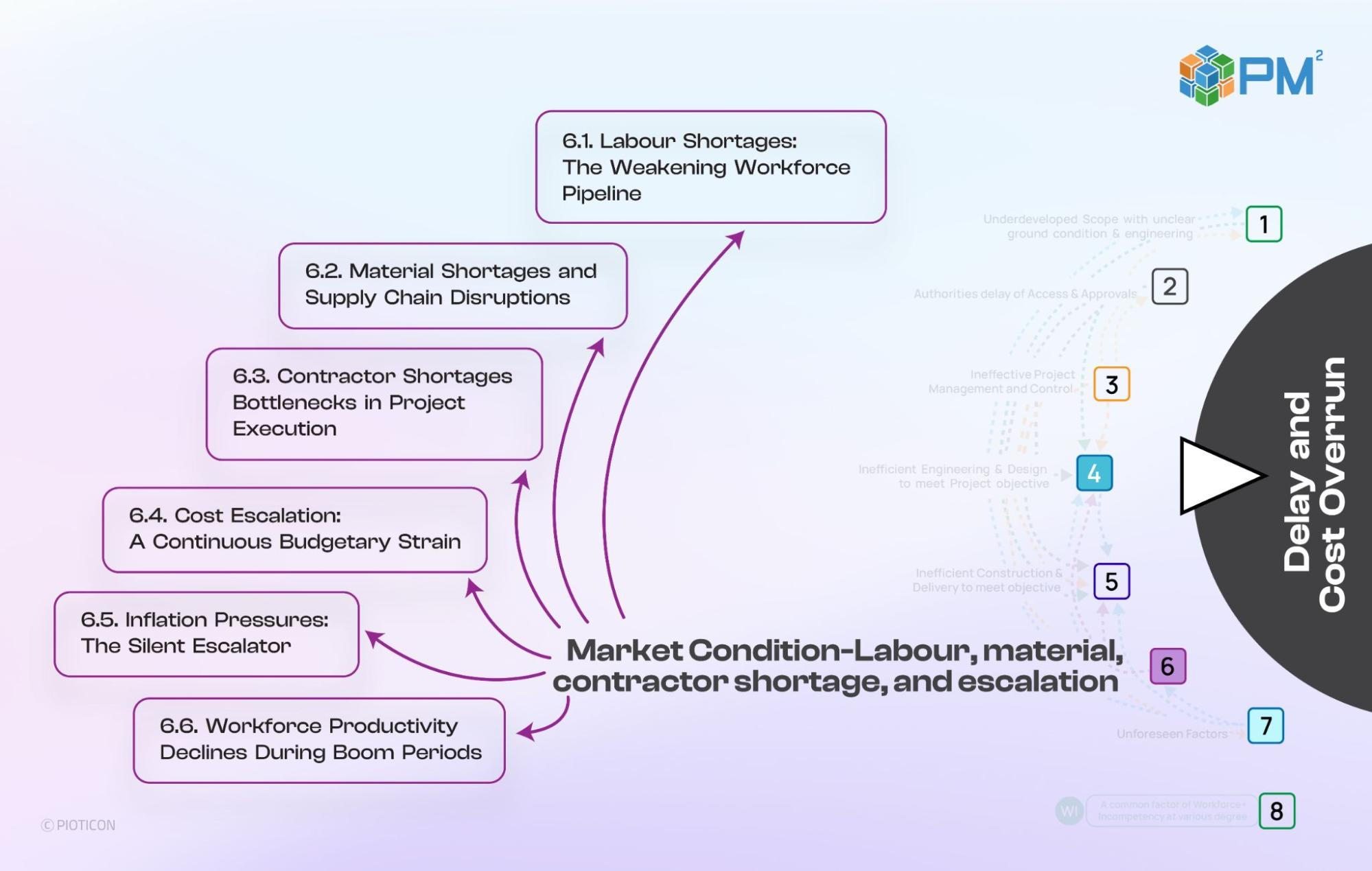
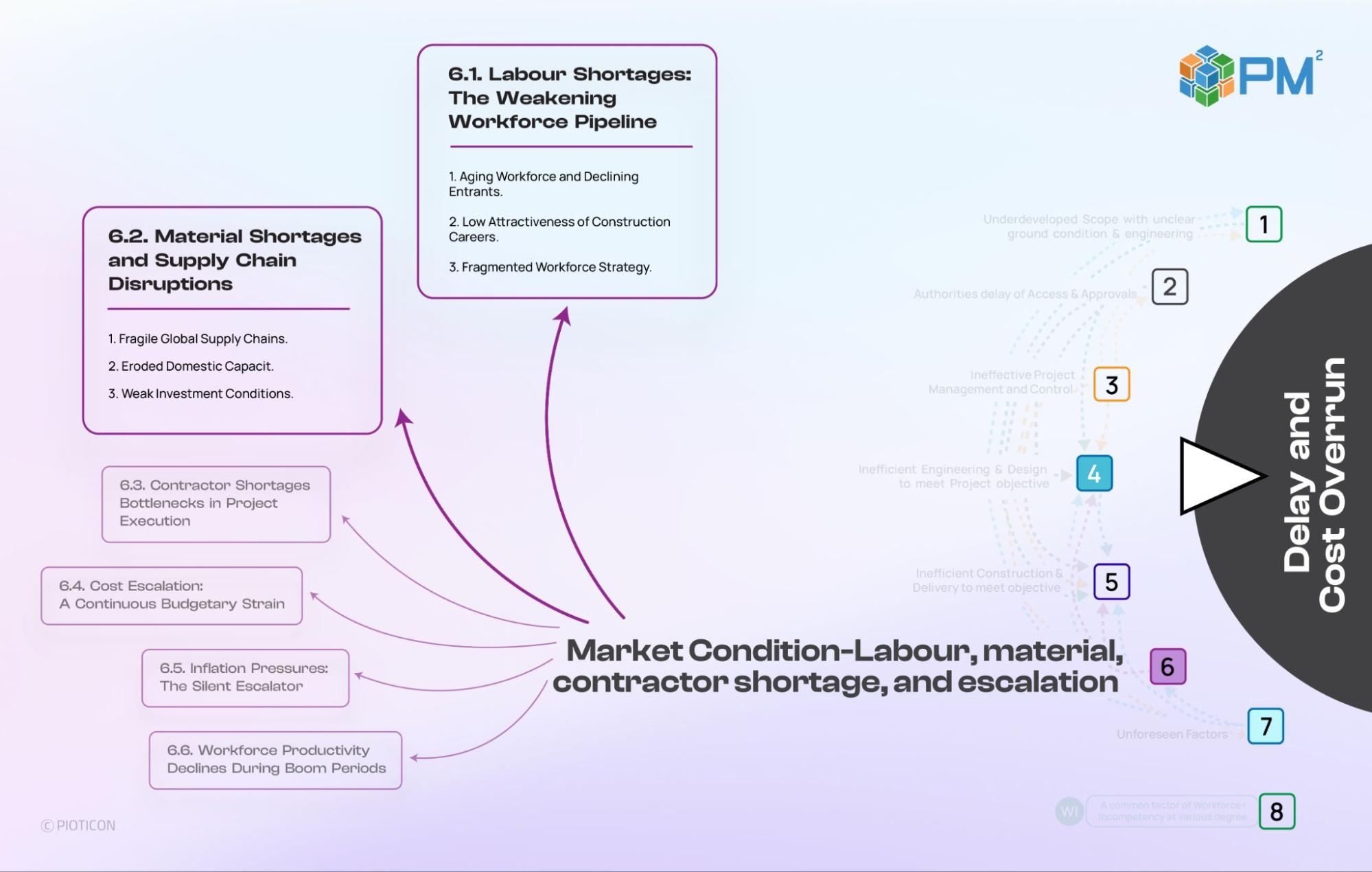
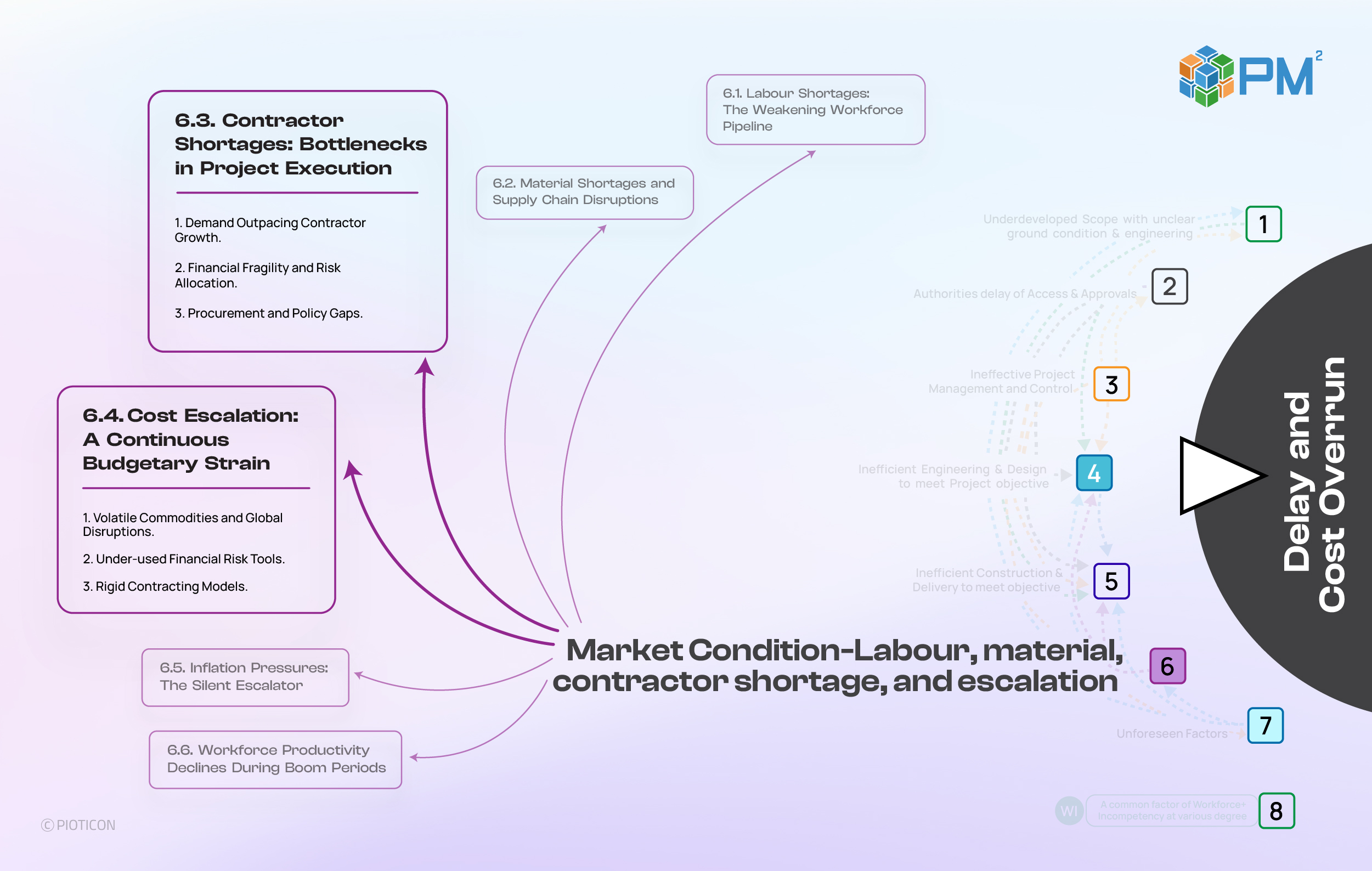
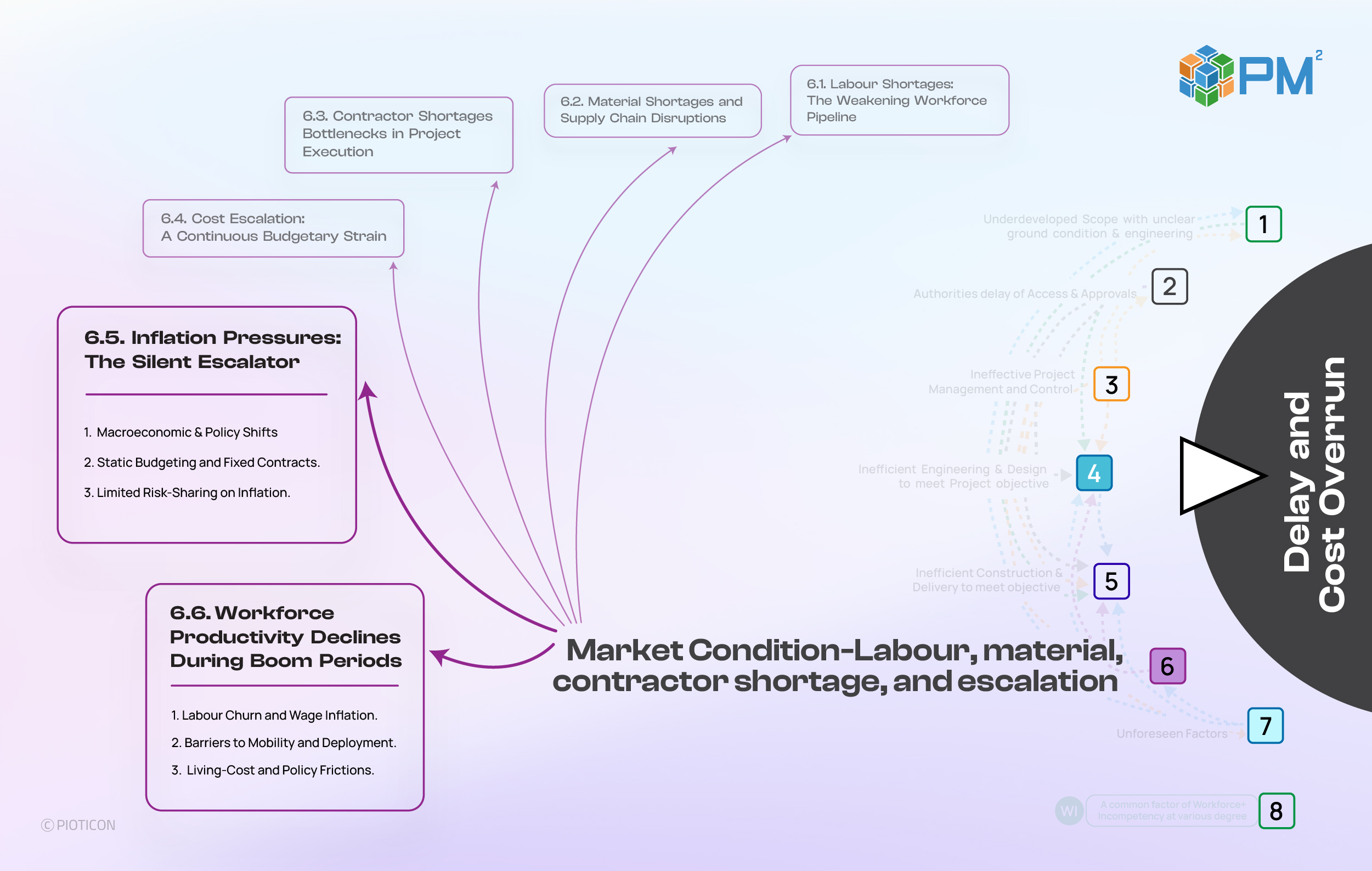
    6. Market condition- labour, materials, contractor shortage, and escalation
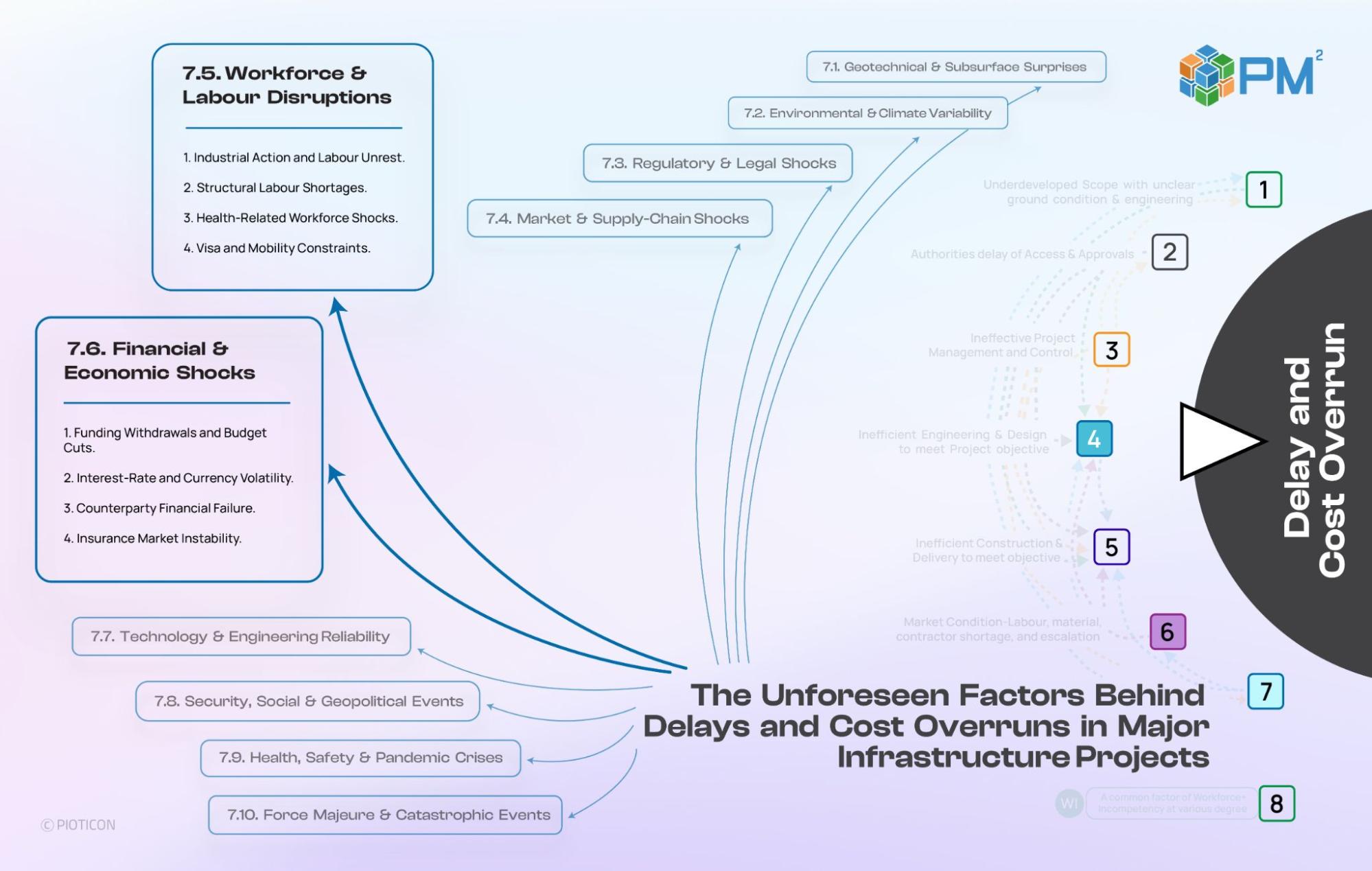
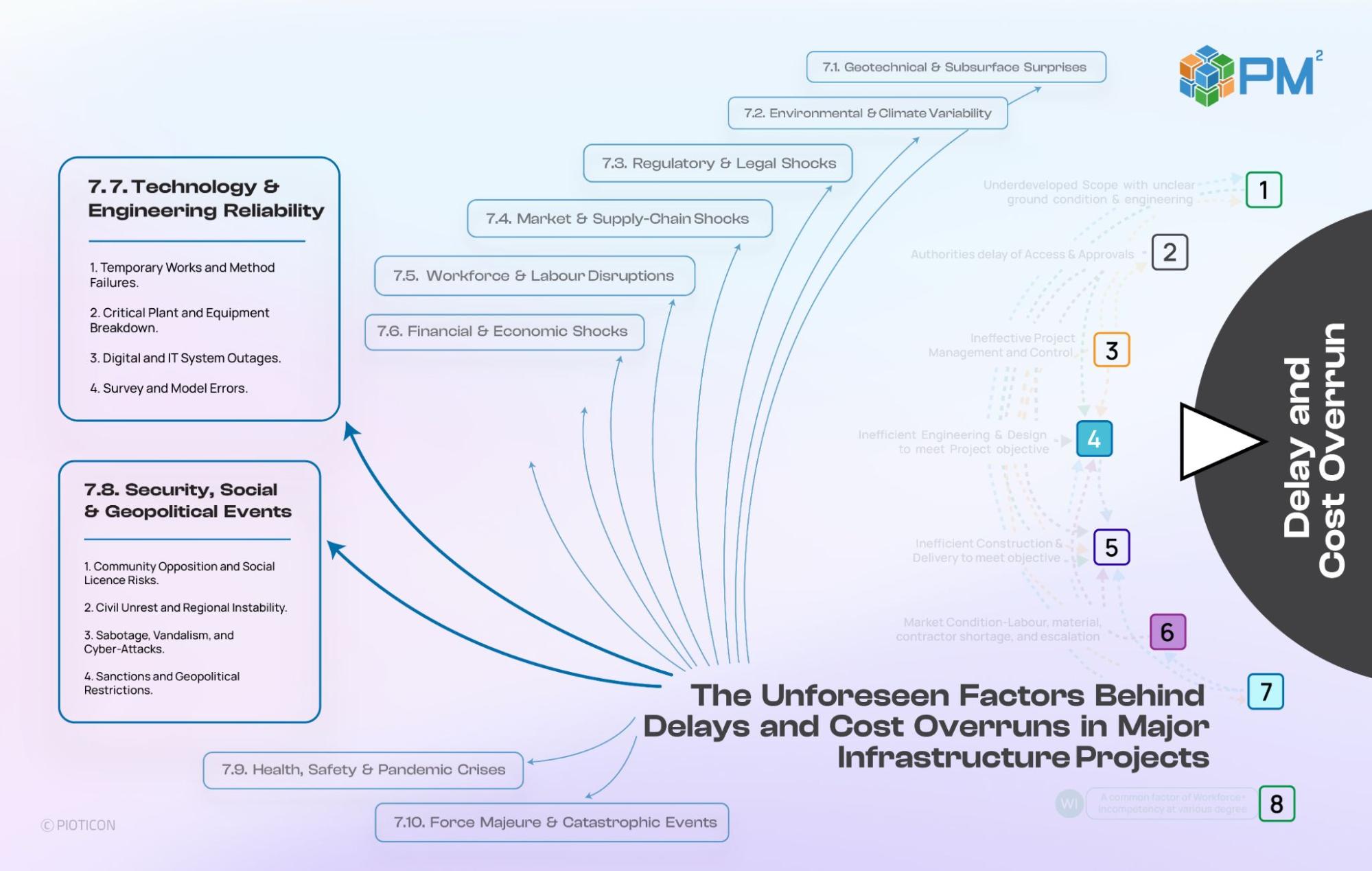
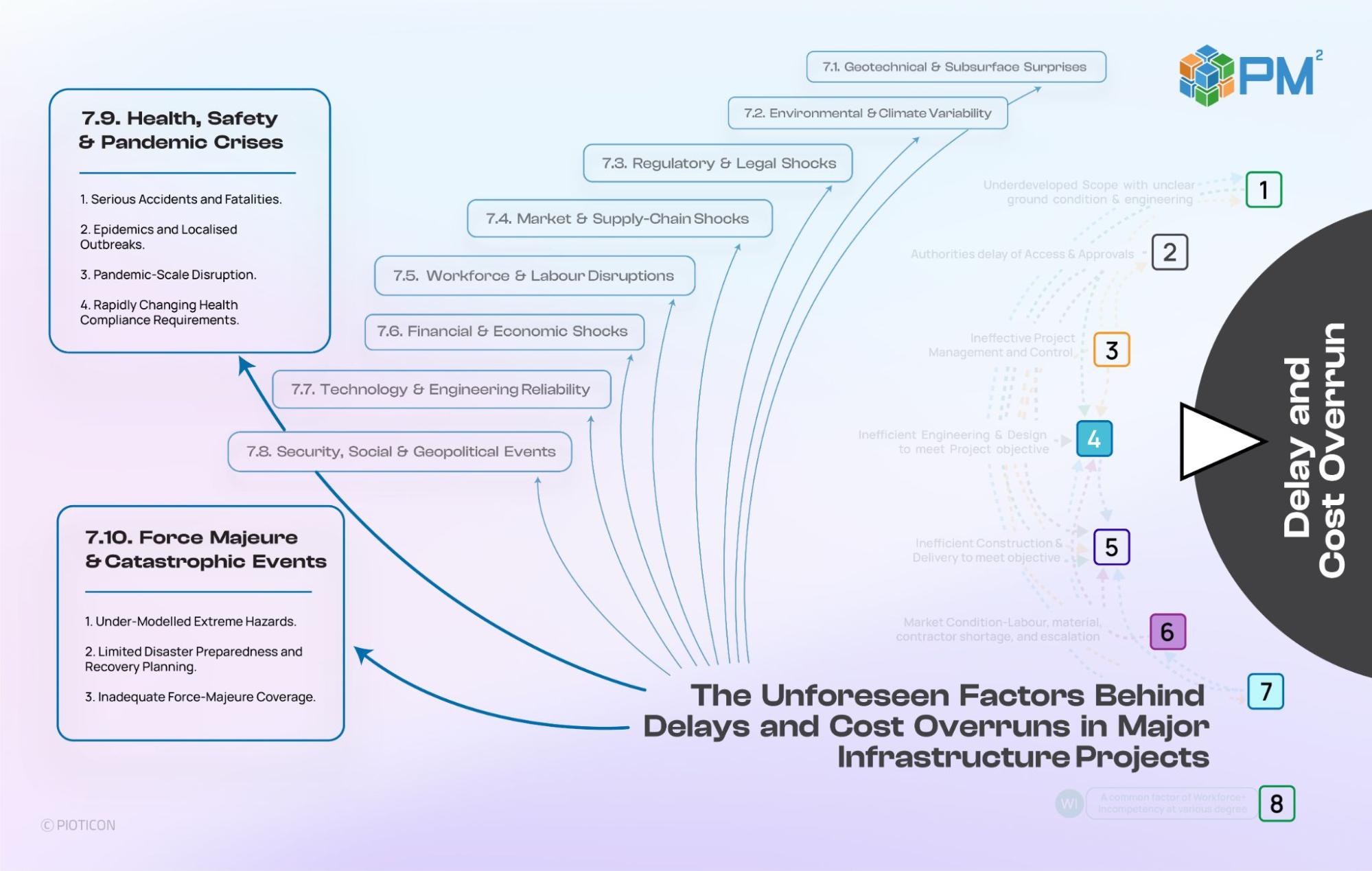
    7. Unforeseen factors
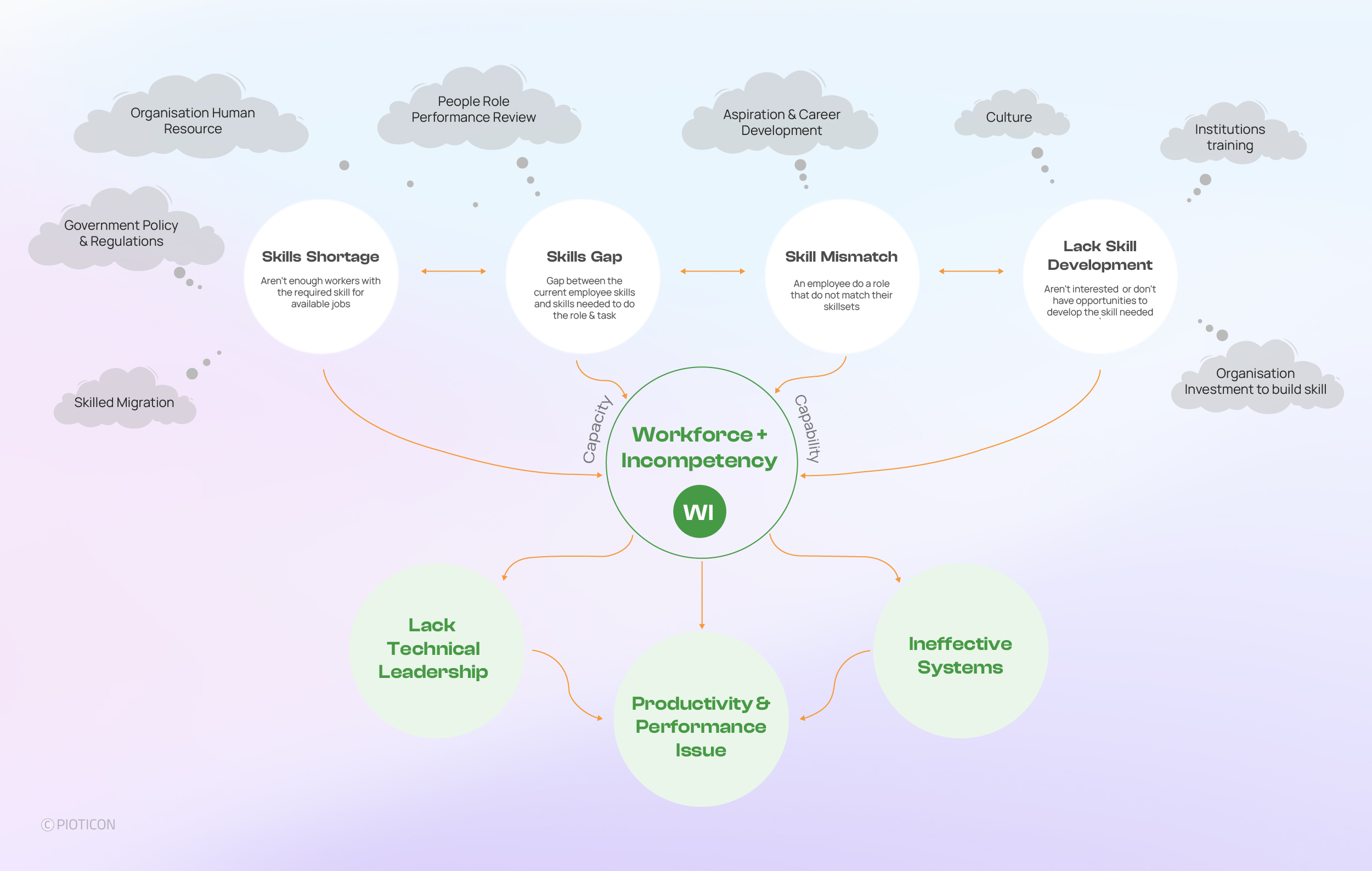
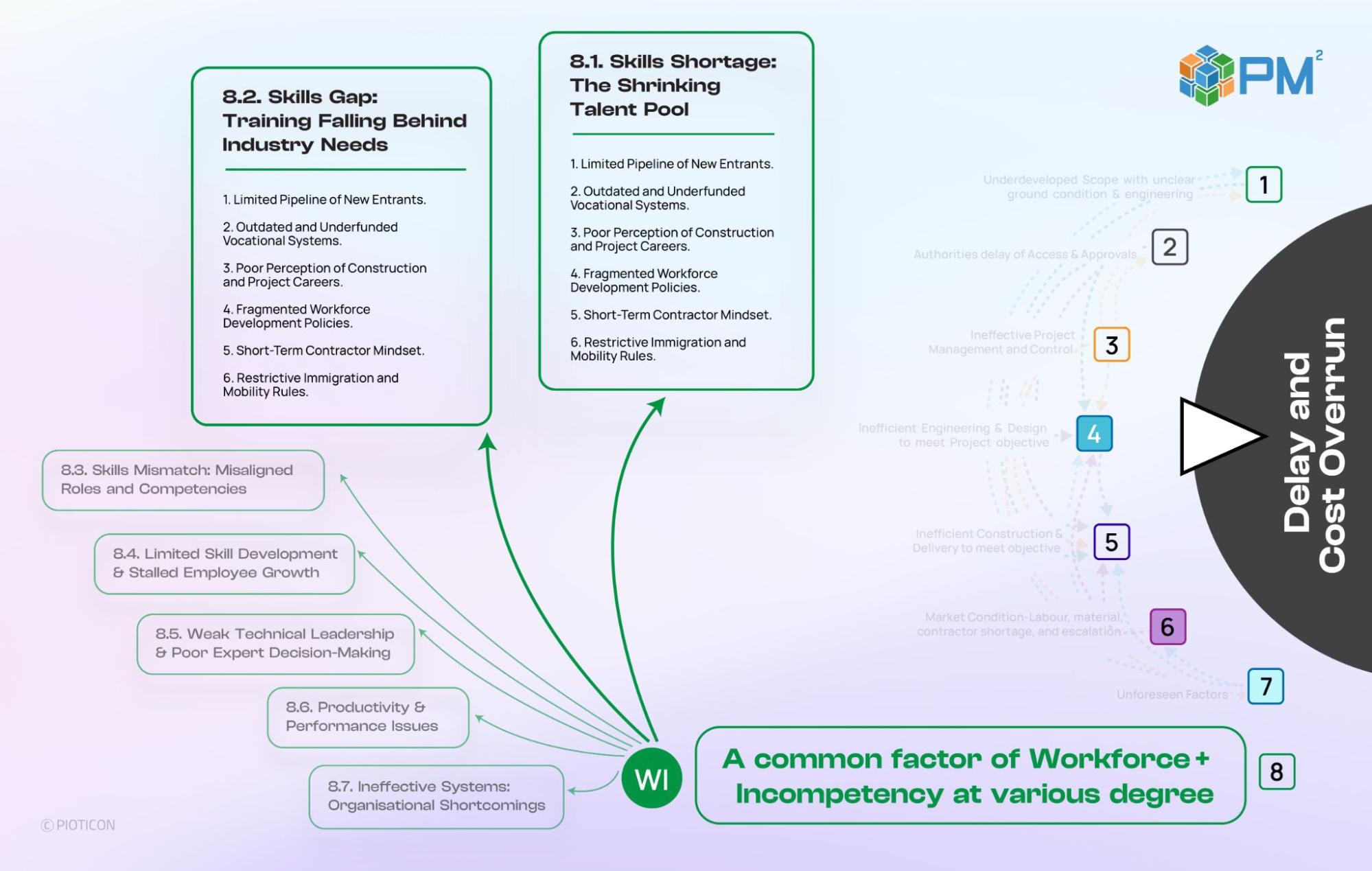
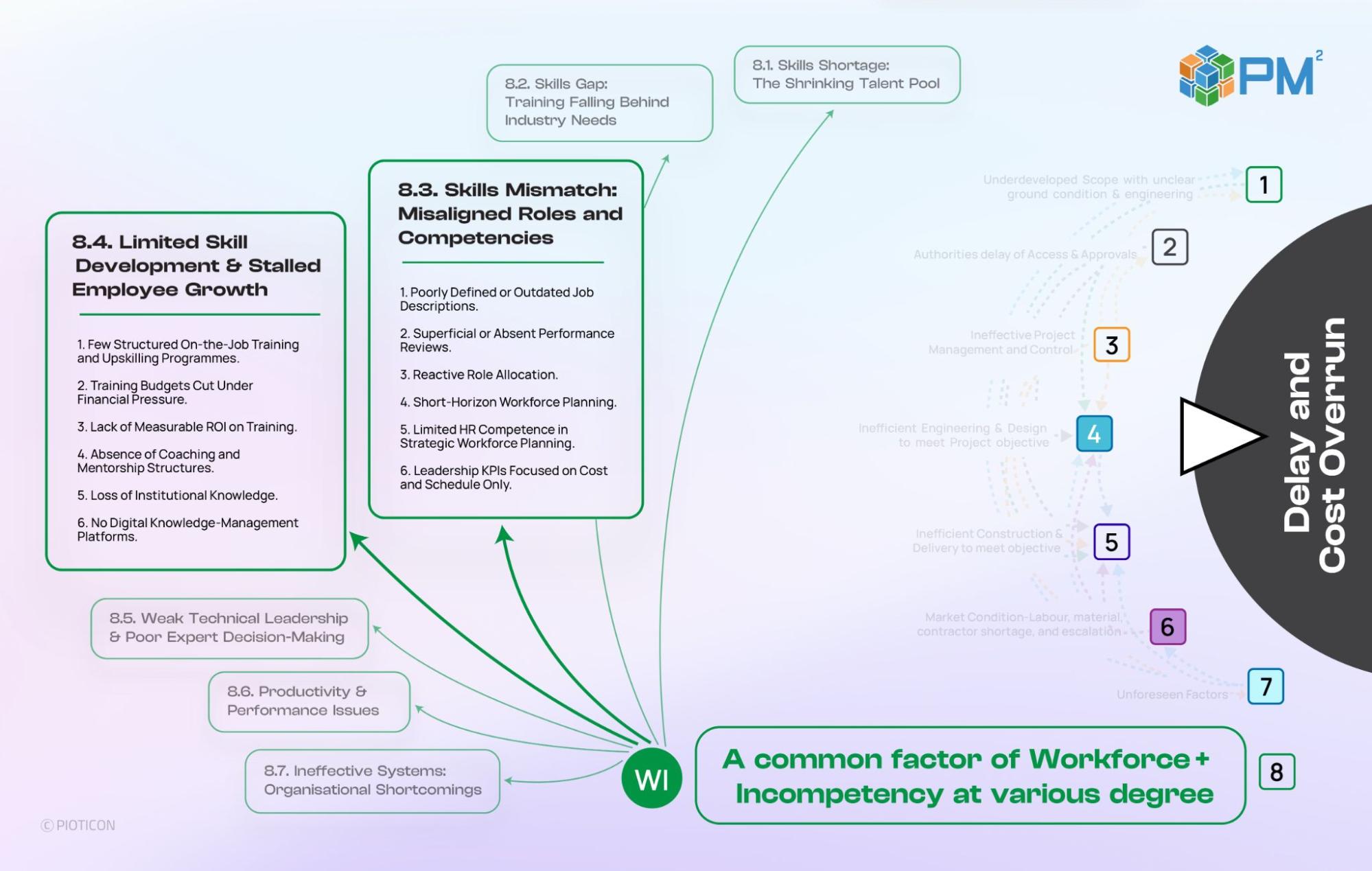
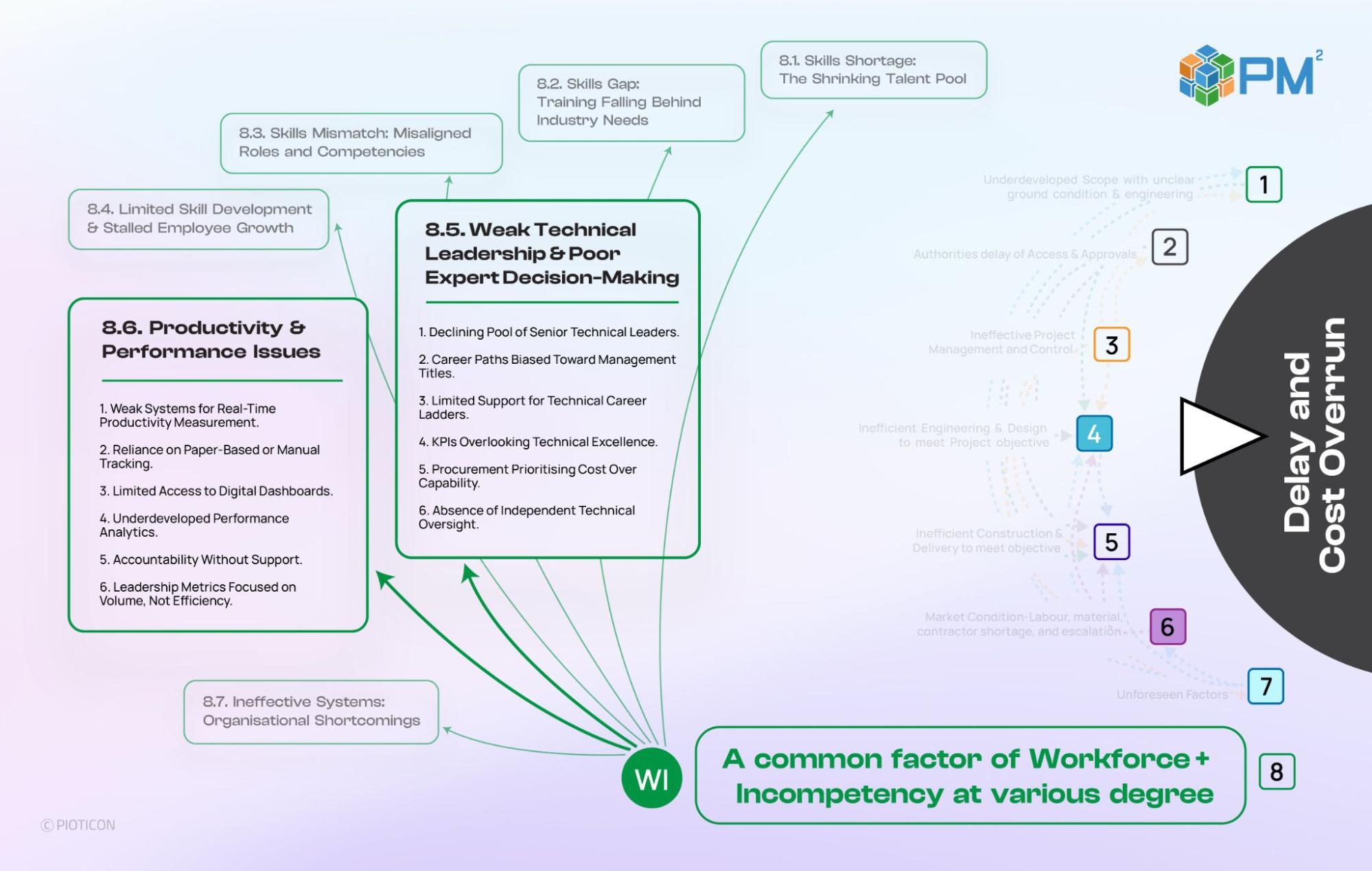
    8. A common factor of workspace + incompetency at various degree

    No single cluster explains all failures. The interdependency between them is what causes delivery to unravel.
    Final Thought

    Project performance failure transcends simplistic blame narratives. It emerges from a complex interplay of unrealistic expectations, misaligned delivery models, capability gaps, and systemic inefficiencies. While infrastructure projects often achieve world-class technical quality, the persistent gap between promise and delivery remains.

    True improvement requires a paradigm shift. Success depends not on fixing isolated factors, but on transforming the entire ecosystem: how projects are conceived, planned, resourced, and executed.

    Only by embracing this holistic, systemic perspective can we begin to bridge the critical divide between project ambition and actual achievement, ensuring projects are delivered not just with technical excellence, but within the time and cost frameworks promised.
  • Generic Project Management Kills Its Own Purpose

    Generic Project Management Kills Its Own Purpose

    Project management today is flooded with frameworks, content, and advice, much of it well-meaning, but often disconnected from the realities of delivery. Across platforms like LinkedIn and mainstream certification programs, a wave of generic project management thinking has emerged. It’s creating more noise than clarity, and in doing so, it’s slowly eroding the value of project management itself.

    Projects vary, not just by size or duration, but by industry, complexity, delivery model, and context. And each of those variables demands a tailored approach, not a standardised one.

    Why Project Type Matters More Than Most Acknowledge

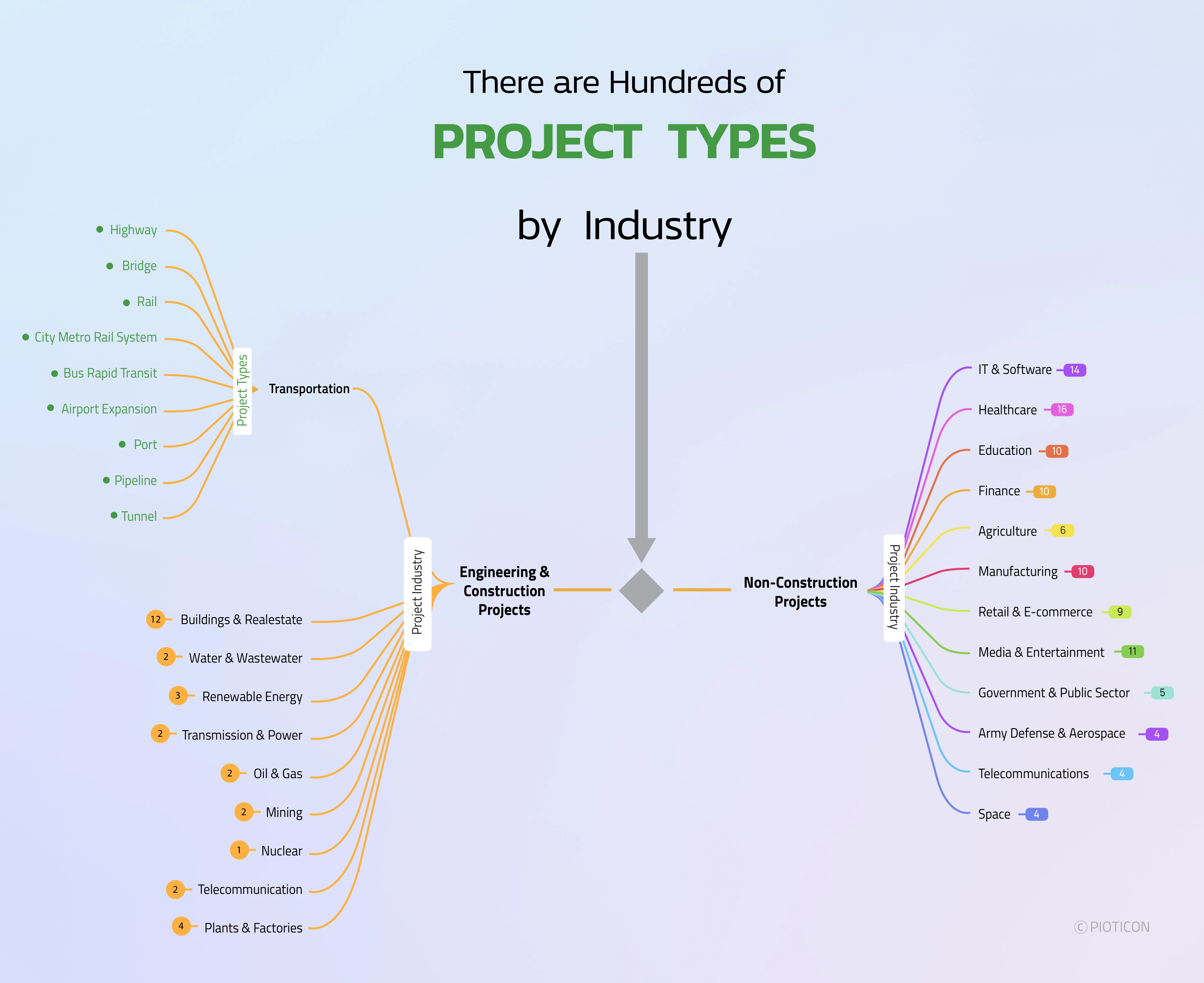
    A glance at the project landscape quickly reveals its diversity. As illustrated in the visual mapping of hundreds of project types by industry, Engineering & Construction Projects (e.g., highways, tunnels, power plants) differ fundamentally from Non-Construction Projects (e.g., IT implementations, finance system rollouts, media production). And even within Engineering & Construction, a highway project is not the same as a high-rise tower or an underground metro system.

    Hundreds of Project Types

    Despite this, project management advice is often treated as one-size-fits-all. The result? Misalignment, reduced effectiveness, and repeated delivery failures.

    While generic project management principles can offer a foundational starting point, they fall short when complexity increases and sector-specific realities come into play. Each project type, and often, each sub-type, requires its own blend of methodology, leadership, and controls.

    Management Capability Must Reflect Project Reality

    To effectively deliver these diverse project types, the capability of the project manager and the structure of the management team must evolve accordingly.

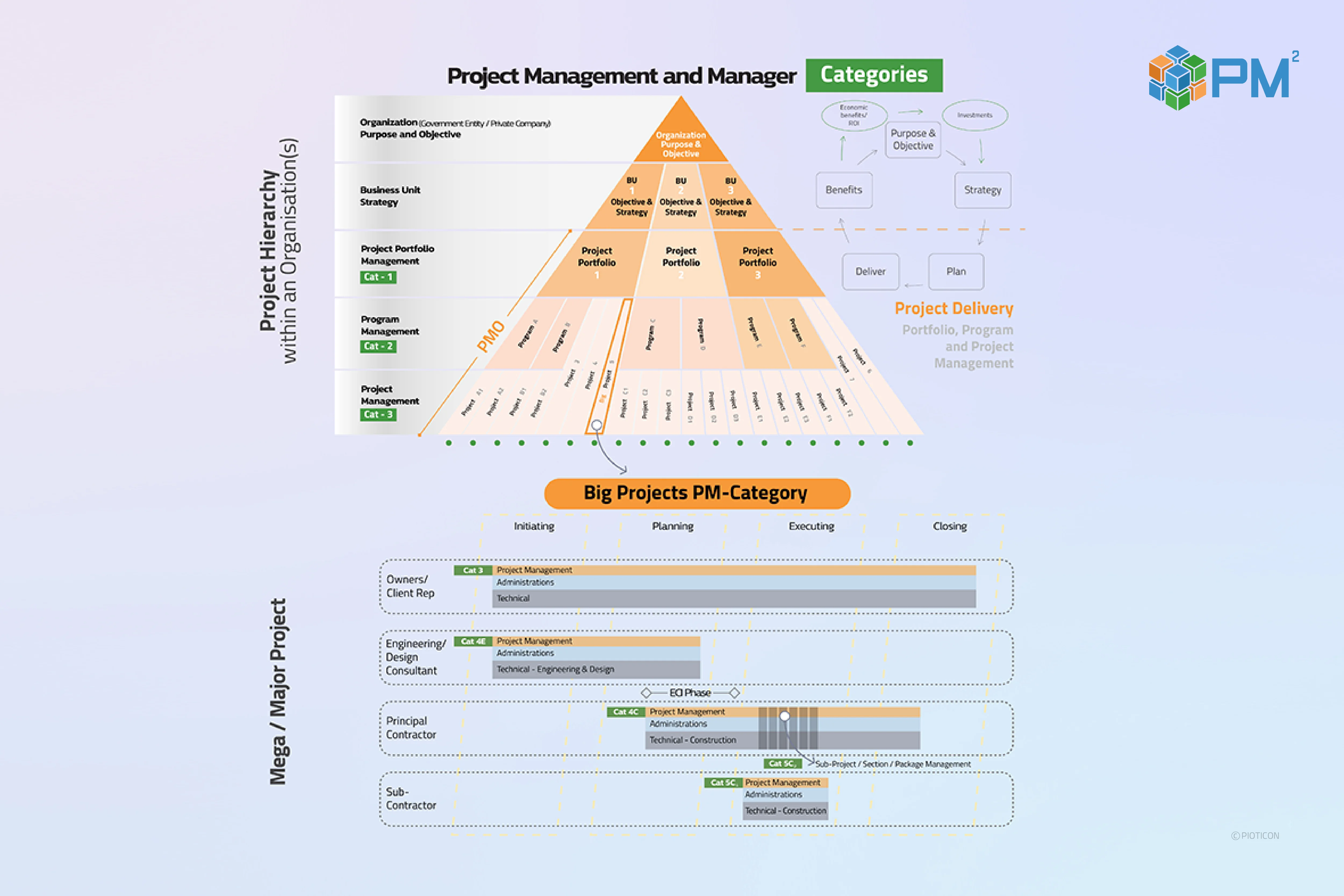
    The graphic below outlines a structured hierarchy of project management categories from project-level to portfolio-level, and illustrates how roles and responsibilities shift across Owners/Client Representatives, Engineering Consultants, Principal Contractors, and Subcontractors in mega or major projects.

    Competency requirements across these roles vary not just by level, but by project category and type. Misunderstanding this often leads to a poor fit between management approach and project demands.

    The Myth of Seamless Transition into Project Management

    A persistent and damaging assumption in the industry is that successful engineers or construction managers can naturally transition into project management roles.

    This thinking fails to acknowledge a critical truth:

    “The skills required to construct a bridge are not the same as those needed to manage a bridge project to time, cost, scope, and quality targets.”

    Project managers require a deep understanding of planning, monitoring techniques, systems, controls, risk, stakeholder alignment, and commercial drivers, not just technical know-how to design or build.

    These misunderstanding fuels the rise of the “accidental project manager”—someone promoted based on just engineering or operational experience, rather than on their ability to manage the full complexity of a project lifecycle.

    Why Generic Tools and Systems Fall Short

    Not only are people misaligned to roles, but so are the tools they’re handed. Project management systems and software that work well for real estate high-rise building towers often fall short in linear infrastructure like highways, rail, or pipelines.

    While certain work or trade packages, like concrete or electrical, may appear similar across projects, they account for only a fraction of total complexity. Delivery environments, stakeholder interfaces, and risk profiles vary greatly.

    The widespread promotion of generic project management platforms and playbooks glosses over these nuances and creates a false sense of readiness.

    The Competency Blend That Actually Delivers

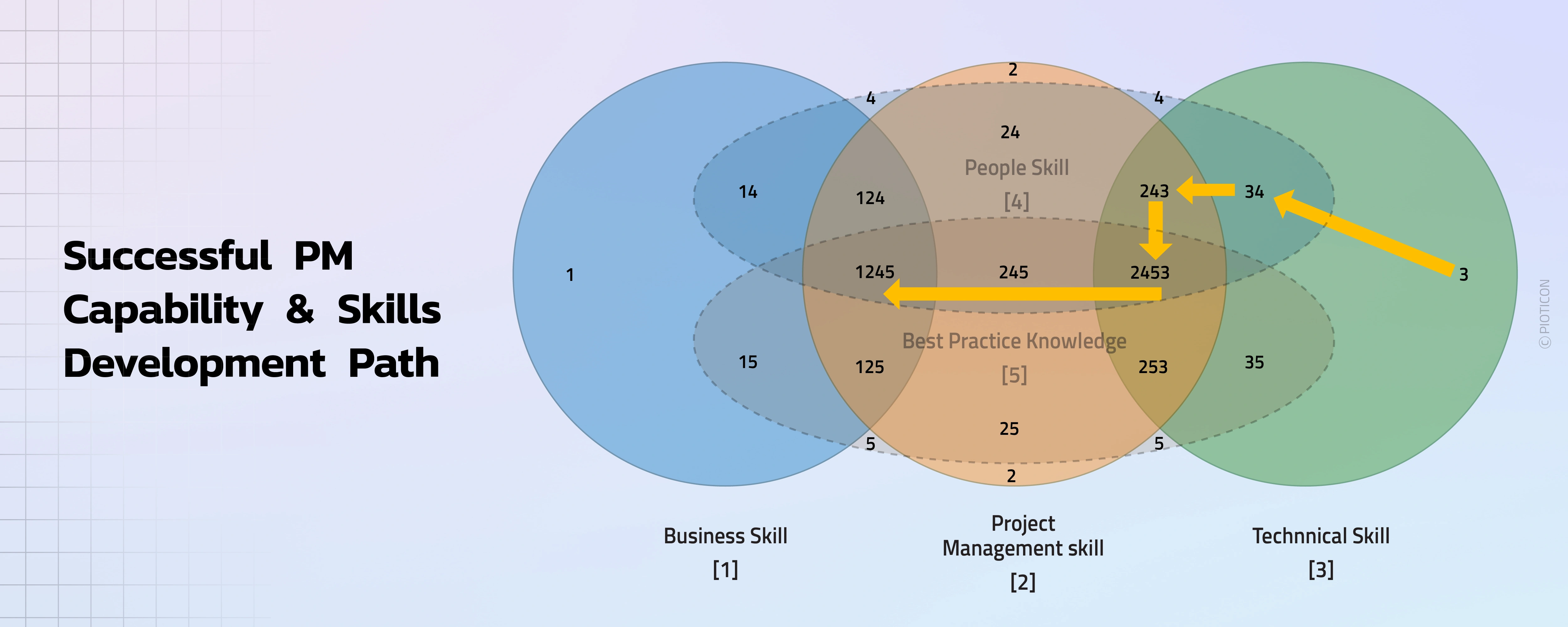
    At Pioticon, we emphasize a structured approach to building real capability. Based on our work in engineering and construction, we focus on five core skill domains:

    1. Business Skills [The know-why behind the work]
    2. Project Management Skills [The know-how to make the work happen successfully]
    3. Technical Skills (Engineering, Design, Construction) [The know-how to do the work]
    4. People Skills [The know-how to lead and influence people to perform]
    5. Best Practice Knowledge [The know-what and why behind doing things the right way]

    The visual framework below illustrates how these domains overlap. While few individuals possess all five at once, the most successful professionals in construction project management evolve along a deliberate path, starting from a strong technical base and progressively building business acumen, leadership capability, and project delivery systems thinking.

    *Technical skills for Categories 1-3 are typically developed through progression from other categories during career advancement. Project Management itself has technical elements that are gained from prior Engineering or Construction experience in other categories.

    ^Categories also apply to Project Management and Control professionals, including Project Controls, Planning & Scheduling, Cost Engineering & Estimation, Risk, and Reporting.

    These skills are essential for productive technical leadership in high-complexity projects. This integration of knowledge is where project control becomes proactive, not reactive. It’s what` enables PMs to navigate scope creep, shifting conditions, and cross-functional pressures.

    Purpose-Built for Engineering & Construction

    At Pioticon, we don’t just believe in tailored project management, we build for it. Our focus remains on Engineering & Construction projects because they require sector-specific systems, delivery-aligned teams, and capability development rooted in real-world complexity.

    We’re not here to offer templates.

    We’re here to offer purpose-built systems, tools, techniques and thinking built for the job at hand.

    Final Word

    Generic project management can actively derail project success by creating false confidence, mismatched expectations, and ineffective leadership paths.

    To achieve performance in complex environments, we must stop treating project management as a universal solution and start treating it as a purpose-built capability, developed in context, for context.

  • Why Do So Many Mega Projects Fail?

    Why Do So Many Mega Projects Fail?

    In the infrastructure and construction world, failure is rarely sudden.
    It builds slowly—behind Gantt charts, under milestone meetings, and beneath well-intended plans.

    You see it in the headlines:

    • “Another tunnel project delayed.”
    • “Budget blows past $1.2B.”
    • “Contract disputes stall completion.”

    We shake our heads. We adjust the plan, and then we do it again on the next project.

    But here’s the question that rarely gets asked:

    Are mega projects failing because they’re hard to execute? Or is it because we’re still managing them with tools built for smaller, simpler systems?

    This post explores why applying linear thinking to exponential complexity is the root of recurring issues in large-scale infrastructure projects—and what must change if we want a different outcome.

    Because complexity isn’t the enemy. How we manage it is.

    Traditional Metrics Miss the Root Causes

    Most projects are judged by:

    • Contractual compliance
    • Schedule and budget targets
    • Business case value
    • Scope delivery

    But these are lagging indicators. They measure what went wrong, not what caused it. By the time your cost curve spikes, it’s too late. If we want to improve project performance, we need to move upstream into systems, controls, and clarity of purpose.

    Early Warning Signs Are Always There

    No matter the geography or delivery model, struggling projects show familiar symptoms:

    • Uncontrolled cost growth
    • Shifting or unclear scopes
    • Delayed decision-making
    • Risk registers that are filled but forgotten

    These symptoms point to something deeper, a mismatch between project scale and the management system trying to control it.

    The Myth of Risk Transfer: Why Balancing Contractual Models Isn’t Enough in Mega Projects

    Here’s where many mega projects go off track: they overestimate the power of contractual frameworks and underestimate the project management capability and competence required to match the project’s complexity on both the client and contractor sides from the very beginning.

    The quality of construction is rarely the issue. Most major infrastructure projects are built to exceptional standards. Yet, they still finish late and/or exceed budget.

    Even with contract clauses like liquidated damages (LDs) designed to keep delivery on track, delays persist. Despite lessons from past project failures, we continue to rely on the same outdated frameworks, traditional mindsets, and ineffective delivery mechanisms.

    Let’s be clear: simply shifting risk between client and #contractor isn’t the solution. It’s not just about who holds the risk, it’s about whether the teams involved have the skills, systems, and strategic alignment needed to manage it effectively.

    In mega projects, complexity doesn’t grow linearly, it grows exponentially. And that exponential complexity demands more than just legal safeguards. It requires a fundamentally different approach, one that integrates people, systems, and strategic intent from the ground up.

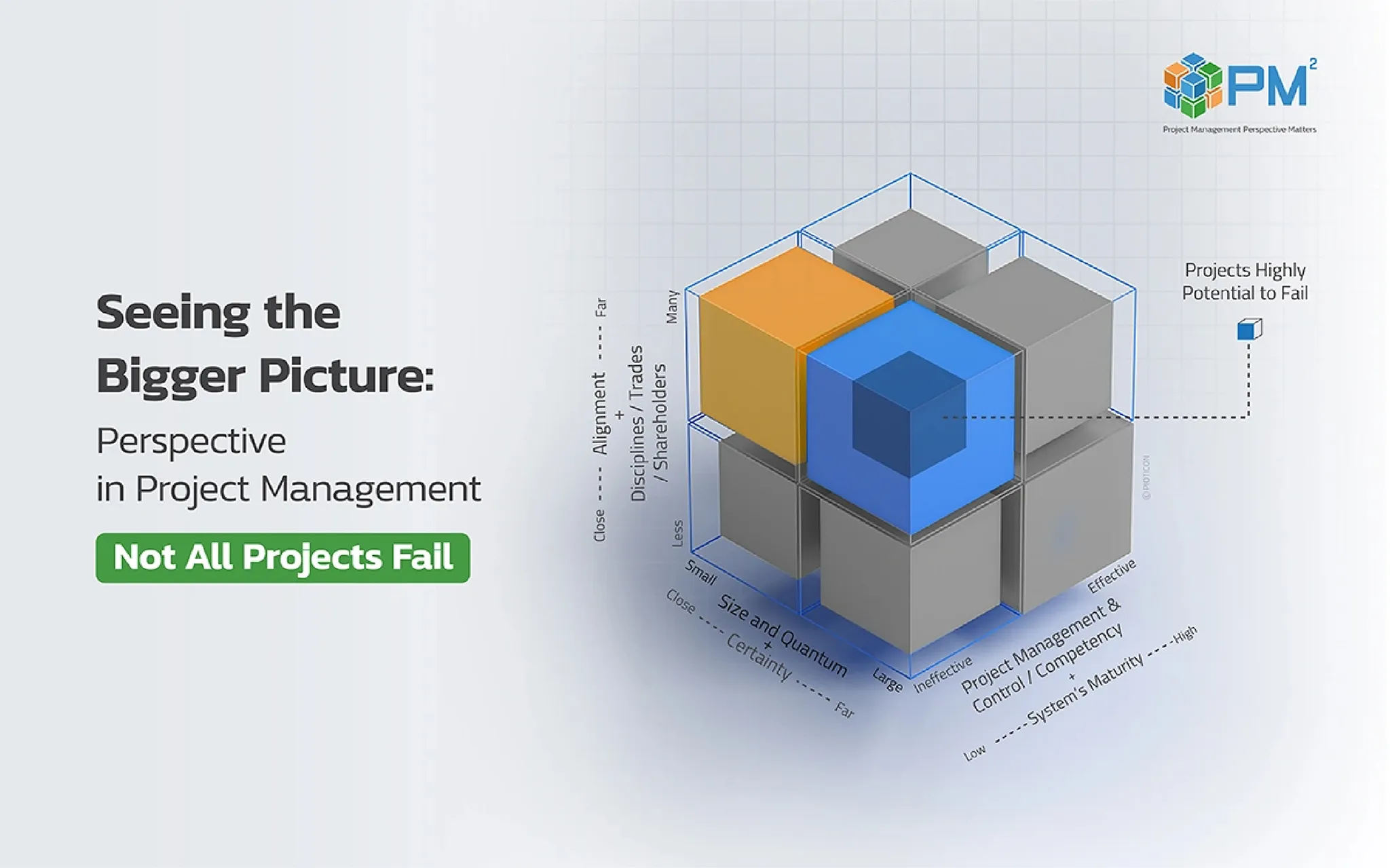
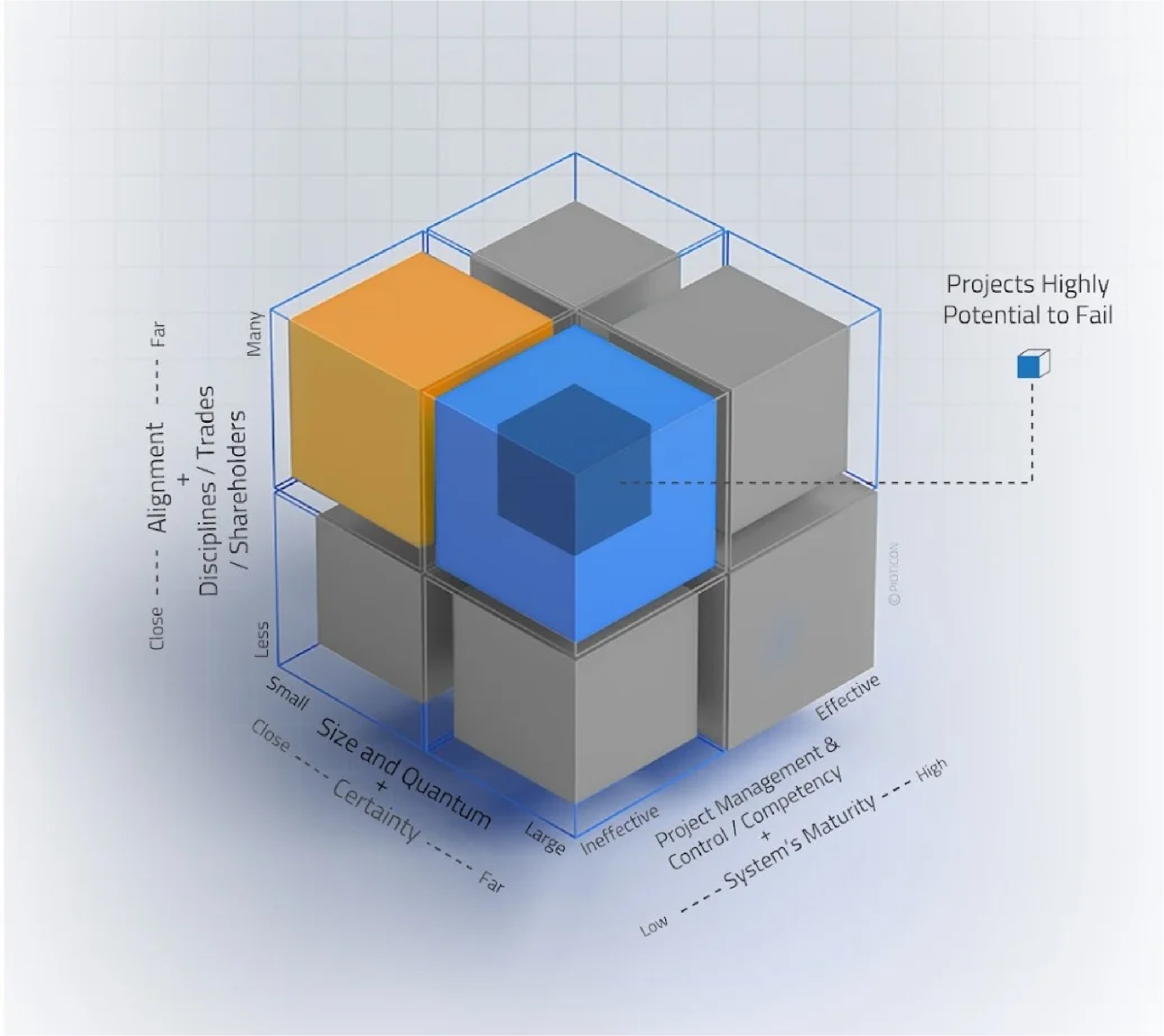
    The Three Dimensions of Complexity

    Based on Pioticon’s experience across sectors, we’ve found that three dimensions define how complex a project really is:

    1. Certainty of Size & Scope
      When project quantum is unclear or changes frequently, everything downstream becomes harder to plan, measure, or control.
    2. Alignment Across Stakeholders
      The more trades, agencies, and layers involved, the more chances for misalignment. Differing goals create friction that cascades across delivery.
    3. Maturity of PMC Systems & Competency
      Even if scope and alignment are strong, an immature project control system will eventually break under pressure. The right systems, dashboards, and controls must be in place—and used daily.

    When one of these dimensions weakens, the other two are forced to overcompensate.
    When all three fail together, even the most promising project will stall.

    What We See: A Cycle of Breakdown

    Mega project issues aren’t random—they’re part of a repeatable cycle:

    • Vague project scopes create uncertainty
    • Misaligned teams make reactive decisions
    • Ineffective systems delay performance tracking
    • Issues escalate while everyone is looking elsewhere

    The result? Delays. Disputes. Cost blowouts. Lost stakeholder trust.

    The Hidden Drivers of Mega Project Failure

    At Pioticon, we’ve identified eight recurring drivers behind time and cost blowouts. The broad theme of those drivers are:

    • Poor integration across delivery functions
    • Weak performance management frameworks
    • Low visibility on early warning indicators
    • Incomplete or outdated system adoption
    • Skill gaps in key leadership roles

    We’ll unpack each of these in future PM² blogs. For now, know this: these factors aren’t isolated, they compound each other.

    The Way Forward

    It’s not more meetings, and it’s not just another software application, or a few PM experts to write generic processes and procedures, or waiting for artificial intelligence to fix cultural problems.

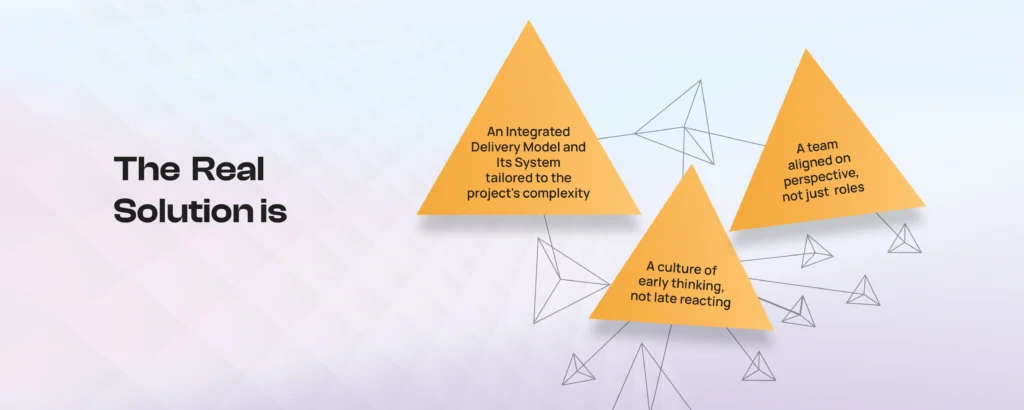
    The real solution is:

    • An Integrated Delivery Model and Its System tailored to the project’s complexity
    • A team aligned on perspective, not just roles
    • A culture of early thinking, not late reacting

    Performance systems don’t work unless teams use them, and project controls don’t matter unless leaders value them.

    Project Failure Is a Systems Issue, Not a Scale or Contractual Issue

    Complexity is not a problem. It’s a reality. But treating complexity with static frameworks is what causes failure. At Pioticon, we don’t just bring tools. We build integrated systems that support proactive leadership and cross-functional alignment designed specifically for the reality of mega infrastructure delivery.

    That’s the core of our PM² (Project Management Perspective Matters) Series.

  • Perspective vs Opinion

    Perspective vs Opinion

    Not all project failures begin with poor planning or flawed execution. Some start with something far more subtle—yet just as powerful: mistaking opinions for perspective.

    In high-stakes infrastructure and construction projects, misalignment rarely looks dramatic at first. It begins quietly—in a meeting where someone says,

    “I need to see it to believe it.”

    It sounds rational. It sounds cautious. But it reflects a deeper issue: the belief that if something isn’t visible now, it isn’t real.

    That’s where projects begin to drift—not because of a lack of expertise, but because of a lack of shared perspective. And in our experience at Pioticon, that gap between what we think we know and what we’ve truly understood is often the difference between a successful outcome and a costly setback.

    The Flat Earth Fallacy in Project Leadership

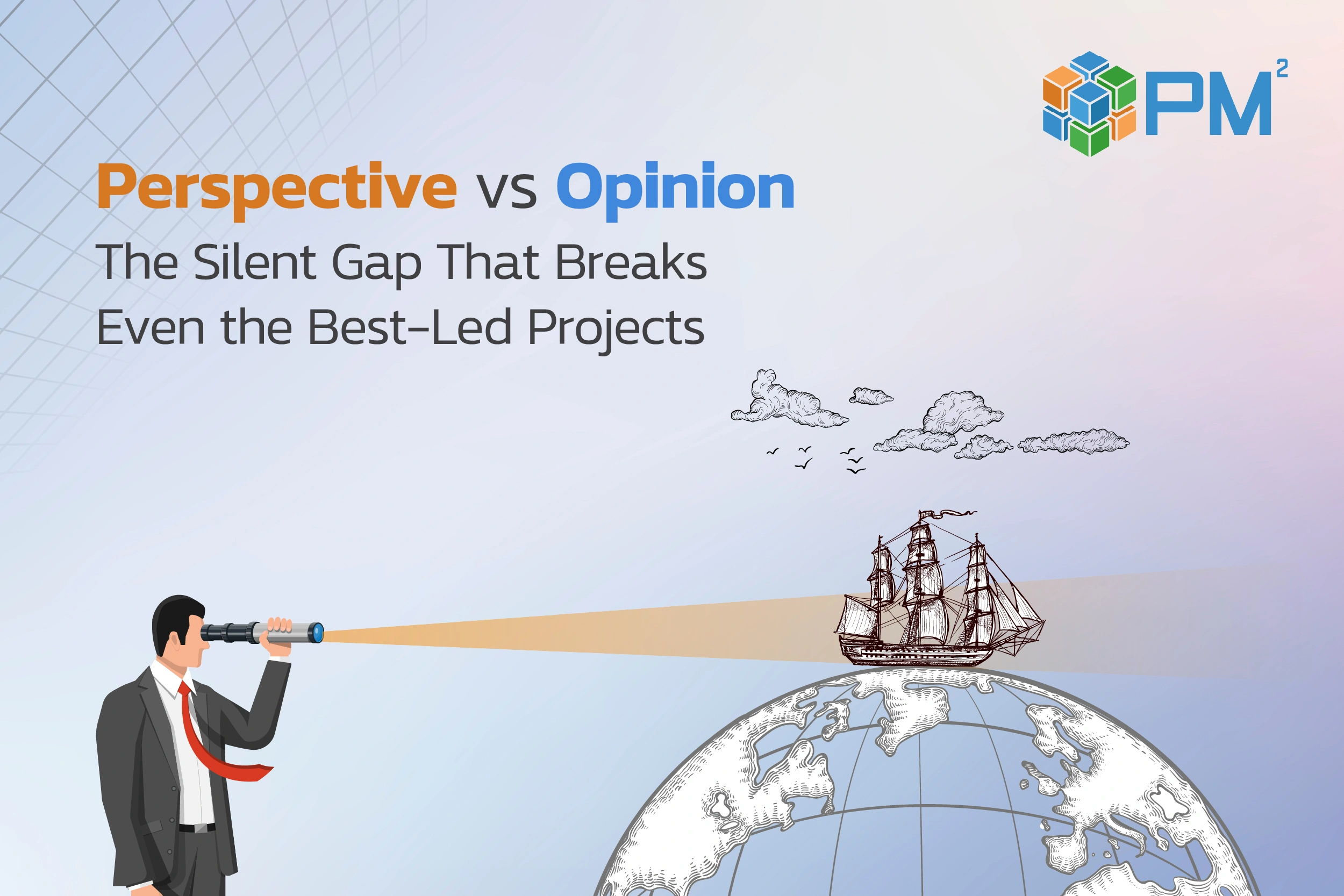
    This mindset, “I need to see it to believe it,” feels like due diligence. But in practice, it’s often a reflection of what we call the Flat Earth Fallacy.

    Centuries ago, many believed the Earth ended at the horizon simply because they couldn’t see beyond it. Similarly, in project delivery, early signals, risk indicators, or emerging trends may be ignored simply because they aren’t immediately visible.

    The result?

    Leaders operate from the assumption that what hasn’t yet surfaced doesn’t exist. But in complex, phased project environments, absence of evidence is not evidence of absence. Dismissing what you can’t see can be a costly mistake.

    The Real Difference Between Perspective and Opinion

    In project environments, it’s common to hear strong statements in meetings like:

    • “There’s no issue yet. We’ll act if something happens.”
    • “Project management is just coordination—it’s not a technical function.”
    • “He seems confident and communicates well; he must be ready to lead.”
    • “She’s too junior for this role.”

    These sound like reasonable points. But are they based on experience, or assumption?

    Let’s define the difference:

    • Opinion is a stance we hold—often shaped by emotion, urgency, or incomplete information. It’s reactive.
    • Perspective is deeper. It’s shaped by experience, exposure, and real understanding. It reflects how we interpret a situation based on what we’ve actually done and lived through.

    Why Perspective Matters More Than Ever in Mega Projects

    At Pioticon, we’ve worked across cultures, regions, and complex infrastructure programs. One insight stands out: teams rarely fall short because of technical skill alone.

    They fall short because team members are acting on unexamined opinions, not aligned perspectives.

    This leads to:

    • Missed early risk signals
    • Delayed decisions based on assumptions
    • Misalignment between strategy and execution
    • Ineffective stakeholder collaboration

    And often, it happens without anyone noticing—until it’s too late.

    Building Aligned Perspective Across Project Teams

    In our PM² (Project Management Perspective Matters) series, we focus not just on leadership, but on perspective alignment across every level of a project.

    Because perspective isn’t just a leadership issue—it’s a team issue.

    Building aligned perspective requires:

    • Continuous Learning – Staying current through practical exposure, not just certifications
    • On-the-Ground Experience – Doing the work, not just directing it
    • Willingness to Recalibrate – Updating assumptions as real-time insights emerge

    The strongest leaders ask themselves:

    “Is this something I know through experience or something I believe strongly?”

    “Am I helping my team think more clearly—or just adding another opinion to the room?”

    Great Leaders Teach People How to Think, Not Just What to Do

    The most valuable project contributors aren’t always the loudest or the most senior. They’re the ones who:

    • See the bigger picture
    • Interpret data through lived context
    • Push discussions from urgency to clarity
    • Align the team around what’s real, not just what’s assumed

    And that starts with perspective.

    Perspective is Foundational in Project Management

    Project success doesn’t come from louder opinions. It comes from shared understanding—from team members who know how to think critically, ask better questions, and recognize when they’re speaking from belief versus experience.

    In mega projects, where timelines are tight and stakes are high, that distinction makes all the difference.

  • Seeing the Bigger Picture: How Perspective Shapes Project Success

    Seeing the Bigger Picture: How Perspective Shapes Project Success

    When infrastructure projects make headlines, it’s often for the wrong reasons—budget overruns, missed deadlines, and large-scale inefficiencies. The narrative seems straightforward: yet another failed project, another financial disaster.

    But is it really that simple?

    Before labeling a project as a failure, we need to step back and ask deeper questions:

    • What does the term project actually mean to different stakeholders?
    • Who defines success, and on what basis?
    • Why do certain projects face more obstacles than others?

    The answers lie in perspective, how different players within a project ecosystem define objectives, risks, and responsibilities. When these perspectives don’t align, the consequences ripple through the entire lifecycle of a project.

    One Project, Many Perspectives

    Let’s take a simple example of a 20km motorway project. While it might appear to be a well-defined endeavor, its meaning varies drastically depending on who you ask:

    • For the client, it’s just one piece of a larger 100km transportation program, where realistic expectations and clear scope drive its success.
    • For the principal contractor, it’s a contractual commitment that must be meticulously managed to avoid scope creep and unforeseen liabilities.
    • For the designer, success means finding a solution in the most economical way, efficiency, and compliance in both temporary and permanent design works.
    • For the subcontractor, the goal is to execute their specialized task as cost-effectively and efficiently as possible.
    • For politicians and governments, it is driven by public perception, funding, and election cycles, the project’s success is tied to policy objectives, economic impact, and public reception.

    Each of these players is operating within the same project, yet their definitions of success—and their risks—are vastly different.

    When Perspectives Clash, Projects Suffer

    The problem arises when these perspectives remain unaligned. Risks are unevenly distributed, decision-making slows down, and the entire project becomes vulnerable to:

    • Scope creep – Unreasonable or vague contractual obligations and Miscommunication between stakeholders leads to unclear or changing expectations.
    • Budget explosions – Cost assumptions made by one party may not reflect on-the-ground realities faced by another.
    • Timelines stretching indefinitely – Conflicting priorities delay decision-making and execution.

    Project success is not just about hitting schedules and staying within budgets—it’s about creating a shared understanding among all stakeholders from the start.

    Reframing Success in Project Management
    Instead of defining success in narrow terms like cost and time, we need a broader, more perspective-driven approach to project management:

    • Stakeholder Alignment: Before execution even begins, ensure every key player understands the project’s objectives and constraints from each other’s point of view. Align on key performance metrics to define success to both stakeholder and project
    • Risk Balancing: Clearly define where responsibilities lie so risks don’t accumulate disproportionately on certain teams.
    • Systems Thinking: A project is not just an isolated contract—it’s a dynamic system of people, decisions, and interdependent parts. Managing it effectively requires stepping back and seeing the bigger picture.

    If you are a project owner, contractor, policymaker, engineer, or anyone involved in large-scale projects, this series will provide valuable insights and strategies for improving project alignments for better outcomes.

    So, What’s Your Perspective?

    How do you define project success in your industry? Have you ever faced challenges aligning different stakeholder expectations?

    Stay tuned for more insights in the Project Management Perspective Matters (PM²) Series by Pioticon.

  • Project Management Perspective Matters: Why Aligning Stakeholder Views is Key to Project Success

    Project Management Perspective Matters: Why Aligning Stakeholder Views is Key to Project Success

    Every major engineering and construction project thrives when every stakeholder shares a common understanding of success. But in reality, perspectives differ.

    From sponsors, clients, principal contractors, and designers to subcontractors, suppliers, and community leaders, each stakeholder brings their own priorities, biases, and expectations to the table. These differences, if left unaddressed, create misalignment, setting the stage for delays, cost overruns, and even project failure.

    At the same time, project beneficiaries- local communities, organizations, end users, and political leaders, often have an entirely different outlook. Their focus is on the final impact, not the countless challenges faced during execution. This contrast can create friction, misunderstandings, and resistance.

    It’s important to note that delays and cost overruns are measured against the baseline plan. However, this baseline may sometimes be unrealistic from the start, while in other instances, inefficient project delivery is indeed the root cause.

    The Cost of Misalignment in Projects

    Misalignment isn’t just an operational hurdle—it’s a critical risk factor. When stakeholders lack a shared vision:

    • Teams struggle with conflicting priorities, leading to inefficiency.
    • Decision-making slows down, increasing costs.
    • Unrealistic expectations create tension and dissatisfaction.
    • Project execution deviates from the intended goals.

    Bridging these gaps requires more than just process optimization; it demands a shift in perspective.

    The Power of Perspective in Project Success
    In the Project Management Perspective Matters (PM²) Series, we’ll explore how these varying viewpoints shape project outcomes and, more importantly, how leaders can bring them into alignment.

    We’ll cover:

    • Why perspective is the missing piece in project success – Understanding how different stakeholders define success and why their perspectives must be accounted for.
    • How misalignment happens before execution even begins – Identifying the early warning signs of divergence and how to address them at the planning stage.
    • What practical steps can help teams work toward the same goal – Actionable strategies to create a shared vision, align expectations, and drive collaboration.

    Beyond Timelines and Budgets: Playing the Same Game

    A successful project isn’t just one that’s completed on time and within budget. True success means every stakeholder sees value in the outcome—because, ultimately, a project’s impact lasts far beyond its execution.

    It starts with understanding perspectives. It succeeds when everyone is playing the same game.

    What’s one perspective shift that completely changed the way you approach project management? Share your thoughts in the comments!

    Stay tuned for the upcoming posts in the Project Management Perspective Matters series, where we’ll dive deeper into these crucial insights.

  • Inefficient Engineering and Design to meet Project objective

    Inefficient Engineering and Design to meet Project objective

    The Crisis of Inefficient Engineering and Design in Mega Projects: A Complete Analysis

    Engineering and design form the backbone of mega projects across infrastructure, energy, industrial, and manufacturing sectors. Despite advances in technology and processes, engineering and design are not able to effectively meet overall project cost and time objectives. Many projects continue to fall short of their cost, schedule, quality, and operational Business case economical objectives. Inefficient engineering and design practices remain a silent crisis that undermines performance, leading to budget overruns, delivery delays, and disputes that erode stakeholder confidence.

    The real challenge lies not in the visible errors but in the interconnected weaknesses within governance, design practices, and project structures. Tackling a single element never works. Lasting improvement demands integrated solutions that address scope, processes, systems, and accountability together.

    This article examines the root causes behind inefficient Long process of engineering and design and engineering induced cost overruns , drawing on a structured root cause analysis framework. It also highlights why solving isolated issues is not enough. Only integrated solutions across governance, technical, operational, and cultural dimensions can address the recurring cycle of delay and cost escalation.

    The Symptom: Engineering Deliverables Fail to Support Project Objectives

    Projects often discover late in delivery that engineering outputs are incomplete, unstable, or incompatible with construction or operational needs. This leads to:
    These are symptoms, not root causes. The true drivers lie deeper across system readiness, governance lapses, siloed workflows, and capability gaps.

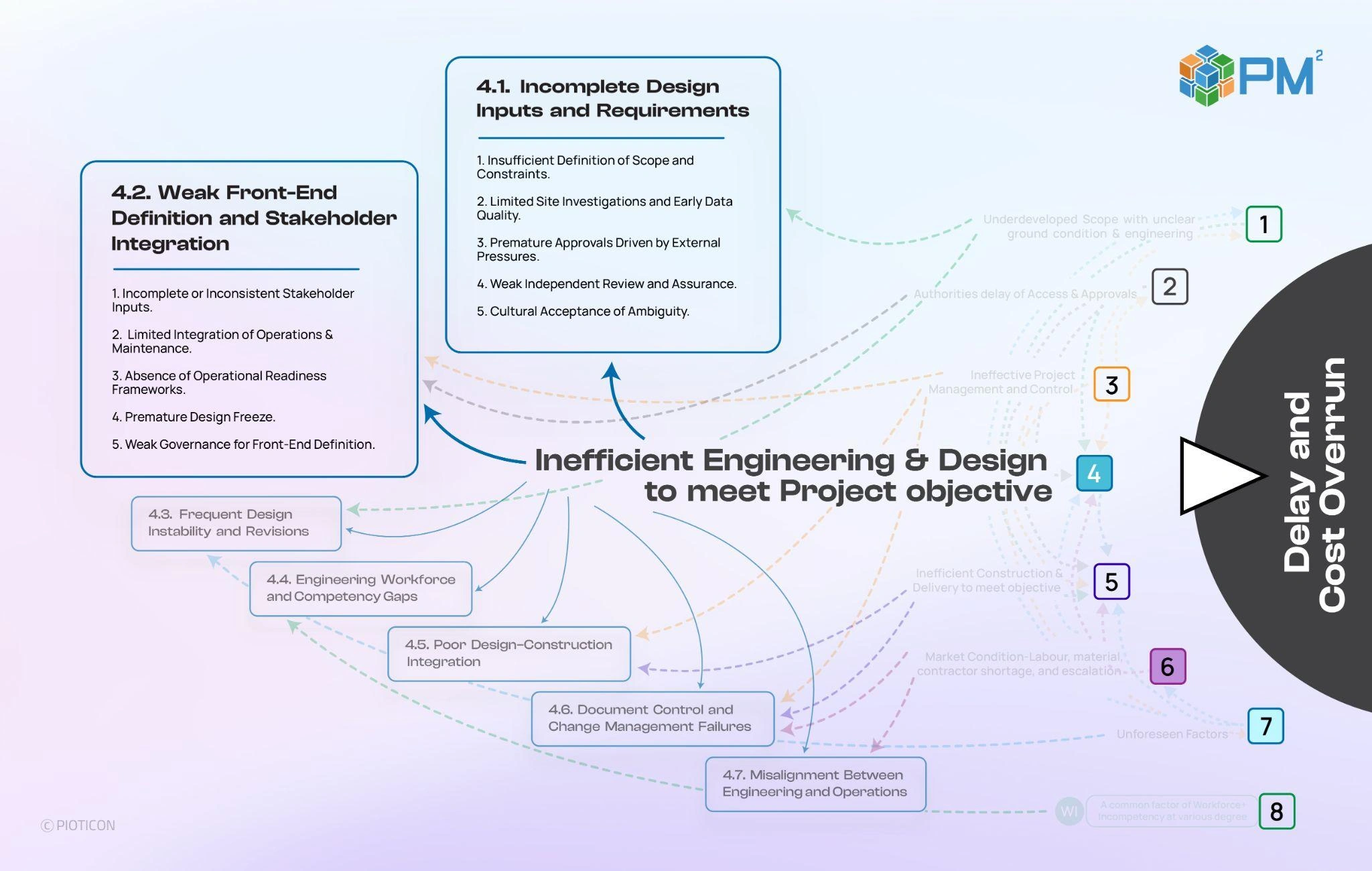
    4.1. Incomplete Design Inputs and Requirements

    The Problem

    Design efforts frequently start without fully defined requirements. When project scope, constraints, and stakeholder needs are not clearly articulated at the outset, engineering teams work with partial information, forcing costly revisions later.

    The Root Causes

    1.1. Insufficient Definition of Scope and Constraints

    • Early design begins without validated scope, constraints, or functional requirements
    • Project teams rely on assumptions rather than verified inputs
    • Ambiguity becomes embedded into the baseline and propagates errors downstream

    1.2. Limited Site Investigations and Early Data Quality

    • Restricted early budgets reduce the depth of geotechnical and survey data
    • Critical subsurface and environmental inputs remain uncertain
    • Missing data forces redesign later, increasing cost and time

    1.3 Premature Approvals Driven by External Pressures

    • Sponsors push for fast-track approvals to meet political or financial milestones
    • Governance prioritizes milestone compliance over technical readiness
    • Immature concepts advance into detailed design

    1.4 Weak Independent Review and Assurance

    • Scope inputs are not independently validated before design start
    • Review mechanisms lack rigor or authority
    • Incomplete requirements progress unchecked into design packages

    1.5 Cultural Acceptance of Ambiguity

    • Teams assume missing information can be resolved later
    • Optimism bias leads to premature freezes and unrealistic baselines
    • Ambiguity becomes normalized and drives repeated redesign

    The Required Shift

    • Institutionalize Front-End Loading (FEL) with readiness reviews
    • Mandate independent scope and site validations before approval
    • Redesign incentive structures to reward quality and completeness, not speed
    💡 Front-End Loading (FEL) is a structured approach that emphasises thorough planning in early project phases. It includes three progressive stages (concept, pre-feasibility, feasibility) to define requirements, assess risks, and align stakeholders before committing significant resources.

    4.2. Weak Front-End Definition and Stakeholder Integration

    The Problem

    Front-end definition often fails to capture the full input of stakeholders, including operators and maintenance teams. Designs therefore focus on capital delivery without aligning to operational realities.

    The Root Causes

    2.1 Incomplete or Inconsistent Stakeholder Inputs

    • Stakeholder requirements are captured superficially
    • Inputs from end users and regulators remain fragmented
    • Misalignment grows as design advances

    2.2 Limited Integration of Operations & Maintenance

    • Operational needs are excluded from early design decisions
    • Lifecycle considerations remain absent from technical criteria
    • Resulting assets create high long-term O&M burden

    2.3 Absence of Operational Readiness Frameworks

    • No defined process aligns engineering with future operation scenarios
    • Design teams lack structured criteria for operability

    2.4 Premature Design Freeze

    • Schedules drive premature locking of design without validation
    • Later-stage changes become costly and disruptive

    2.5 Weak Governance for Front-End Definition

    • No accountability for ensuring completeness before progressing
    • Governance bodies accept incomplete documentation

    The Required Shift

    • Conduct multi-stakeholder workshops to align requirements
    • Integrate operational readiness scenarios into design reviews
    • Enforce formal design-readiness gates tied to technical criteria, not schedule optics

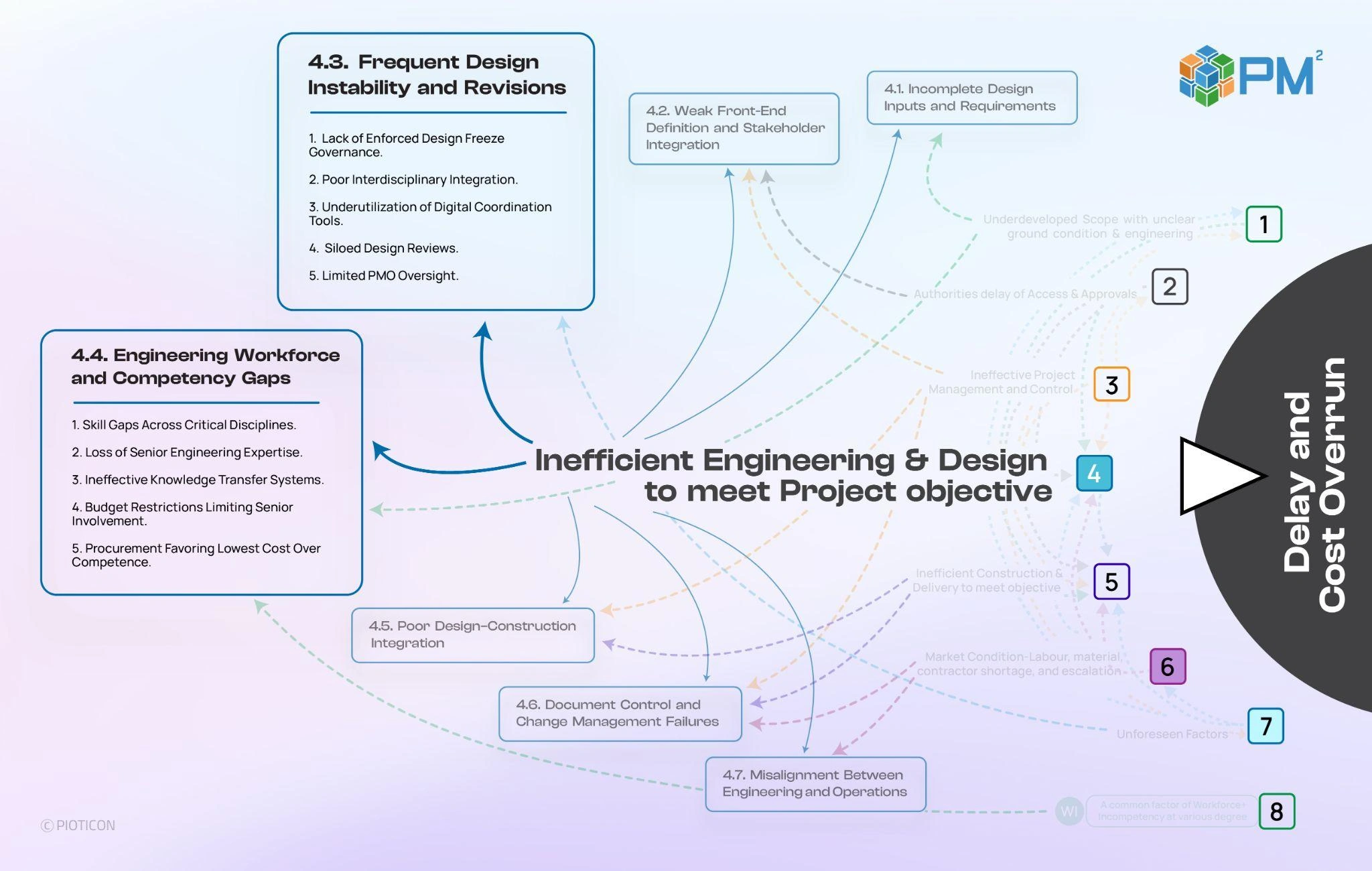
    4.3. Frequent Design Instability and Revisions

    The Problem

    Constant design changes during execution undermine cost, schedule, and constructability.

    The Root Causes

    3.1 Lack of Enforced Design Freeze Governance

    • Design freeze milestones exist but are not respected
    • Late changes disrupt engineering and construction sequences

    3.2 Poor Interdisciplinary Integration

    • Design conflicts are discovered late due to isolated discipline reviews
    • Coordination mechanisms are weak or underutilized

    3.3 Underutilization of Digital Coordination Tools

    • BIM, 3D models, and clash detection are inconsistently applied
    • Design maturity assessments lack digital support

    3.4 Siloed Design Reviews

    • Reviews occur discipline-by-discipline rather than integrated
    • System-level issues remain undiscovered until construction

    3.5 Limited PMO Oversight

    • PMOs lack authority to enforce integrated reviews or quality gates

    The Required Shift

    • Mandate digital interdisciplinary reviews using BIM and clash detection
    • Empower PMOs with authority to enforce integrated reviews
    • Require formal design freeze enforcement backed by governance accountability

    4.4. Engineering Workforce and Competency Gaps

    The Problem

    Engineering teams often lack the depth of expertise and continuity needed for modern complex projects.

    The Root Causes

    4.1 Skill Gaps Across Critical Disciplines

    • Emerging technologies outpace current engineering capabilities
    • Hard-to-fill roles undermine design robustness

    4.2 Loss of Senior Engineering Expertise

    • Retirements and turnover weaken mentorship and decision-making
    • Institutional knowledge is not transferred effectively

    4.3 Ineffective Knowledge Transfer Systems

    • No structured mentorship or knowledge management platforms
    • Tacit knowledge remains undocumented

    4.4 Budget Restrictions Limiting Senior Involvement

    • Cost pressures reduce participation of expert engineers
    • Junior teams handle complex tasks without adequate guidance

    4.5 Procurement Favoring Lowest Cost Over Competence

    • Design contracts prioritize low pricing instead of expertise
    • Technical capability assessments remain weak or absent

    The Required Shift

    • Establish engineering competency standards with certification requirements
    • Fund structured mentorship and knowledge transfer programs
    • Reform procurement to prioritize quality and expertise over lowest bids

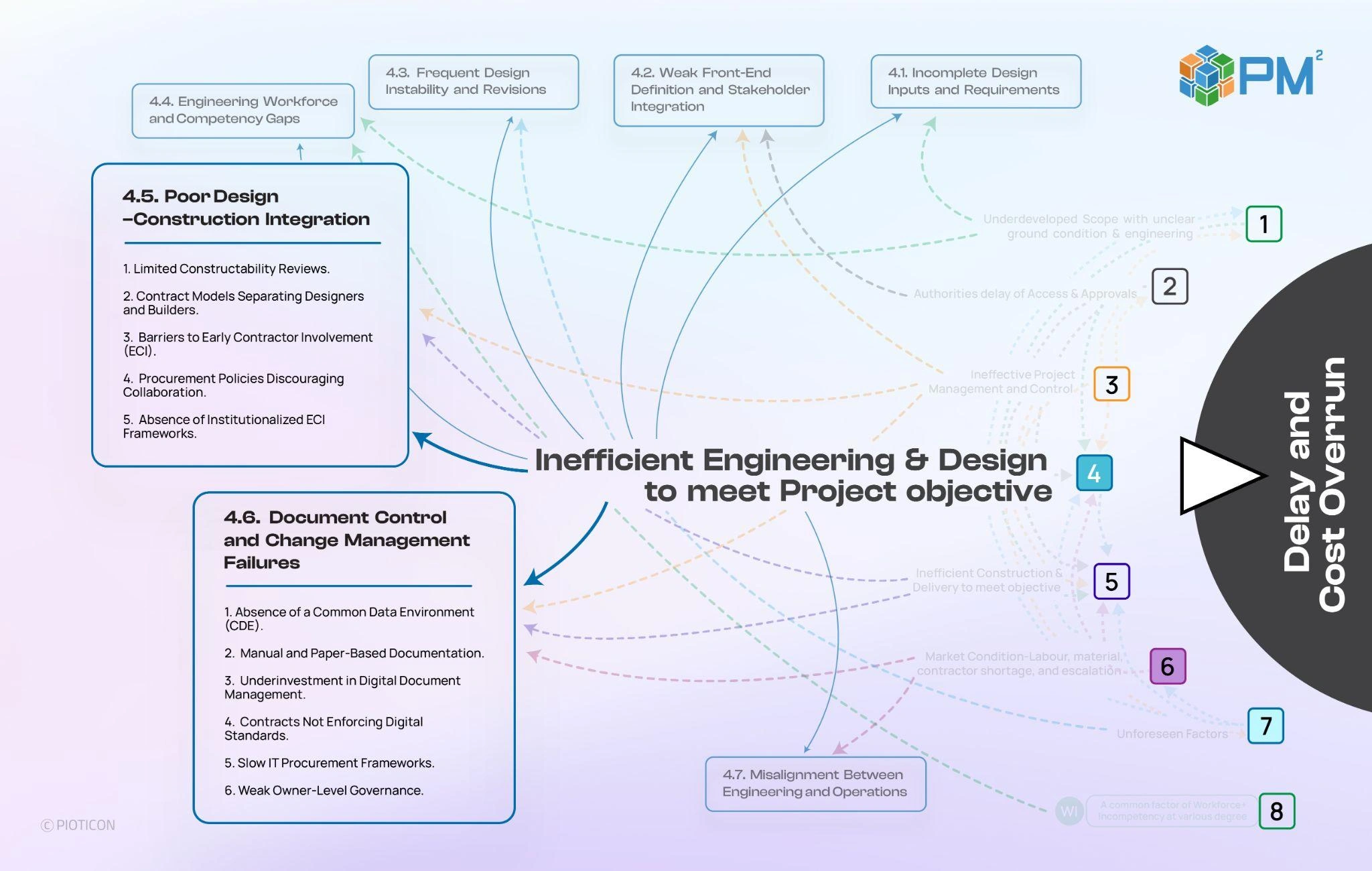
    4.5. Poor Design – Construction Integration

    The Problem

    Design teams often fail to align designs with real-world constructability, including temporary works, leading to costly changes during construction.

    The Root Causes

    5.1 Limited Constructability Reviews

    • Reviews are superficial or conducted late in the design cycle
    • Temporary works and sequencing constraints are overlooked

    5.2 Contract Models Separating Designers and Builders

    • Traditional Design–Bid–Build limits collaboration
    • Designers lack early access to construction feedback

    5.3 Barriers to Early Contractor Involvement (ECI)

    • Commercial and legal frameworks do not support ECI
    • Contractors cannot influence buildability during design

    5.4 Procurement Policies Discouraging Collaboration

    • Rigid tendering processes limit dialogue between design and construction
    • Value engineering becomes reactive, not proactive

    5.5 Absence of Institutionalized ECI Frameworks

    • No standardized approach for early construction input
    • Engineering progresses without field insights

    The Required Shift

    • Introduce structured Early Contractor Involvement frameworks
    • Reform procurement policies to incentivize collaboration while maintaining transparency
    • Mandate constructability reviews as part of design milestones

    4.6. Document Control and Change Management Failures

    The Problem

    Poor document control creates rework, RFIs, and safety risks as outdated or conflicting versions circulate.

    The Root Causes

    6.1 Absence of a Common Data Environment (CDE)

    • Engineering teams rely on separate systems and manual workflows
    • Version control errors propagate rework

    6.2 Manual and Paper-Based Documentation

    • Slow, error-prone systems delay information flow

    6.3 Underinvestment in Digital Document Management

    • Organizations deprioritize modern platforms and tools

    6.4 Contracts Not Enforcing Digital Standards

    • Documentation requirements are not embedded contractually

    6.5 Slow IT Procurement Frameworks

    • Digital upgrades cannot be implemented at project pace

    6.6 Weak Owner-Level Governance

    • No enforcement of compliance with digital protocols

    The Required Shift

    • Mandate cloud-based, real-time document control systems
    • Require all participants to operate through a common data environment
    • Build contractual clauses to enforce digital compliance

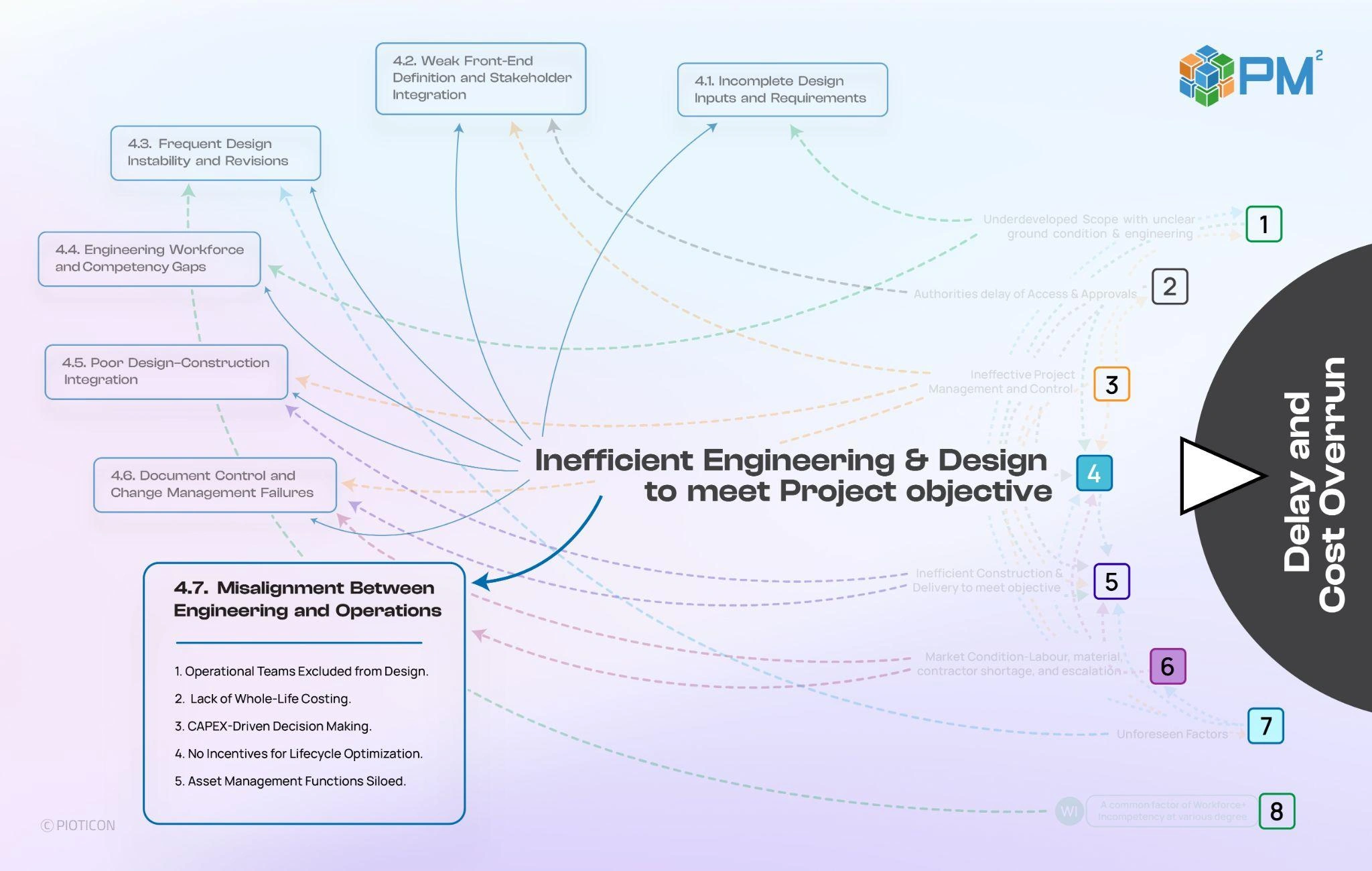
    4.7. Misalignment Between Engineering and Operations

    The Problem

    Designs often fail to reflect operational needs, leading to high lifecycle costs.

    The Root Causes

    7.1 Operational Teams Excluded from Design

    • Critical O&M needs are not reflected in design decisions

    7.2 Lack of Whole-Life Costing

    • OPEX implications are not analyzed during design selection

    7.3 CAPEX-Driven Decision Making

    • Short-term capital budgets override lifecycle performance

    7.4 No Incentives for Lifecycle Optimization

    • Teams are not rewarded for reducing long-term operating cost

    7.5 Asset Management Functions Siloed

    • No integration between asset managers and engineering leads

    The Required Shift

    • Integrate operational readiness teams into design reviews
    • Apply whole-life costing models during design selection
    • Incentivize project teams to optimize total lifecycle performance

    Integrated Solutions Over Isolated Fixes

    Engineering inefficiencies do not arise from one weak function. They emerge when interdependent systems—scope, design, planning, procurement, risk, governance, and capability – fail to operate in coordination.
    Each PMC sub-cluster both influences and depends on the others:
    • Scope & Change Management
      Incomplete or shifting scope destabilizes design; unstable design triggers uncontrolled scope changes.
    • Planning & Scheduling
      Schedules collapse when design maturity is misaligned with construction sequencing and logic ties.
    • Estimating & Cost Management
      Inaccurate design inputs distort cost estimates, contingencies, and forecasts.
    • Risk Management
      Engineering assumptions become risk drivers that must feed directly into risk models and exposure buffers.
    • Performance Reporting
      Reporting must reflect actual design maturity—not misleading “green” progress KPIs.
    • Fragmented Project Controls
      Engineering must feed cost, schedule, and risk systems; otherwise controls remain disconnected.
    • PMC Governance
      Governance must enforce design readiness standards and hold oversight teams accountable.
    Sub-ClustersIntegrated Solution Focus
    Scope & Change ManagementAnchor engineering through validated scope inputs and aligned change governance
    Planning & SchedulingIntegrate design maturity into logic sequencing, milestones, and construction readiness
    Estimating & Cost ManagementTie estimates to evolving design maturity with continuous updates and benchmarked data
    Risk ManagementEmbed design assumptions into quantitative risk models and contingency structures
    Performance ReportingAlign reporting with real design readiness, not calendar-driven progress
    Fragmented Project ControlsLink engineering data into cost, schedule, and risk systems to remove silos
    PMC GovernanceEnforce design gate governance and hold teams accountable for readiness
    PMC CompetencyBuild multi-disciplinary design leadership with delivery, systems, and technical depth

    Beyond Engineering: How Other Clusters Affect Design

    PMC is not an isolated function. Its effectiveness depends on the stability of the other seven PM² clusters:

    • If Scope shifts, design becomes unstable.
    • If Access & Approvals delay, design revisions pile up to match new conditions.
    • If Market Conditions shift (material price, supply chain delays), design must be reworked for feasibility.
    • If Construction is inefficient, design becomes reactive, creating churn.
    • If Governance is weak, design gates become meaningless.
    • If Risk is not integrated, engineering assumptions go unvalidated.
    • If Workforce Competency is low, design quality degrades and errors multiply.

    Engineering both absorbs these shocks and amplifies them when weak.

    This makes integration across all eight clusters essential.

    Conclusion: Integration is the Only Real Strategy

    Engineering inefficiency is a systemic failure.

    Design quality, stability, constructability, and readiness depend on synchronized systems linking:
    • Scope
    • Planning
    • Risk
    • Constructability
    • Governance
    • Workforce competency
    Piecemeal fixes will continue to recycle the same failures.
    True improvement demands integrated, cross-functional governance and aligned incentives.
    Engineering excellence is achieved not when drawings are complete, but when the entire delivery system moves in coordination.
  • The Real Cost of Ineffective Project Management and Control: A Root Cause Analysis

    The Real Cost of Ineffective Project Management and Control: A Root Cause Analysis

    Project delays and cost overruns rarely happen overnight. They build up slowly through a thousand small misalignments, rushed decisions, and siloed systems. Despite modern tools and frameworks, large infrastructure projects continue to suffer from poor delivery outcomes.
    This is not due to lack of effort, but lack of integration and effective system.
    Success requires more than fixing one flaw at a time. Addressing just risk without looking at scope, or cost without factoring in planning, will only move the problem around. A truly effective project management approach demands interconnected solutions across all control dimensions.
    This blog applies a root cause lens across seven core domains, such as, Scope, Planning, Cost, Risk, Reporting, Controls, and PMC Governance, to reveal where breakdowns happen and what integrated shifts are required to deliver lasting change.

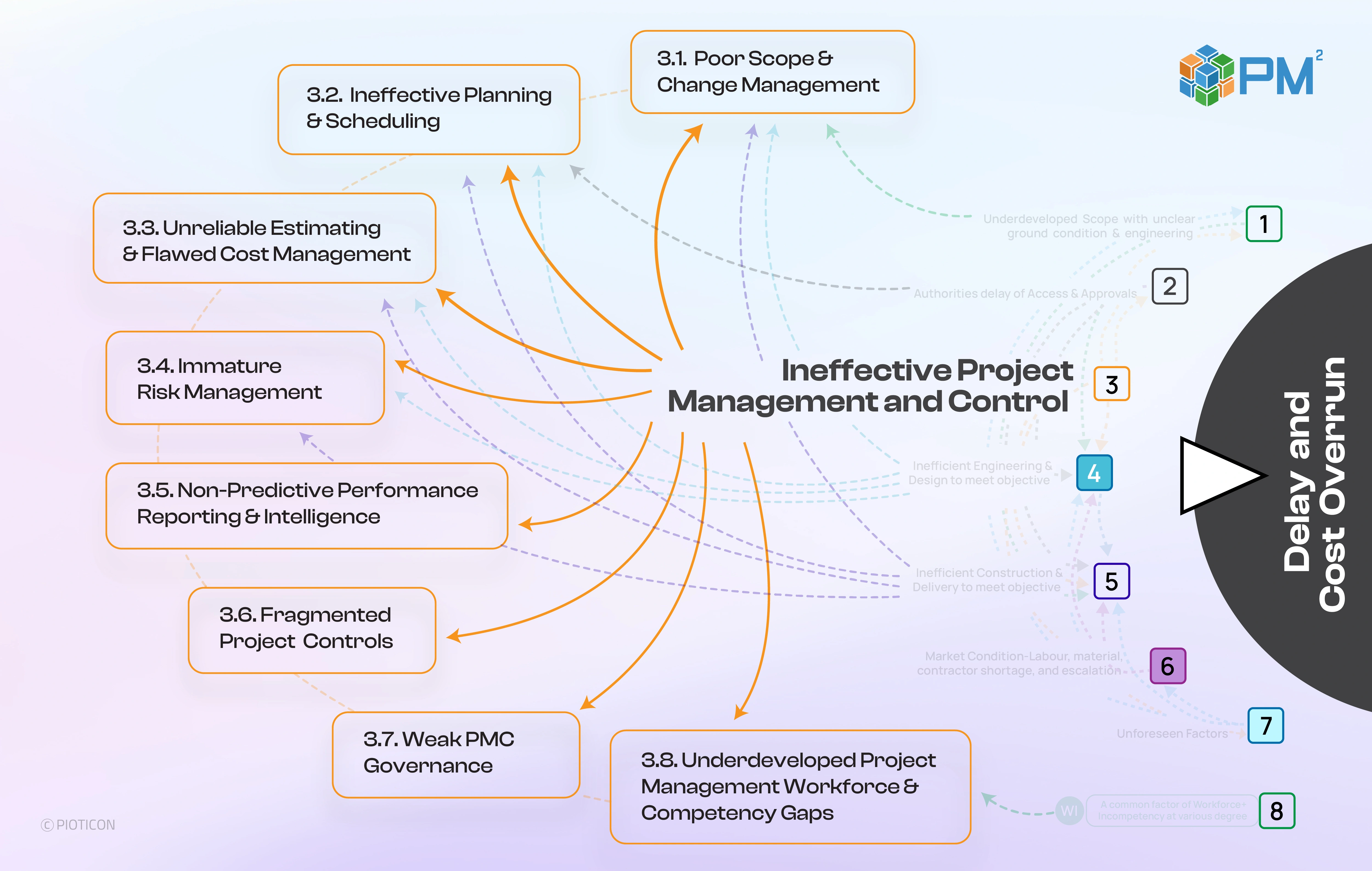
    3.1. Poor Scope & Change Management

    The Problem

    Projects falter early when scope is ill-defined, stakeholders misaligned, and changes flow without analysis. Uncontrolled scope changes result in significant deviations from original baselines, creating cascading effects on cost, schedule, and quality.

    The Root Causes

    1.1 Ill-Defined and Immature Scope at Early Stages

    • Poorly defined scopes, lacking the detail necessary to anchor planning and execution

    1.2 Uncontrolled Scope Changes at Detailed Levels

    • Scope changes occur primarily at detailed levels below Level 2. For instance, while a bridge’s overall length rarely changes, specific scope items and quantum and elements like concrete quantities, machinery hours, or labor requirements often change significantly. The impact of these detailed changes is frequently overlooked
    • Changes are processed without fully analyzing their cost and schedule impacts
    • Insufficient technical competency among Design Engineers, Construction Engineers, and Quantity Surveyors to accurately estimate quantities during both design and execution stages

    1.3 Stakeholder Misalignment and Lack of Requirement Traceability

    • Misaligned expectations between sponsors, end-users, and regulators generate conflicting priorities
    • Limited stakeholder workshops and absence of requirement traceability tools weaken the quality of scope documentation

    1.4 Inadequate Professional Capability in Requirements Management

    • Teams often lack professionals skilled in eliciting and documenting requirements effectively
    • Early optimism, often politically motivated, overrides technical assessments

    1.5 Lack of Formal Gatekeeping and Change Control Processes

    • The absence of formal gatekeeping processes during concept development allows immature scope definitions to proceed unchecked

    The Required Shift

    • Implement an Integrated and Advanced Work Package delivery model
    • Formalize Front-End Loading (FEL) to delay scope freeze until readiness
    • Conduct structured scope alignment workshops at concept stage
    • Institutionalize change control boards that include cost and schedule analysts
    • Coach and Develop professionals to build capability and competency in scope and change management at all levels from board to ground.

    3.2. Ineffective Planning & Scheduling

    The Problem

    Plans often look good on paper but collapse on the field. Projects frequently suffer from schedule slippage, often missing key milestones and ultimately delaying completion.

    The Root Causes

    2.1 Disconnected Top-Down and Bottom-Up Planning
    • Planning is often conducted in isolation without striking an appropriate balance between top-down strategic direction and bottom-up implementation insights.
    2.2 Ineffective Work Breakdown Structure (WBS), Works Package and Integration
    • Continuous changes in scope items compromise optimal execution planning and lead to reduced productivity.
    • Ineffective Work Breakdown Structure (WBS) development results in shallow and incomplete project plans that fail to integrate across scope, schedule, cost, and risk.
    • Deliverable work packages are not well integrated with design, procurement, construction, and completion packages.
    2.3 Exclusion of Contractors and Construction Teams in Planning
    • Construction teams, vendors, and contractors are often excluded from the planning process.
    • Poor coordination of cross-discipline and contractor dependencies weakens schedule realism.
    • In many cases, schedules become overly biased toward construction team details, creating unnecessarily complex schedules that are difficult to manage effectively.
    2.4 Overly Optimistic and Deterministic Scheduling
    • Overly aggressive timelines set to appease stakeholders ignore execution realities.
    • Projects typically operate with overly optimistic deterministic schedules.
    • Probabilistic simulations with quality data of Monte Carlo analysis are rarely used to quantify schedule risk. Even when teams do implement these techniques, they often fail to deliver their intended benefits due to other functions factors.
    • Planners often lack deep project-specific knowledge, resulting in either oversimplified schedules or overly complex, excessively detailed schedules.
    2.5 Plans Used for Reporting, Not Execution
    • Plans are treated as paper exercises for reporting rather than practical execution guides.

    The Required Shift

    • Develop a balanced approach that combines Management top-down and detail bottom-up schedules with input from all stakeholders
    • Implement collaborative planning with effective engagement across Master Schedule to Last Planner System
    • Train Planning and Scheduling professionals in advanced integrated planning and scheduling techniques and interface management
    • Conduct probabilistic schedule risk assessments to develop realistic, risk-adjusted schedules

    3.3. Unreliable Estimating & Flawed Cost Management

    The Problem

    Budgets collapse under poor estimation. Early cost models are often disconnected from design or realistic construction methodology, schedule and resource utilisation or based on outdated data.

    The Root Causes

    3.1 Estimates Based on Incomplete or Evolving Scope

    • Changes in scope items disrupt optimal planning, consequently impacting estimation accuracy and cost control effectiveness
    • Cost estimates and forecasts are built on incomplete or evolving scope definitions, methodology and schedule
    • Insufficient design input at early stages leads to flawed cost assumptions

    3.2 Absence of Market-Based Cost Data and Historical Benchmarking

    • Estimates often lack grounding in current market-tested data
    • Absence of cost databases and parametric models undermines estimate reliability

    3.3 Poor Integration with Engineering and Scheduling Inputs

    • Procurement terms may not align with estimating assumptions
    • Cost estimates are not updated as design matures, leading to outdated financial baselines

    3.4 Arbitrary Contingencies Without Risk-Based Justification

    • Contingency budgets are often arbitrary, lacking structured risk analysis backing

    3.5 Failure to Update Estimates Through Design Maturity

    • Direct labor, machinery and material productivities, and proportionate indirect costs are not tracked effectively

    The Required Shift

    • Improve productivity through cost-effective design and planning, and implement tracking systems to monitor and prevent resource underutilization.
    • Use structured cost estimation maturity models to stage-gate estimate development
    • Align estimating activities with engineering progression gates
    • Build and maintain institutional cost databases that capture historical and market data

    3.4. Immature Risk Management Approaches

    The Problem

    Projects react rather than anticipate. Risks are recorded but rarely drive planning or decision-making.

    The Root Causes

    4.1 Superficial Risk Identification and Assessment

    • Many projects start with superficial risk identification
    • Limited participation across technical, legal, and external expert domains

    4.2 Lack of Quantitative Risk Modelling

    • Risks are not quantitatively modeled to accurately assess financial or schedule impacts

    4.3 Contingency Planning Not Tied to Actual Risk Exposure

    • Contingency allocations are not directly tied to quantified risk exposure

    4.4 Unclear Ownership and Accountability for Mitigation

    • Without clear accountability, mitigation actions fall through the cracks.
    • Many PMOs and Project Management professionals lack staff skilled in quantitative risk analytics to establish an effective action and track to control risk

    4.5 Static Risk Registers Not Aligned to Project Evolution

    • Risk profiles are not dynamically updated as projects evolve

    The Required Shift

    • Institutionalize integrated quantitative risk management across all projects
    • Formally assign risk ownership with clear accountability
    • Link risk exposure directly to contingency setting for more resilient financial planning

    3.5. Non-Predictive Performance Reporting & Intelligence

    The Problem

    By the time bad news surfaces, it’s too late. Reporting is backward-looking and lacks predictive capability.

    Reports provide only basic insights, lacking the forecasting and predictive capabilities necessary for effective decision making.

    The Root Causes

    5.1 Backward-Looking Metrics Focused on Historical Data
    • Metrics often reflect past performance rather than forecasting future trends
    • Early warning systems are rarely deployed.
    5.2 Delayed Reporting Cycles (Monthly/Quarterly)
    • Reliance on monthly or quarterly reporting cycles delays issue visibility
    5.3 Manual, Spreadsheet-Based Tracking Introduces Errors
    • Spreadsheet-based tracking introduces errors and slows data flow
    5.4 Lack of Real-Time Progress and Cost Visibility
    • Real-time data on progress, costs, and risks is often unavailable
    • Fragmented project control software prevents holistic project visibility
    5.5 Underutilization of Business Intelligence Tools
    • Organisations / PMOs lack personnel trained in business intelligence (BI) tools

    The Required Shift

    • Implement integrated digital control systems for real-time data capture
    • Deploy predictive analytics tools to identify emerging risks
    • Train Project Management staff in effectively review performance reporting, business intelligence platforms and analytics

    3.6. Fragmented Project Controls

    The Problem

    Project controls are commonly misunderstood, often confused with just as financial control, commercial management, or field operations controls – largely because these functions operate in isolation without Project Management capability.

    The essential Project Management and Control functions – cost, schedule, risk, and change management – frequently operate without effective communication between them. This critical integrated function is either overlooked or deprioritized by leadership.

    The Root Causes

    6.1 Disjointed Cost, Schedule, Risk, and Change Functions
    • Insufficient Project Management and Control competence for the specific project type and complexity
    • Different disciplines use independent processes and systems
    6.2 Lack of Leadership Recognition of Project Controls’ Value
    • Organizational/Enterprise Leadership often overlooks Project Controls, viewing it as a cost rather than a value-adding function
    • Controls are seen as administrative rather than strategic
    • Control functions operate without sufficient influence
    6.3 No Enterprise-Wide Control System or Process Standards
    • No enterprise-wide project control system definitions exist
    • Control processes are rarely evaluated systematically
    6.4 Insufficient Technical Leadership to Guide Control Strategy
    • Insufficient technical leadership to establish effective Integrated Project Controls.
    • Lack of senior oversight prevents effective control system evolution
    6.5 Limited Professional Development in Control Functions
      • Limited professional development hinders control expertise

    The Required Shift

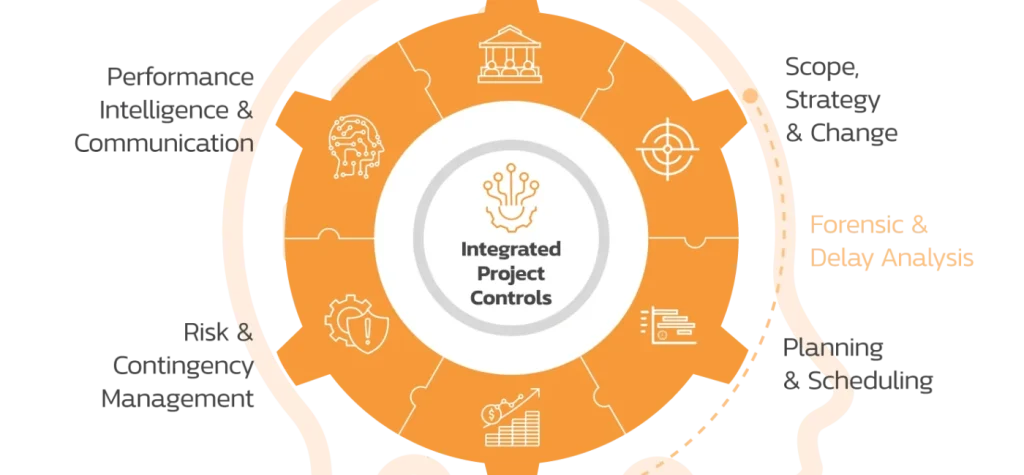
    • Implement an enterprise Integrated Project Controls(IPC) Framework
    • Elevate the PMC function to have clear authority and accountability
    • Build robust career pathways for project controls professionals
    • Conduct regular controls maturity audits to drive continuous improvement

    3.7. Weak PMC Governance

    The Problem

    Project Management Control Governance is often overly biased toward Engineering and Construction execution rather than appropriately balancing project performance to meet stakeholder objectives.

    Project performance metrics for scope, schedule, cost, and risk are frequently misaligned and not set up for success relative to the specific complexity and type of project. Consequently, information flowing to governance bodies lacks meaningful insight for effective decision-making. These reports often serve merely as compliance exercises rather than tools for driving strategic performance management.

    The Root Causes

    7.1 Governance Teams Lack Project Management Control Expertise
    • Governance bodies lack Project Management and Control subject matter expertise
    • Leaders with titles but insufficient technical competence fail to provide proportionate technical leadership
    • Decision makers rely on opinion-based views rather than quality data-driven insights
    7.2 No Clear Mandate or Authority for PMC Professionals
    • PMC professionals often lack clear mandates, operating under diluted authority
    • Responsibility matrix are poorly defined, creating confusion
    7.3 Misalignment of Performance Metrics with Project Complexity
    • PMC effectiveness is rarely measured quantitatively
    • Contracts typically lack outcome-based performance indicators that can be effectively monitored on a regular basis
    7.4 PMC Selection Based on Lowest Cost, Not Capability
    • PMC selection often prioritizes lowest cost over competency
    • There is no formalized assessment of PMC capabilities
    7.5 Lack of Regular Independent Audits or Performance Reviews
    • Third-party audits of PMC performance are rare

    The Required Shift

    • Include Project Management Control expertise in the governance body.
    • Define clear PMC competency standards and integrate them into selection criteria to enroll project management professionals team to deliver projects
    • Implement PMC performance scorecards with quantitative KPIs to steer team with quality questions
    • Conduct independent PMC audits to validate oversight effectiveness

    3.8. Underdeveloped Project Management Workforce & Competency Gaps

    The Problem

    Large-scale infrastructure projects demand more than systems and tools, they need capable people at the core. Yet, across the board, there is a persistent mismatch between the complexity of projects and the competencies of professionals leading them.

    PMC roles are often assigned without rigorous assessment of capability. As a result, critical functions like planning, cost control, and risk management are handled by professionals who may not be equipped for the task not due to lack of intent, but due to lack of structured pathways and standards.ween the complexity of projects and the competencies of professionals leading them.

    The Root Causes

    8.1 No Standardized Capability Framework for PMC Roles

    • No standardised capability frameworks to guide hiring, development, or role allocation.

    8.2 PMC Roles Viewed as Administrative, Not Strategic

    • PMC careers are undervalued, often perceived as administrative rather than strategic.

    8.3 Siloed Skillsets Across Planning, Cost, Risk, and Engineering

    • Cross-functional understanding is missing, creating silos across planning, cost, risk, and engineering.

    8.4 Lack of Leadership and Systems Thinking at Mid/Senior Levels

    • Technical and leadership maturity is lacking, especially in mid and senior roles.

    8.5 Training Focused on Tools Rather Than Functional and Decision-Making Capability

    • Current training prioritises teaching technical tools and software rather than developing deeper functional understanding of project management principles
    • There’s insufficient focus on building decision-making skills that allow PMC professionals to make strategic choices
    • Tool-focused training creates professionals who know how to operate systems but may lack the judgment to interpret results effectively

    The Required Shift

    • Establish clear competency standards and career pathways for PMC roles across all project levels.
    • Invest in structured training and development, beyond tool proficiency — focused on systems thinking and decision-making.
    • Elevate the role of PMC functions, positioning them as equal to engineering and commercial leadership.
    • Promote cross-disciplinary exposure to foster holistic understanding across delivery functions.

    Integrated Solutions Over Isolated Fixes

    Project delays and cost overruns rarely result from a single weak link. They accumulate when interdependent systems underperform without coordination. Isolated fixes may offer temporary relief, but without addressing the underlying connections across planning, controls, governance, and capability, problems resurface in new forms.

    Each PMC sub-cluster both depends on and influences the others:

    • Scope & Change Management sets the baseline, but unstable scope feeds directly into unreliable schedules, cost estimates, and risk buffers.
    • Planning & Scheduling can only hold if scope is mature and risks are quantified; otherwise, timelines collapse and contractors disengage.
    • Estimating & Cost Management relies on realistic planning and design progress, while inaccurate estimates distort governance and reporting.
    • Risk Management must tie into cost and schedule buffers; left standalone, risks become a registry exercise without impact.
    • Performance Reporting needs integrated inputs across scope, cost, and risk to provide foresight, not just backward-looking compliance.
    • Project Controls and Governance must enforce integration across functions, while PMC Competency underpins every cluster with skilled people.

    Beyond PMC, delays in Access & Approvals, frequent Scope Changes, or inefficiencies in Design & Construction all ripple into PMC processes. At the same time, weak PMC disciplines amplify failures across these clusters.

    Sub-Clusters Integrated Solution Focus
    Scope & Change Management Anchor planning through mature scope and aligned change control
    Planning & Scheduling Institutionalize Link execution logic with risk exposure and interface inputs
    Estimating & Cost Management Develop living estimates that evolve with changes in scope and emerging risks
    Risk Management Tie risk outputs to schedule float and contingency buffers
    Performance Reporting Build intelligence systems that cut across cost, time, scope, and earned value
    Fragmented Project Controls Break silos and report cumulative impact across functions
    PMC Governance Hold oversight teams accountable to integrated performance, not just siloed metrics
    PMC Competency Build a capable workforce with aligned technical depth, delivery mindset, and leadership clarity

    In addition, PMC is not self-contained. Its effectiveness is shaped by the other seven clusters of project performance (as outlined in Pioticon’s holistic model). For example:

    • When Scope keeps changing, baselines collapse and planning becomes unreliable.
    • When Access & Approvals slip, schedules stall and workforce capability is undercut.
    • When Design & Construction is inefficient, estimates and risk buffers lose validity.

    PMC not only absorbs these shocks but also amplifies them if its own sub-clusters are weak. This makes integration across all eight clusters essential for sustainable project performance.

    Conclusion: Integration Is the Only Real Strategy

    Project failure is not born of individual errors. It emerges when systems are misaligned, decisions are made in silos, and functions operate without shared purpose.

    Leaders must resist the temptation of isolated fixes. Addressing risk without controls, or scope without planning, guarantees only partial progress.

    Sustainable improvement will come only when organizations commit to integration across capabilities, tools, teams, and timelines.

    Project excellence is not a product of control in one area. It is a result of unified oversight, collaborative intelligence, and synchronized execution.

  • Breaking Through Bureaucracy: Root Cause Analysis of Authorities Delay of Access & Approvals in Infrastructure Projects

    Breaking Through Bureaucracy: Root Cause Analysis of Authorities Delay of Access & Approvals in Infrastructure Projects

    Infrastructure projects drive economic progress and national development. Delays in gaining access and securing approvals from authorities, however, remain one of the biggest threats to timely execution. These delays raise project costs, weaken investor confidence, and lead to public dissatisfaction. Understanding the root causes is critical to finding long-term solutions.

    Symptom: Delay in Authorities’ Access and Approvals

    At the surface level, the delays present as:

    • Prolonged, unpredictable, or inconsistent approval processes
    • Delayed land access or site handovers
    • Regulatory reviews that extend without clarity

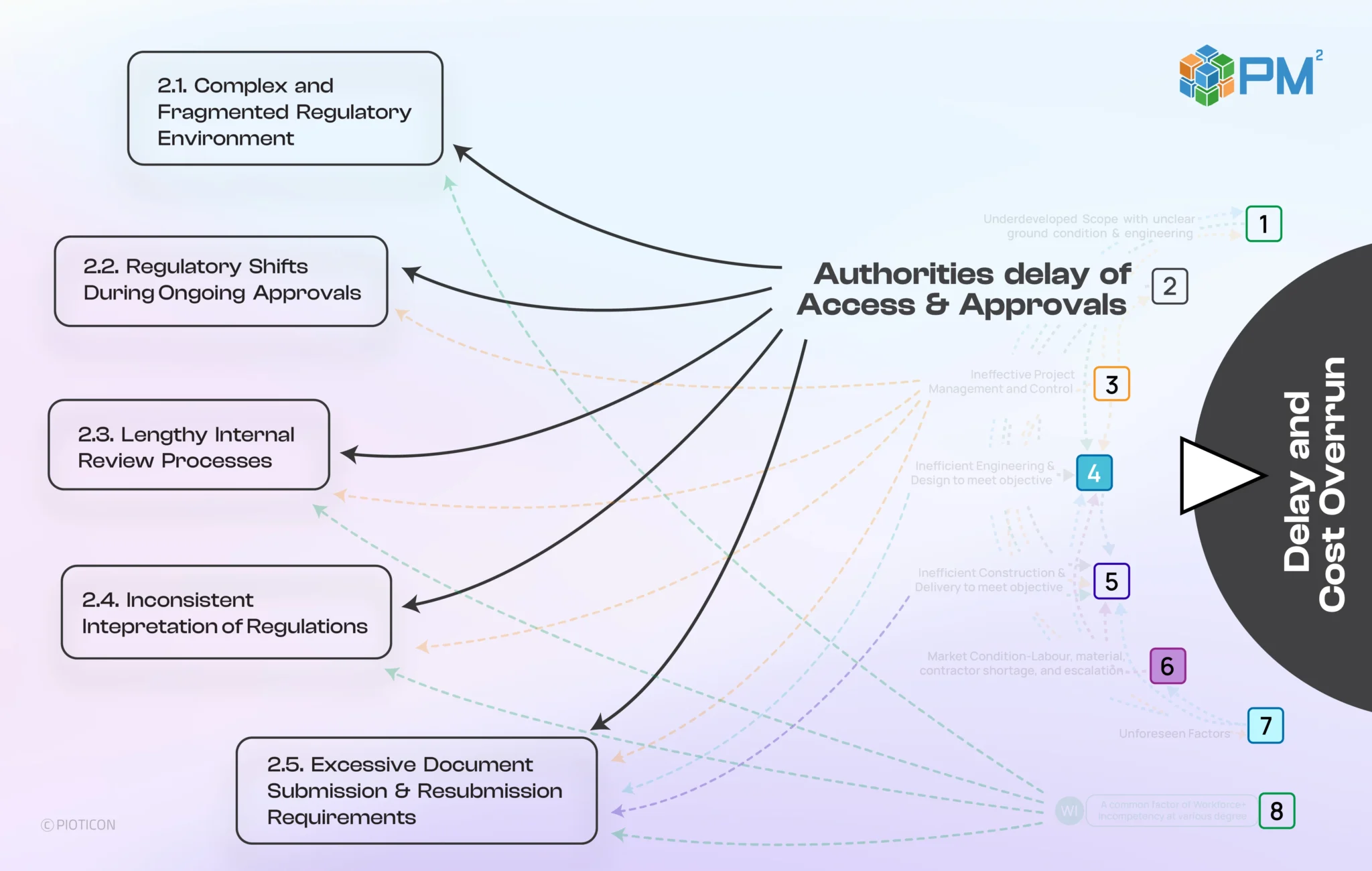
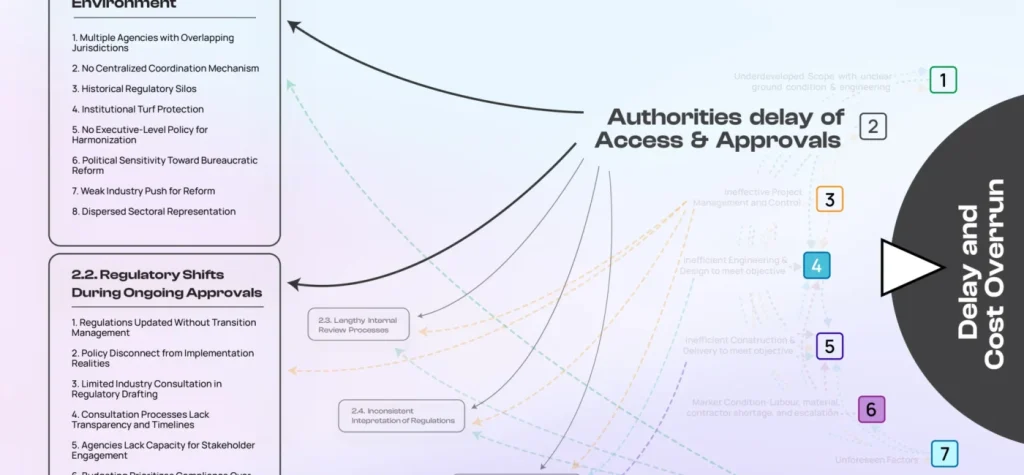
    2.1. Complex and Fragmented Regulatory Environment

    1. Multiple Agencies with Overlapping Jurisdictions

    Most infrastructure projects need clearance from various departments including environment, transport, urban development, and utilities. Each one follows different rules and timelines. This creates:

    • Duplication of paperwork
    • Conflicting requirements
    • Delayed coordination

    2. No Centralized Coordination Mechanism

    Without a unified command center to coordinate the various agencies involved, project delivery teams must navigate a complex bureaucratic maze independently.
    • Agencies rarely synchronize their processes
    • There is no “single window” where applications can be processed collectively

    3. Historical Regulatory Silos

    Many agencies work under outdated laws created without anticipating the complexity of modern infrastructure. These silos reduce collaboration.
    • Each agency protects its mandates
    • Cross-agency coordination is limited by legal autonomy

    4. Institutional Turf Protection

    Agencies resist sharing authority due to fear of losing control over budget, staff, and relevance. This leads to fragmented decision-making.

    5. No Executive-Level Policy for Harmonization

    In the absence of higher-level mandates, coordination between departments remains optional rather than required.

    6. Political Sensitivity Toward Bureaucratic Reform

    Attempts to restructure longstanding bureaucracies face internal resistance and political hesitation.

    7. Weak Industry Push for Reform

    Industry stakeholders often face these issues alone. Few collective platforms exist to lobby for systemic reform.

    8. Dispersed Sectoral Representation

    Each industry (power, housing, transport) has its own associations. This weakens their combined influence.

    Mitigation: Executive-Led One-Stop Clearance Bodies

    • Create centralized approval offices under executive mandate
    • Build digital platforms for cross-agency coordination and real-time tracking
    • Enforce fixed decision timelines with service-level agreements

    2.2. Regulatory Shifts During Ongoing Approvals

    1. Regulations Updated Without Transition Management

    New regulations are often applied to projects already in the pipeline, forcing redesigns and resubmissions.
    • Retroactive application of new laws disrupts planning certainty
    • Lack of “grandfathering” provisions undermines investor confidence

    2. Policy Disconnect from Implementation Realities

    Policymakers craft new regulations without consulting people responsible for execution and not understanding project-level implications, causing misalignment.

    3. Limited Industry Consultation in Regulatory Drafting

    When industry feedback is requested, it often arrives too late to influence final policies.

    4. Consultation Processes Lack Transparency and Timelines

    Stakeholders are not given adequate time or visibility to prepare for new rules.
    • Public notice periods may be short
    • Stakeholders may not even be aware of consultation opportunities

    5. Agencies Lack Capacity for Stakeholder Engagement

    Resource constraints limit proactive, meaningful engagement with industry, especially for technical or large-scale projects.

    6. Budgeting Prioritizes Compliance Over Stakeholder Relations

    Stakeholder engagement is often treated as a secondary activity compared to regulatory enforcement.

    7. Leadership KPIs Focus on Rule Enforcement

    Agency success is typically measured by volume of regulations issued or enforced, not by industry satisfaction or practical implementation.

    Mitigation: Transparent Regulatory Impact Assessment

    • Mandate public consultation for all new rules
    • Run technical and economic impact assessments
    • Pilot major rules through sandbox environments before full rollout

    2.3. Lengthy Internal Review Processes

    1. Limited Technical Expertise or Staff Capacity

    Many regulatory agencies lack qualified staff and relevant skills to review modern infrastructure proposals efficiently. Specialists such as environmental scientists, transport modelers, or safety engineers are in short supply.

    2. Talent Retention Issues

    Public sector roles struggle to attract and retain talent due to lower pay and slower growth compared to private sector that often offers better compensation, career prospects, and work environments.

    3. Rigid Government Hiring Practices

    In many countries, Civil service recruitment is often governed by:
    • Lengthy recruitment processes
    • Rigid qualification criteria
    • Seniority-based promotion systems

    4. Uncompetitive Compensation Structures

    Pay grades are not adjusted for high-demand technical roles, widening the talent gap.

    5. Budget Constraints

    Agency budgets often shrink or stagnate even as project volumes increase.

    6. Legislative Funding Disconnect from Agency Workloads

    Government appropriations rarely consider project complexity or volume when assigning funds.

    7. No Performance-Based Budgeting

    Agency funding models lack performance incentives for reducing approval backlogs.

    Mitigation: Build Professional Regulatory Cadres

    • Introduce technical career tracks within regulatory agencies
    • Align budgets with project volumes and technical complexity
    • Offer competitive pay for critical skills

    2.4. Inconsistent Interpretation of Regulations

    1. Absence of Unified Guidelines

    Many regulations are vague, leaving wide room for individual interpretation by different reviewers.

    2. Vague Legal Language

    Rules are often written with broad language, which allows flexibility but causes inconsistency.

    3. Drafting Without Field Input

    Legal and policy teams draft rules with minimal input from technical reviewers.

    4. Silos Within Agencies

    Legal, technical, and administrative divisions work in isolation without coordination.

    5. No Incentives for Internal Reform

    Agency leadership is rarely rewarded for improving process quality or consistency.

    6. External Oversight Focuses on Output

    Legislative and executive oversight often emphasizes quantity of regulations rather than user experience.

    Mitigation: Standardized Guidelines and Shared Knowledge

    • Create standard operating procedures with examples
    • Build internal platforms for case-sharing and interpretation
    • Form multidisciplinary policy-drafting teams

    2.5. Excessive Document Submission & Resubmission Requirements

    1. Lack of Digital Systems

    Manual, paper-based submissions increase chances of document loss and duplication.

    2. Underinvestment in IT Infrastructure

    Permitting departments often operate with outdated technology or none at all.

    3. Lower Priority for Internal Services

    Permitting functions receive less attention compared to citizen-facing digital services.

    4. Limited Awareness of Economic Impact

    Decision-makers often overlook how delays damage investment flows and GDP.

    5. No Metrics for Delay Cost

    Very little data exists on the cost of delays to the economy or businesses.

    6. Disconnect Between Economic and Regulatory Agencies

    Lack of coordination weakens the link between competitiveness goals and regulatory reforms.

    7. Absence of Efficiency Mandates

    Regulatory performance rarely forms part of national competitiveness strategy.

    Mitigation: Complete Digitalization of Permitting

    • Launch online portals for document submission, progress tracking, and issue resolution
    • Automate internal workflows for faster routing and accountability
    • Apply AI tools for preliminary reviews and quality checks

    Cross-Cutting Solutions: A Holistic Path Forward

    Fixing permitting delays cannot stand alone. Each solution must connect with other systemic levers across the project lifecycle to prevent cascading cost and schedule overruns. The following integrated pathways highlight how Access & Approvals reforms interface with other critical clusters of PM²:

    Executive-Led One-Stop Clearance Bodies and Digital Portals

    Streamlines fragmented governance while directly strengthening governance and stakeholder management (Cluster 7), ensuring agencies and industry align under unified service-level agreements.

    • Transparent Regulatory Impact Assessments and Consultation Frameworks
      Builds predictability in the policy environment and reduces retroactive disruptions, while reinforcing planning and readiness (Cluster 1) by giving project teams greater certainty on compliance pathways.
    • Professionalized Regulatory Cadres and Capacity-Building Programs
      Expands agency capability and retention, directly linking with workforce capability (Cluster 8). Skilled, adequately resourced regulators accelerate reviews and reduce inconsistencies.
    • Unified SOPs and Internal Knowledge-Sharing Platforms
      Standardizes interpretation of regulations across departments, supporting risk management (Cluster 4) by reducing ambiguity and dispute potential while feeding into governance and learning (Cluster 7).
    • End-to-End Digitalization of Permitting Systems
      Automates submission, review, and tracking while integrating with performance reporting and intelligence (Cluster 5). This not only improves visibility of delays but also enables predictive analytics for bottleneck resolution.

    Challenge Area

    Recommended Solution

    Fragmented Governance

    Create Executive One-Stop Shops for integrated permitting

    Policy Uncertainty

    Institutionalize Regulatory Impact Assessment and transparent consultations

    Agency Capacity Constraints

    Invest in Professionalization, Competitive Pay, and Capacity Building

    Inconsistent Interpretations

    Develop Unified SOPs and Internal Knowledge Bases

    Manual, Inefficient Systems

    Fully Digitalize Permitting Processes end-to-end

    Why Integration Matters

    Addressing Access & Approvals in isolation only shifts the bottlenecks elsewhere. Each recommendation reinforces not only this cluster but also the wider ecosystem of planning readiness, risk management, governance, workforce capability, and performance intelligence. Only by treating these interdependencies as one connected system can infrastructure projects break free from chronic bureaucratic delays and deliver outcomes at pace.

    Conclusion

    Delays in securing access and approvals remain one of the most significant risks in infrastructure delivery. These are not isolated or accidental failures. They stem from systemic issues that require sustained, executive-level attention.

    Countries that treat regulatory efficiency as a competitiveness issue can attract faster investment, accelerate public benefits, and build stronger public-private trust. The choice lies not only in project execution strategies but also in structural commitment to better governance.

  • Underdeveloped Scope with Unclear Ground Condition and Engineering: A Deep Dive into Root Causes and Solutions

    Underdeveloped Scope with Unclear Ground Condition and Engineering: A Deep Dive into Root Causes and Solutions

    Major infrastructure projects continue to face one persistent and costly problem: underdeveloped scope combined with unclear ground conditions and immature engineering practices. This issue is not confined to one country or sector; it appears repeatedly across geographies, budgets, and delivery models. Budget overruns, delays, disputes, and even outright failures all trace back to these foundational weaknesses.

    The discussion usually focuses on surface symptoms like, budget blowouts and schedule slips, but these are merely the outcomes of deeper structural and behavioral issues. A closer look reveals that these problems arise long before the first shovel touches the ground.

    The Visible Symptom: Underdeveloped Scope and Unclear Ground Conditions

    Many leaders and teams first notice these problems only after execution begins. By that point, incomplete scopes and vague ground data have already introduced hidden risks into the project. Teams then scramble to solve issues that could have been avoided with more rigorous preparation.
    Projects often move into execution phases with incomplete scopes. Key information on ground conditions remains missing or generalized. Engineering assumptions are based on minimal evidence, and contingency planning often lacks rigor.
    Some uncertainty is expected early on. However, many projects advance with a level of ambiguity far beyond what should be acceptable. Risks become embedded into the project from the outset, making future challenges unavoidable.
    These symptoms do not emerge by accident. They result from a set of root causes embedded in governance, financial incentives, organizational culture, and decision-making processes.

    1.1. Incomplete Early Stage Site Investigation

    The Initial Chain of Causes

    Insufficient site investigation during feasibility and pre-design phases stands as a primary contributor. Essential activities such as geotechnical surveys, environmental assessments, and detailed topographical studies are either minimized or entirely skipped.
    Several systemic factors drive this behavior:
    1. Limited Funding and Compressed Budgets Sponsors frequently restrict early-stage spending. Comprehensive site investigations require significant upfront investment, and decision-makers often hesitate to commit before full project approvals.
    2. Pressure for Fast-Track Approvals Sponsors prioritize early green lights to secure funding or meet political and regulatory promises. Project readiness often takes a back seat.
    3. Misaligned Incentives Project leaders receive recognition for achieving initial approvals rather than ensuring robust technical readiness. This misalignment pushes teams to rush.
    4. Milestone-Driven Governance Structures Approval frameworks emphasize stage-gate milestones rather than actual readiness, allowing projects to proceed despite unresolved technical gaps.
    5. Weak Independent Reviews The absence of strong third-party validations leaves scope and technical assessments unchecked.
    6. Cultural Acceptance of Uncertainty Many organizations hold a belief that unknowns can be managed later, underestimating future impact.
    7. Optimism Bias and High-Risk Appetite Overconfidence in later-stage problem-solving often leads to freezing scope prematurely.

    The Solution

    Front-end loading (FEL) processes with strict readiness criteria set a stronger foundation. Independent scope and site validations before approvals ensure critical risks are addressed. Incentive structures should reward thoroughness and technical quality rather than speed alone.
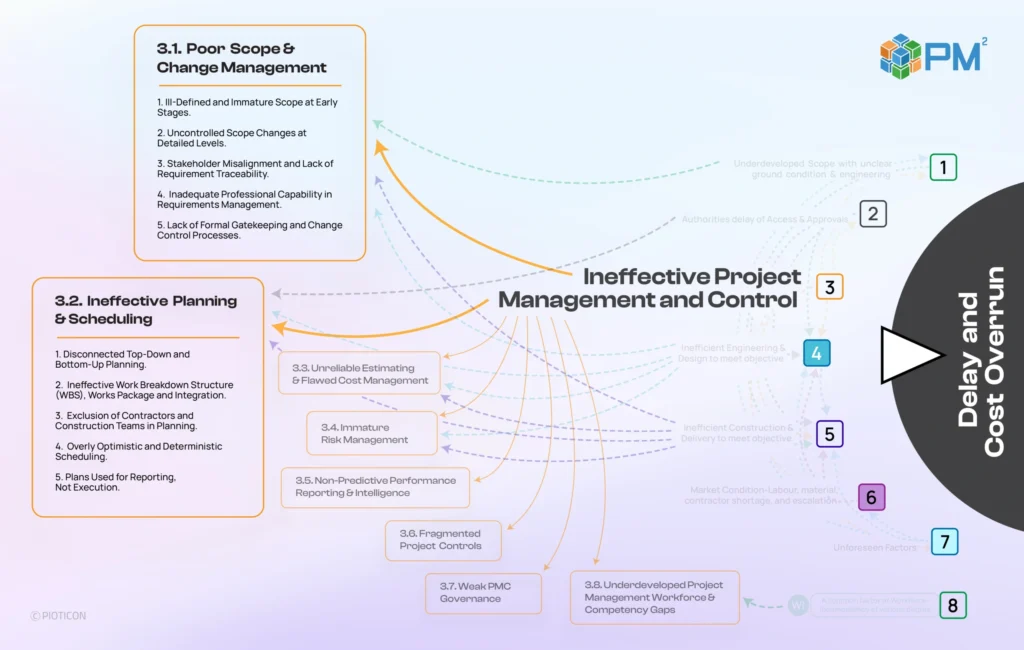
    1.2. Poor Interdisciplinary Coordination

    The Fragmentation Challenge

    Disciplines such as geotechnical, civil, environmental, and structural engineering frequently work in silos. Gaps between these areas create conflicting assumptions and elevate risks.

    Several reasons drive this fragmentation:

    1. Siloed Organizational Structures
      Departments operate as isolated units, reducing information flow and collaboration.
    2. Absence of Integrated Digital Platforms
      Critical data remains trapped in disconnected systems without a unified view.
    3. Legacy Processes
      Reliance on outdated document transfers stifles dynamic design evolution.
    4. Resistance to Digital Adoption
      Teams often hesitate to embrace new systems like BIM or GIS, viewing them as optional rather than essential.
    5. Inadequate Training and Change Support
      Teams receive insufficient guidance and support to adopt new practices effectively.
    6. Leadership Underestimation
      Senior leaders sometimes treat digital transformation as an IT task instead of a core strategic shift.
    7. Limited Investment in Capability Building
      Budgets focus heavily on delivery at the expense of internal capability and digital maturity.

    The Solution

    Mandating integrated digital platforms improves transparency and cross-disciplinary alignment. Investment in comprehensive training and change support builds true adoption. Leaders must treat digital enablement as a central business strategy rather than a side initiative.

    1.3. Limited Access to Historical Data

    The Data Deficit

    Many projects start without access to valuable data from earlier studies or nearby projects, forcing teams to rebuild knowledge from scratch.

    Key reasons for this gap include:

    1. Fragmented Data Ownership
      Data resides across different private and public entities, making access difficult.
    2. Absence of Centralized Repositories
      National or regional infrastructure data repositories are rare or nonexistent.
    3. Lack of Policy Frameworks
      Without clear regulations, data sharing remains inconsistent and discretionary.
    4. Legal and Commercial Barriers
      Concerns around liability and intellectual property discourage open data sharing.
    5. No Standardized Legal Protections
      Absence of consistent agreements makes data custodians hesitant to release valuable information.
    6. Short-Term Political Focus
      Leaders prioritize quick wins over systemic improvements, leaving data strategies neglected.
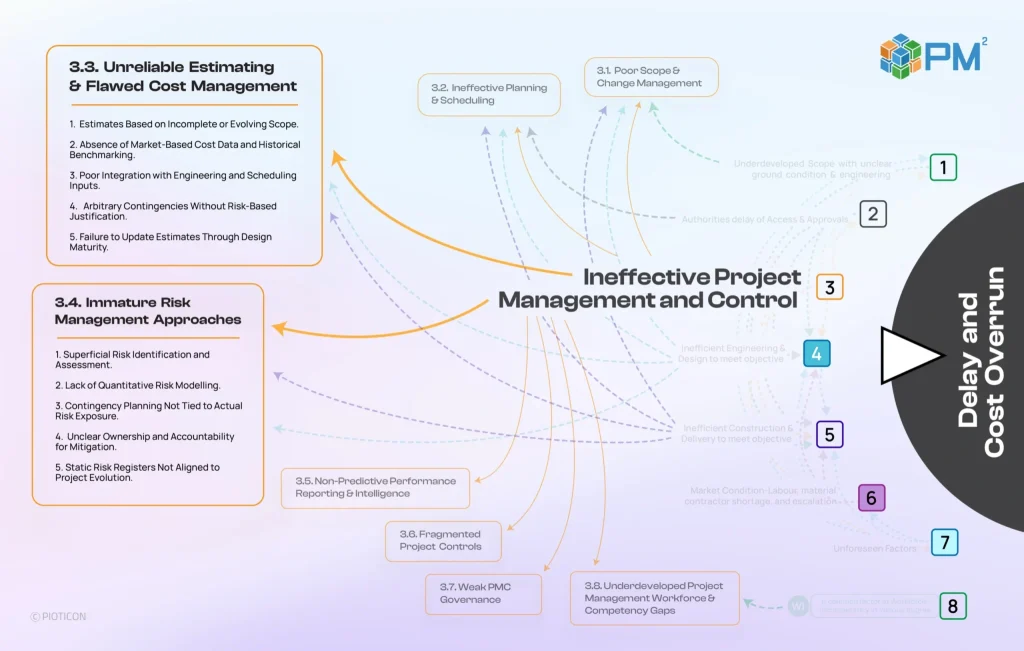
    7. Weak Industry Pressure for Reform
      Stakeholders rarely push hard enough for collective data sharing reforms.

    The Solution

    Establishing national infrastructure data repositories with mandatory submission requirements supports transparency. Developing legal frameworks ensures safe and fair data sharing. Tying data compliance to funding or permit approvals encourages participation.

    1.4. Inadequate Subsurface Risk Modeling

    Blind Spots in Modeling

    Available data often receives simplistic treatment, leading to unrealistic assumptions or overly conservative designs.

    Key reasons for weak subsurface modeling include:

    1. Simplistic or Conservative Approaches
      Teams may oversimplify or adopt overly cautious assumptions due to confidence gaps.
    2. Underuse of Advanced Tools

       Tools, techniques and skills to accurately perform 3D geotechnical modeling and probabilistic risk analysis remain inadequate.

    3. Shortage of Specialized Expertise

       Skilled professionals in advanced geotechnical modeling are in limited supply.
    4. Low Priority for Geotechnical Work
      Compared to other engineering disciplines, geotechnical input often receives less attention and investment.
    5. Procurement Focus on Lowest Cost
      Tender processes reward cheaper options instead of thorough technical analysis.
    6. Contract Evaluations Emphasize Price
      Procurement scoring frameworks undervalue technical rigor.
    7. Procurement Misalignment with Lifecycle Risk
      Short-term cost focus disregards long-term risk exposure.

    The Solution

    Organizations should mandate advanced geotechnical modeling early, invest in 3D modeling training, use probabilistic risk analysis, and elevate geotechnical work’s importance. Procurement frameworks must prioritize technical submissions. Requiring advanced risk modeling in feasibility phases strengthens project readiness. Moving evaluations beyond price toward lifecycle value reduces future overruns and delays.

    1.5. Frequent Scope Revisions During Construction

    The Cascade of Unknowns

    Unforeseen ground conditions force redesigns mid-construction, driving up costs and timelines.

    Key reasons for ongoing scope changes include:

    1. Lack of Early Utility Mapping
      Inadequate investment in tools like GPR and LiDAR leaves subsurface surprises.
    2. Reluctance to Spend on Early Detection
      Decision-makers consider upfront investigations an unnecessary expense.
    3. Underestimation of Variation Costs
      Many organizations fail to appreciate the true cost impact of late-stage changes.
    4. No Structured Cost-Benefit Analysis
      Few institutions compare early detection investment against potential redesign costs systematically.
    5. Absence of Formal VOI Studies
      Projects rarely quantify the benefits of better information before construction.
    6. Qualitative Treatment of Ground Risks
      Risks appear as generic entries in registers without quantified impacts.
    7. Optimism in Early Estimates
      Understated risks help secure approvals but undermine delivery integrity.

    The Solution

    Mandating VOI studies in planning phases quantifies early information value. Quantitative ground risk registers throughout design and construction phases support realistic decision-making. Frameworks comparing early and late-stage cost impacts help stakeholders make informed investments upfront.

    Cross-Cutting Recommendations: Linking Scope to the Wider Delivery System

    Fixing underdeveloped scope cannot stand alone. Each solution must connect with other systemic levers across the project lifecycle to prevent overruns and delays. The following integrated pathways highlight how scope-related reforms interface with other critical clusters of PM²:
    • Front-End Loading (FEL) and Independent Readiness Reviews Strengthens early project assurance and ensures that authorities’ approvals (Cluster 2) are based on realistic, fully validated baselines, reducing late-stage regulatory challenges.
    • Integrated Digital Engineering Platforms and Leadership Alignment Improves coordination between disciplines while simultaneously feeding accurate, real-time data into performance reporting and intelligence systems, breaking silos and enabling predictive insights.
    • National Infrastructure Data Repositories and Legal Frameworks Enhances not only early scope development but also supports risk management (Cluster 4) and future project benchmarking, creating an institutional knowledge base for ongoing PMC governance (Cluster 7).
    • Advanced Geotechnical Modeling and Risk-Based Procurement Reform Directly improves subsurface risk management while ensuring procurement decisions align with broader integrated project control standards (Cluster 6), preventing lowest-cost bias from undermining delivery.
    • Institutionalized Value of Information (VOI) Studies and Quantitative Ground Risk Registers Provides a structured approach to weighing early detection costs against late-stage redesign impacts, directly linking with risk buffers in planning and scheduling (Cluster 3) and ensuring better control over change management (Cluster 1).

    Why Integration Matters

    Addressing scope in isolation only shifts the problem elsewhere. Each recommendation reinforces not only the cluster of underdeveloped scope but also the broader ecosystem of approvals, controls, risk management, and governance. Only by treating these interdependencies as one connected system can major projects break the cycle of overruns and deliver outcomes that match ambition.

    Challenge

    Solution

    Incomplete Scope

    Front-End Loading (FEL), independent readiness reviews, governance reform

    Poor Interdisciplinary Coordination

    Integrated digital engineering platforms, capability-building, leadership alignment

    Data Access Gaps

    National infrastructure data repositories, legal frameworks for data sharing

    Weak Subsurface Modeling

    Advanced geotechnical modeling requirements, procurement reform

    Costly Scope Revisions

    Institutionalized VOI studies, quantitative ground risk management

    Conclusion

    Project failures do not arise from random technical errors or delivery team missteps alone. They are rooted in a systemic failure to connect realistic early-stage assumptions with market realities, workforce capacity, and delivery frameworks.
    Technical excellence in construction remains strong, but consistent failure to meet budget and time commitments signals a deeper structural problem.
    Successful outcomes depend on reforming how projects are scoped, awarded, and managed. Leadership courage, not technical knowledge, stands as the true barrier to progress.
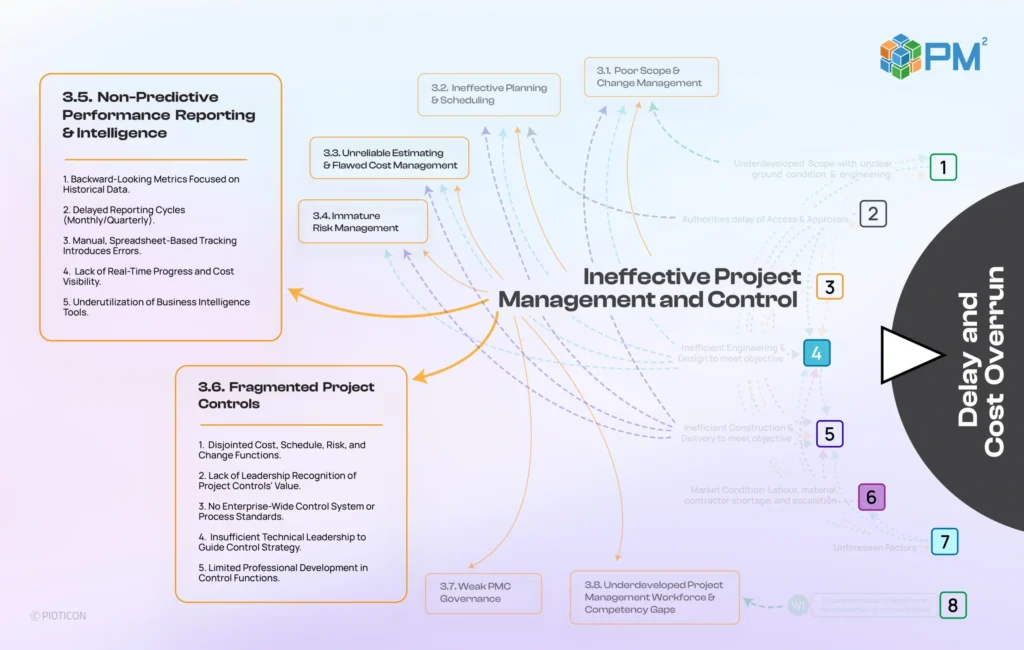
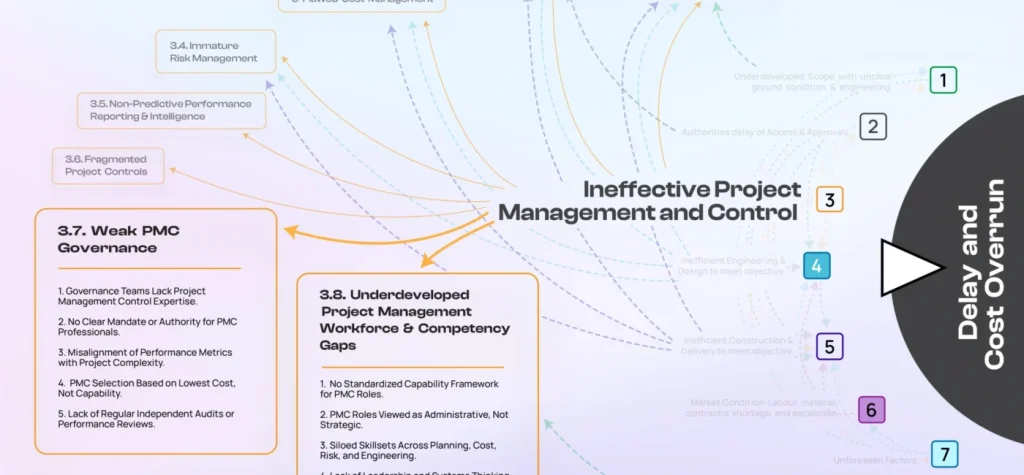
    Shifting from a focus on isolated problems to a comprehensive, systemic understanding offers the only path to bridging the gap between project ambition and actual delivery.