Breaking the Cycle of Delays and Overruns: A Root Cause Analysis of Construction & Delivery Inefficiency
The Symptom: Delivery Breakdown on the Field
- Missed milestone dates
- Rising costs and resequencing
- High frequency of rework and NCRs
- Safety or Environmental incidents causing shutdowns
- Disputes between contractors, subcontractors, and owners
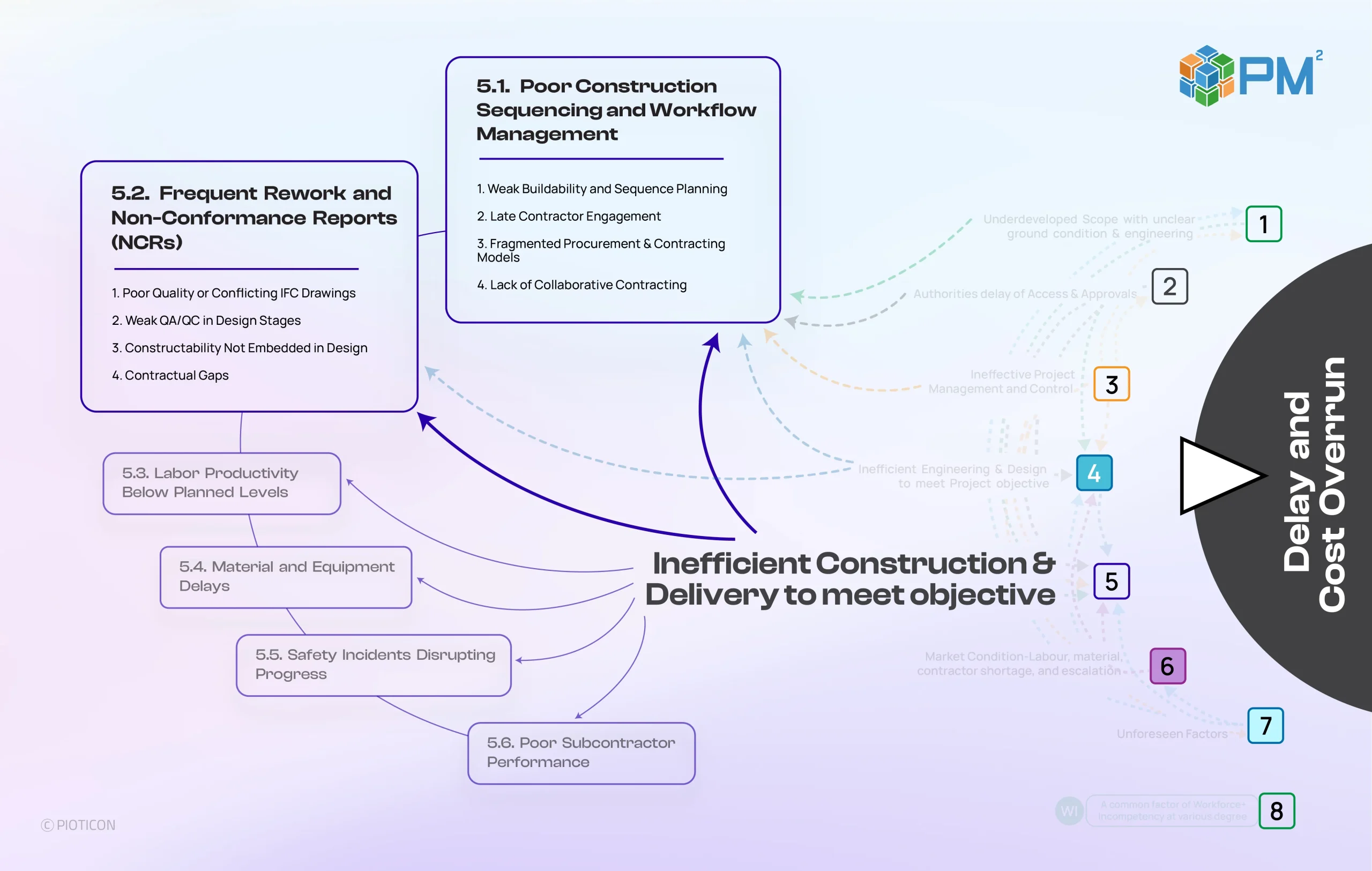
5.1. Poor Construction Sequencing and Workflow Management
The Problem
The Root Causes
1.1 Weak Buildability and Sequence Planning
- Limited use of Expert knowledge and effective technology (4D/5D models) to test constructability
- Engineering deliverables not aligned with field execution logic
- Buildability risks identified late in the cycle
1.2 Late Contractor Engagement
- Contractors brought in after design completion
- Practical field insights missing during sequencing
- Key construction constraints ignored in planning
1.3 Fragmented Procurement & Contracting Models
- Design–Bid–Build reinforces siloed hand-offs
- No framework for early collaboration or integrated solutions
- Lowest-cost tendering suppresses innovation
1.4 Lack of Collaborative Contracting
- Limited use of frameworks like Integrated Project Delivery or Alliancing
- Risk-averse policies discourage alternate sequencing approaches
The Required Shift
- Adopt collaborative procurement frameworks that enable effective early contractor involvement
- Integrate technology into planning and constructability reviews
- Shift bid evaluation toward value creation and buildability, not just cost
5.2. Frequent Rework and Non-Conformance Reports (NCRs)
The Problem
The Root Causes
2.1. Poor Quality or Conflicting IFC Drawings
- Drawings lack maturity or contain coordination errors
- Conflicts discovered only during execution
2.2. Weak QA/QC in Design Stages
- Compressed design timelines reduce design review quality
- Early starts push incomplete packages to site
2.3. Constructability Not Embedded in Design
- Field insights not integrated into engineering reviews
- Confusion over who verifies constructability
2.4. Contractual Gaps
- No penalties for design errors discovered on site
- Accountability diffuse across design and build team
The Required Shift
- Institutionalize interdisciplinary constructability reviews with design and field teams
- Enforce design QA/QC gates within project governance
- Tie contractor and designer incentives to quality and constructability KPI
- Use digital common data environments to maintain version control and traceability
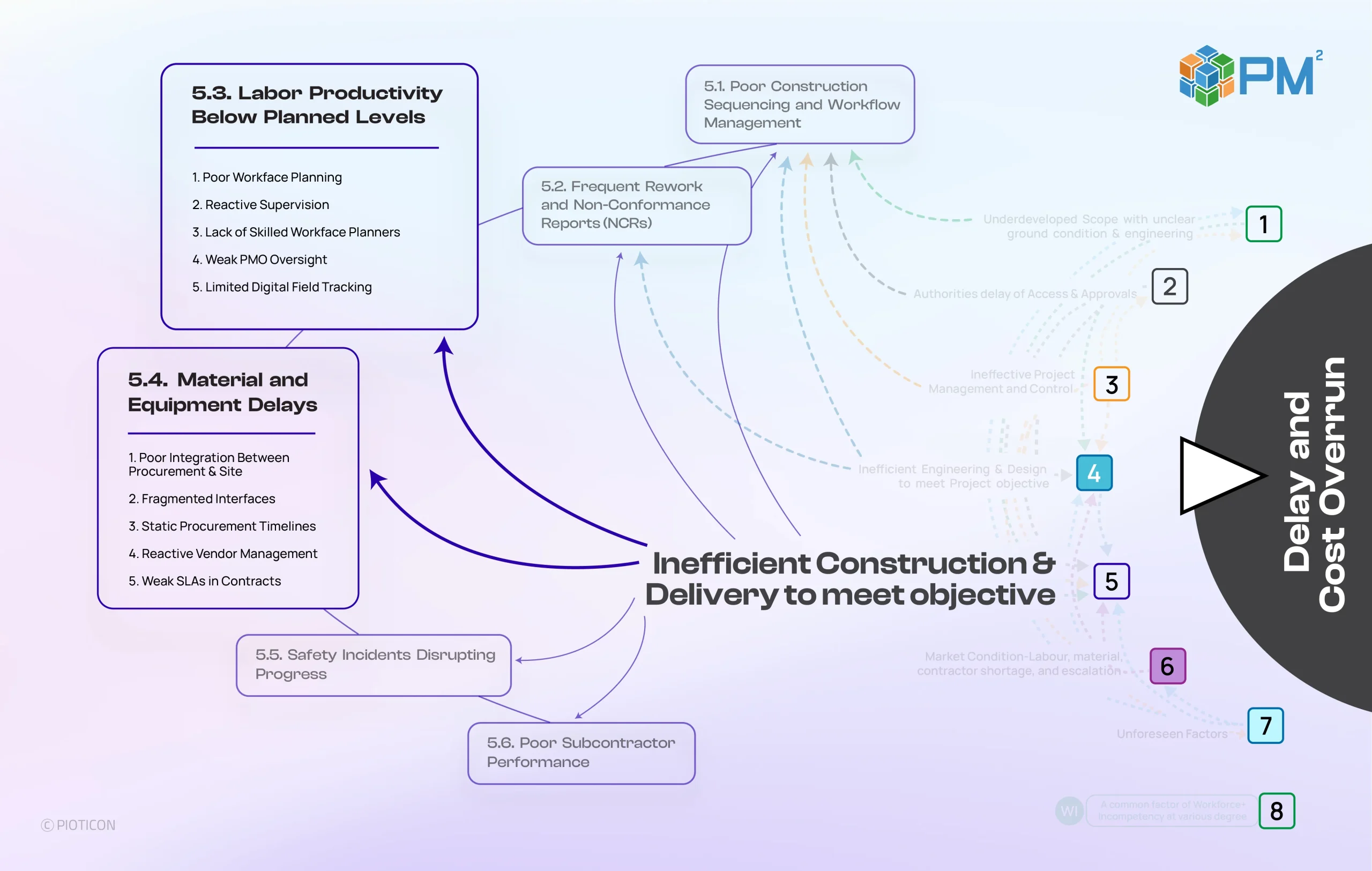
5.3. Labor Productivity Below Planned Levels
The Problem
The Root Causes
3.1. Poor Workface Planning
- Crews lack timely access to materials, tools, and work front
- Constraint analyses are irregular or missing
3.2. Reactive Supervision
- Supervisors rely on informal planning
- No standardized work package processes
3.3. Lack of Skilled Workface Planners
- No certification or structured training for workface planning roles
3.4. Weak PMO Oversight
- No governance over work package readiness or performance KPIs
3.5. Limited Digital Field Tracking
- Productivity measured manually with outdated tools
- Real-time issues not escalated quickly
The Required Shift
- Implement Advanced Work Packaging (AWP) governed by a central PMO
- Deploy digital field-execution platforms for real-time productivity tracking
- Establish daily constraint-free work packages and monitor through dashboards
5.4. Material and Equipment Delays
The Problem
The Root Causes
4.1. Poor Integration Between Procurement & Site
- Procurement decisions not synchronized with field progress
- No dynamic planning for material requirements
4.2. Fragmented Interfaces
- Weak coordination between engineering, procurement, and construction
4.3. Static Procurement Timelines
- Plans do not adjust to site progress or design maturity
4.4. Reactive Vendor Management
- Vendor performance tracked only after delays occur
4.5. Weak SLAs in Contracts
- Performance metrics not embedded in procurement agreements
The Required Shift
- Develop integrated supply-chain systems linked to construction schedules
- Use vendor scorecards and dashboards for proactive monitoring
- Embed service-level agreements and reliability metrics in procurement contracts
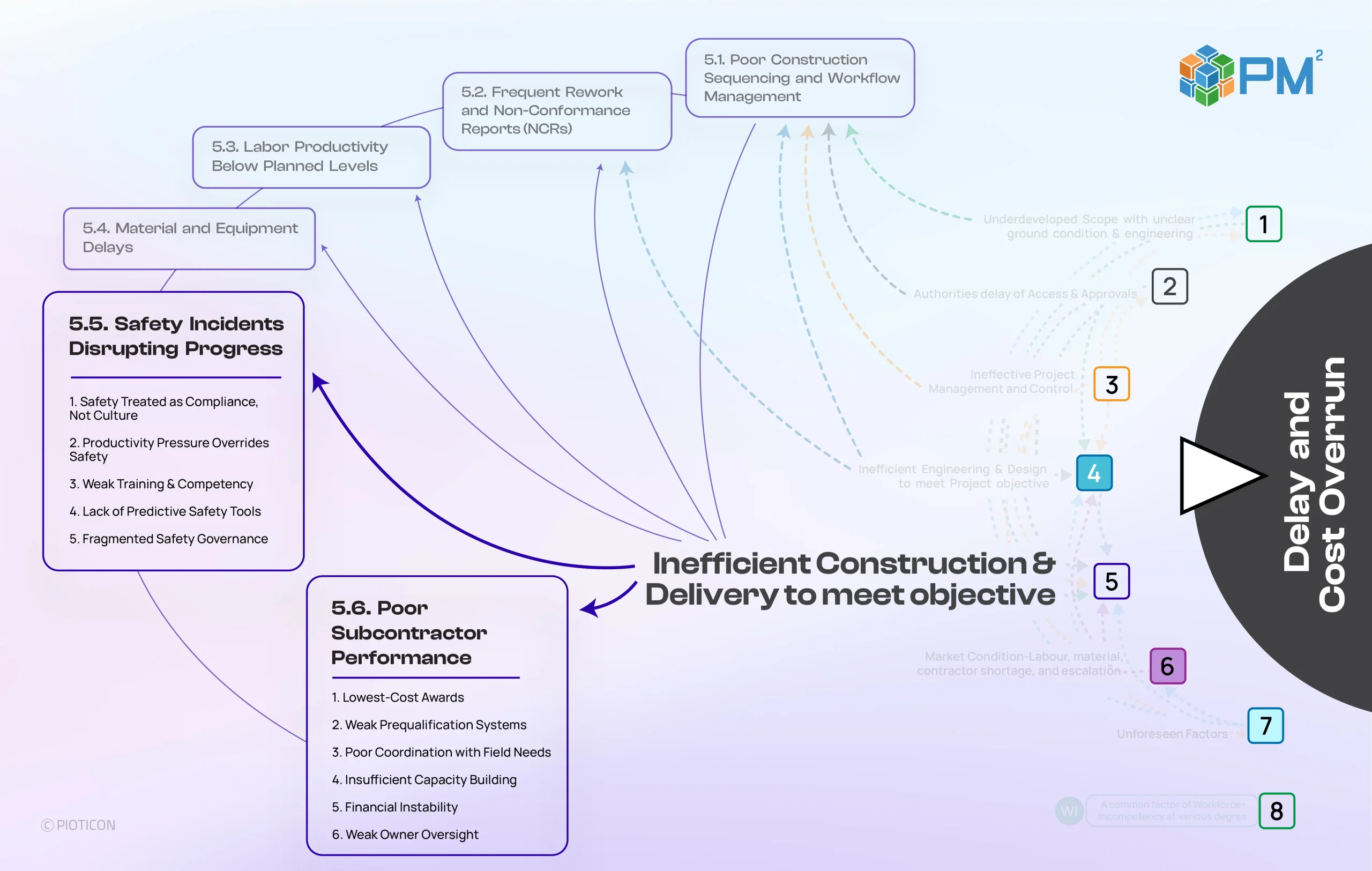
5.5. Safety Incidents or Environmental Hazards Disrupting Progress
The Problem
The Root Causes
5.1. Safety Treated as Compliance, Not Culture
- Rules followed superficially without behavioral reinforcement
5.2. Productivity Pressure Overrides Safety
- Supervisors deprioritize safety for speed
5.3. Weak Training & Competency
- Training lacks depth or behavior-based safety components
5.4. Lack of Predictive Safety Tools
- No analytics to anticipate high-risk conditions
5.5. Fragmented Safety Governance
- Roles unclear across owner, contractor, and subcontractor levels
The Required Shift
- Integrate predictive safety analytics into project intelligence systems
- Link contract payments to leading safety indicators
- Build leadership accountability for safety performance at every level
- Elevate safety from rule-following to shared operational culture
5.6. Poor Subcontractor Performance
The Problem
The Root Causes
6.1. Lowest-Cost Awards
- Capability overlooked for price, reducing reliability
6.2. Weak Prequalification Systems
- No standardized evaluation for capability or history
6.3. Shallow Market for competent Sub-contractors
- Demand for capable sub-contractors exceeds available market supply
6.4. Poor Coordination with Field Needs
- Procurement decisions lack field input
6.5. Insufficient Capacity Building
- No structured training or development for subcontractors
6.6. Financial Instability
- Payment delays and thin margins drive cash-flow stress
6.7. Weak Owner Oversight
- Oversight delegated entirely to main contractors
The Required Shift
- Adopt capability-based subcontractor pre-qualification frameworks
- Build development programs to strengthen local subcontractor capacity
- Maintain owner-level oversight with KPIs for time, quality, and safety
- Introduce performance-linked payments and early-warning reporting
Integrated Solutions Over Isolated Fixes
Each construction sub-cluster both depends on and influences the others:
- Sequencing & Buildability depends on design maturity and procurement readiness.
- Workface Planning & Productivity collapses if materials are late or workfronts are unavailable.
- Quality & Rework Control relies on integrated design–construction communication.
- Material & Equipment Readiness drives or delays productivity and safety.
- Safety Management shapes productivity and workforce stability.
- Subcontractor Capability determines quality, safety, and delivery speed.
- Governance & Intelligence integrates all data for real-time decision-making.
- Workforce Capability underpins every sub-cluster with skilled teams.
| Sub-Clusters | Integrated Solution Focus |
|---|---|
| Sequencing & Buildability | Combine 4D/5D simulation with procurement and site logistics to deliver constructible, conflict-free schedules. |
| Workface Planning & Productivity | Institutionalize Advanced Work Packaging with digital field tracking and PMO oversight. |
| Quality & Rework Control | Establish constructability and QA/QC gates connecting design, field execution, and governance. |
| Material & Equipment Readiness | Link supply-chain dashboards and vendor KPIs with live construction milestones. |
| Safety & Site Risk Management | Apply predictive safety analytics tied to behavioral performance and incentive systems. |
| Subcontractor Capability & Oversight | Use capability-based pre-qualification and performance-linked contracts under owner-level monitoring. |
| Governance & Performance Intelligence | Build unified dashboards combining safety, productivity, and subcontractor data for real-time decision-making. |
| Workforce Capability Development | Create certification and cross-disciplinary training pathways that turn skill into consistent site performance. |
- When Scope keeps changing, baselines collapse and site sequencing breaks down.
- When Access & Approvals slip, workfronts close and productivity drops.
- When Engineering & Design is inefficient, rework multiplies and cost buffers erode.
Conclusion: Efficiency Requires Integrated Discipline
Pioticon Blog is proudly powered by WordPress