Infrastructure projects drive economic progress and national development. Delays in gaining access and securing approvals from authorities, however, remain one of the biggest threats to timely execution. These delays raise project costs, weaken investor confidence, and lead to public dissatisfaction. Understanding the root causes is critical to finding long-term solutions.
Symptom: Delay in Authorities' Access and Approvals
At the surface level, the delays present as:
- Prolonged, unpredictable, or inconsistent approval processes
- Delayed land access or site handovers
- Regulatory reviews that extend without clarity
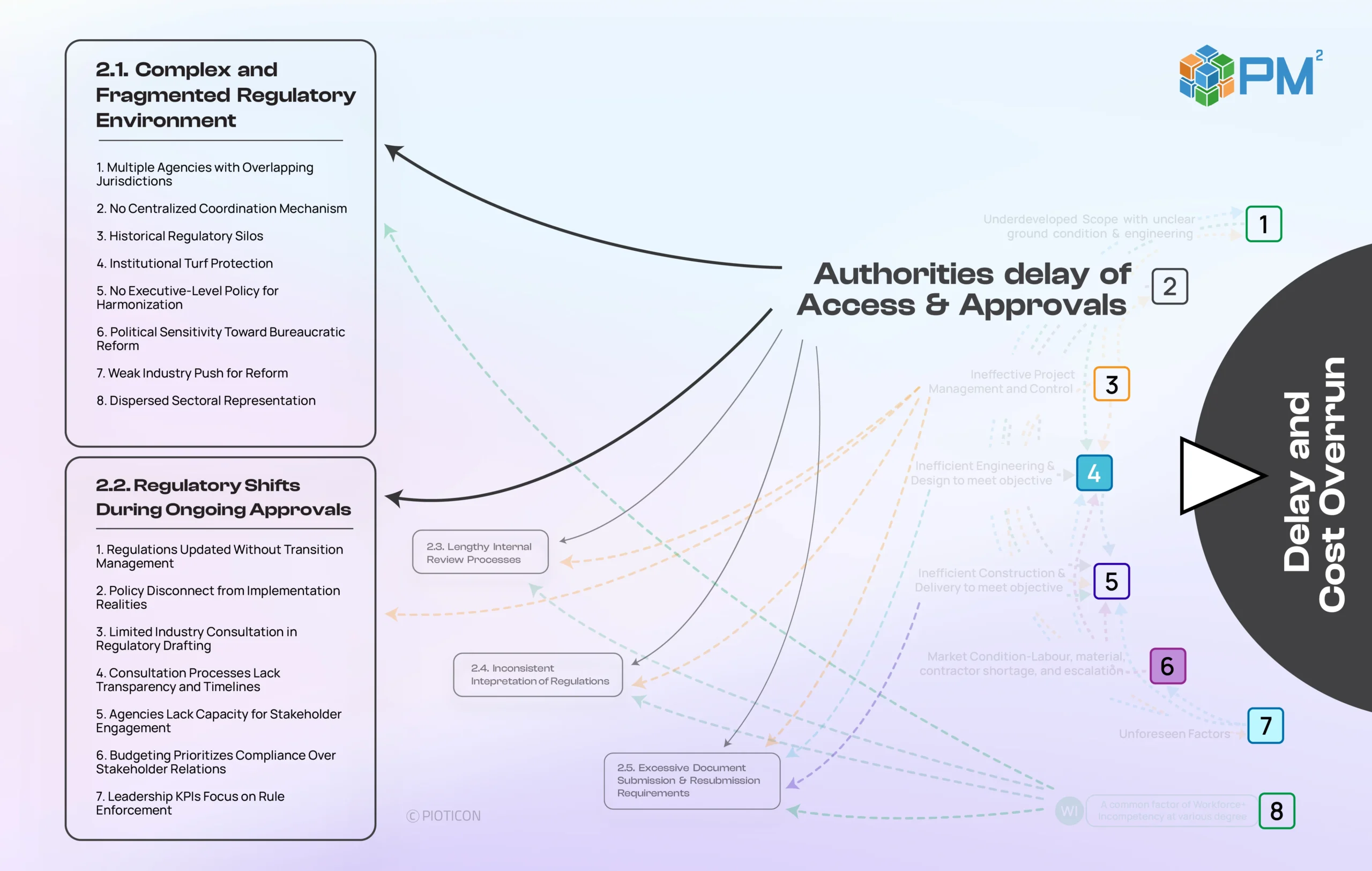
2.1. Complex and Fragmented Regulatory Environment
1. Multiple Agencies with Overlapping Jurisdictions
Most infrastructure projects need clearance from various departments including environment, transport, urban development, and utilities. Each one follows different rules and timelines. This creates:
- Duplication of paperwork
- Conflicting requirements
- Delayed coordination
2. No Centralized Coordination Mechanism
- Agencies rarely synchronize their processes
- There is no “single window” where applications can be processed collectively
3. Historical Regulatory Silos
- Each agency protects its mandates
- Cross-agency coordination is limited by legal autonomy
4. Institutional Turf Protection
5. No Executive-Level Policy for Harmonization
In the absence of higher-level mandates, coordination between departments remains optional rather than required.
6. Political Sensitivity Toward Bureaucratic Reform
Attempts to restructure longstanding bureaucracies face internal resistance and political hesitation.
7. Weak Industry Push for Reform
Industry stakeholders often face these issues alone. Few collective platforms exist to lobby for systemic reform.
8. Dispersed Sectoral Representation
Each industry (power, housing, transport) has its own associations. This weakens their combined influence.
Mitigation: Executive-Led One-Stop Clearance Bodies
- Create centralized approval offices under executive mandate
- Build digital platforms for cross-agency coordination and real-time tracking
- Enforce fixed decision timelines with service-level agreements
2.2. Regulatory Shifts During Ongoing Approvals
1. Regulations Updated Without Transition Management
- Retroactive application of new laws disrupts planning certainty
- Lack of “grandfathering” provisions undermines investor confidence
2. Policy Disconnect from Implementation Realities
3. Limited Industry Consultation in Regulatory Drafting
4. Consultation Processes Lack Transparency and Timelines
- Public notice periods may be short
- Stakeholders may not even be aware of consultation opportunities
5. Agencies Lack Capacity for Stakeholder Engagement
Resource constraints limit proactive, meaningful engagement with industry, especially for technical or large-scale projects.
6. Budgeting Prioritizes Compliance Over Stakeholder Relations
7. Leadership KPIs Focus on Rule Enforcement
Agency success is typically measured by volume of regulations issued or enforced, not by industry satisfaction or practical implementation.
Mitigation: Transparent Regulatory Impact Assessment
- Mandate public consultation for all new rules
- Run technical and economic impact assessments
- Pilot major rules through sandbox environments before full rollout
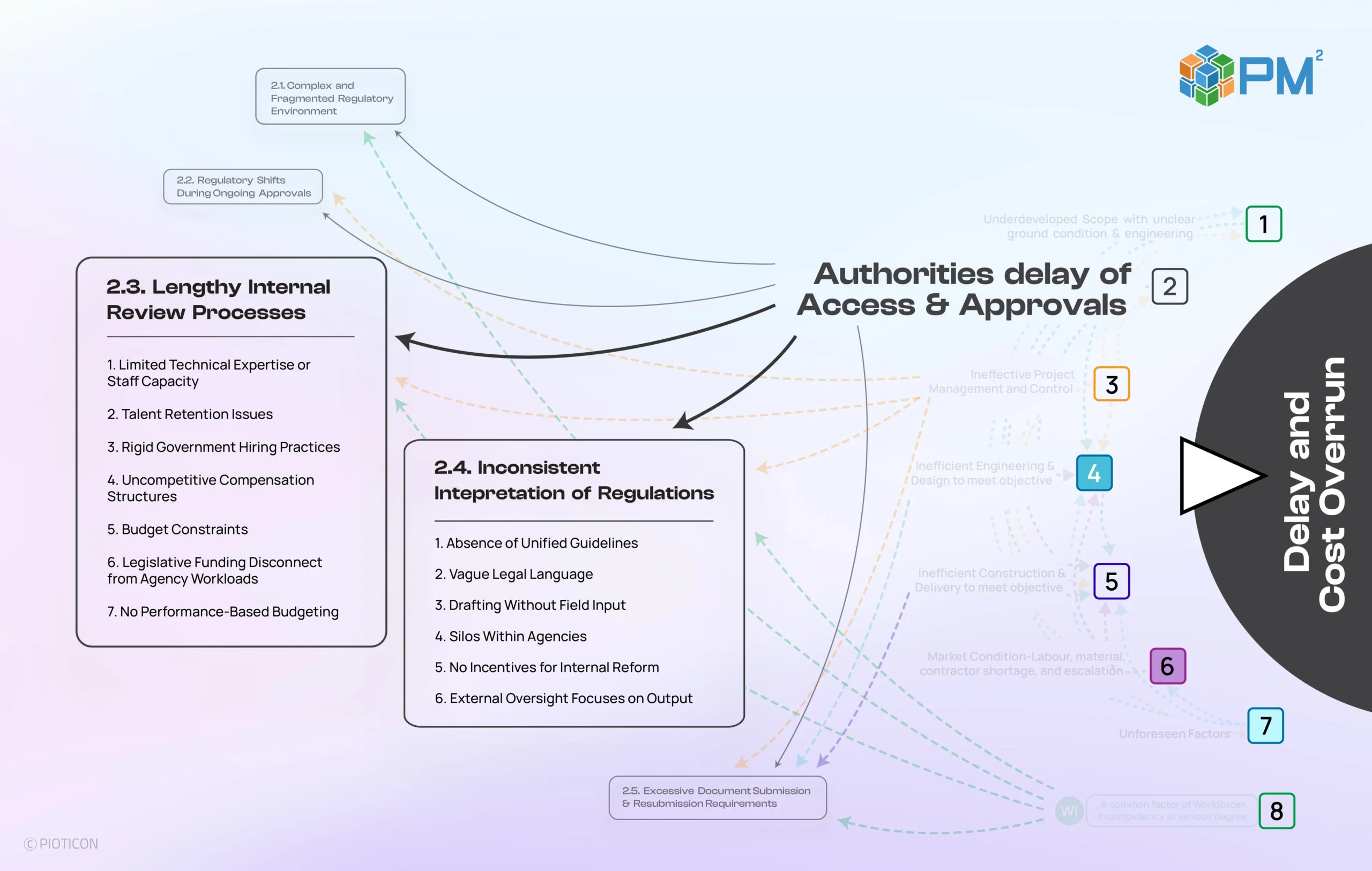
2.3. Lengthy Internal Review Processes
1. Limited Technical Expertise or Staff Capacity
2. Talent Retention Issues
3. Rigid Government Hiring Practices
- Lengthy recruitment processes
- Rigid qualification criteria
- Seniority-based promotion systems
4. Uncompetitive Compensation Structures
5. Budget Constraints
6. Legislative Funding Disconnect from Agency Workloads
7. No Performance-Based Budgeting
Agency funding models lack performance incentives for reducing approval backlogs.
Mitigation: Build Professional Regulatory Cadres
- Introduce technical career tracks within regulatory agencies
- Align budgets with project volumes and technical complexity
- Offer competitive pay for critical skills
2.4. Inconsistent Interpretation of Regulations
1. Absence of Unified Guidelines
2. Vague Legal Language
3. Drafting Without Field Input
Legal and policy teams draft rules with minimal input from technical reviewers.
4. Silos Within Agencies
5. No Incentives for Internal Reform
6. External Oversight Focuses on Output
Legislative and executive oversight often emphasizes quantity of regulations rather than user experience.
Mitigation: Standardized Guidelines and Shared Knowledge
- Create standard operating procedures with examples
- Build internal platforms for case-sharing and interpretation
- Form multidisciplinary policy-drafting teams
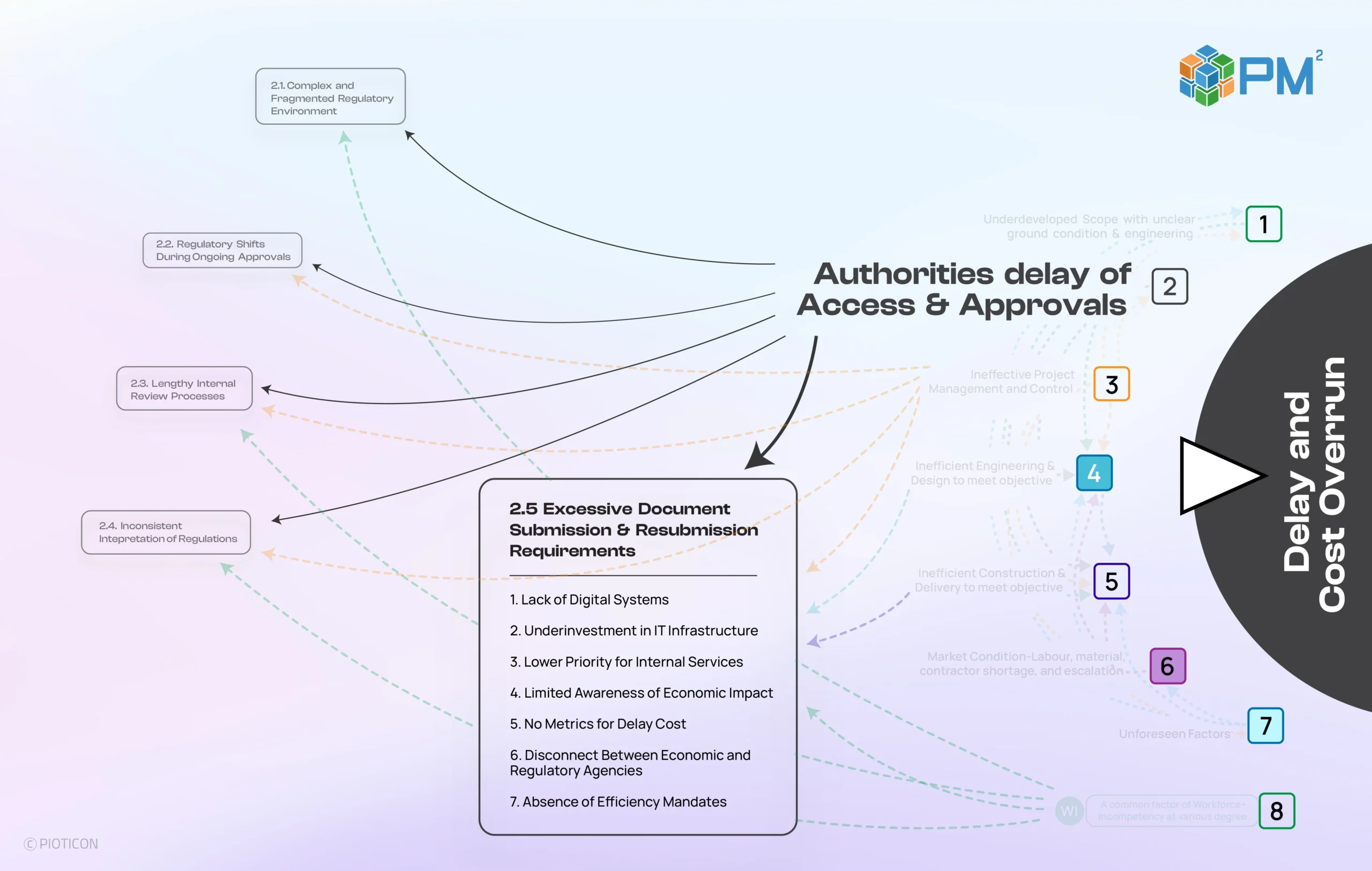
2.5. Excessive Document Submission & Resubmission Requirements
1. Lack of Digital Systems
2. Underinvestment in IT Infrastructure
3. Lower Priority for Internal Services
4. Limited Awareness of Economic Impact
Decision-makers often overlook how delays damage investment flows and GDP.
5. No Metrics for Delay Cost
6. Disconnect Between Economic and Regulatory Agencies
7. Absence of Efficiency Mandates
Regulatory performance rarely forms part of national competitiveness strategy.
Mitigation: Complete Digitalization of Permitting
- Launch online portals for document submission, progress tracking, and issue resolution
- Automate internal workflows for faster routing and accountability
- Apply AI tools for preliminary reviews and quality checks
Cross-Cutting Solutions: A Holistic Path Forward
Fixing permitting delays cannot stand alone. Each solution must connect with other systemic levers across the project lifecycle to prevent cascading cost and schedule overruns. The following integrated pathways highlight how Access & Approvals reforms interface with other critical clusters of PM²:
Executive-Led One-Stop Clearance Bodies and Digital Portals
Streamlines fragmented governance while directly strengthening governance and stakeholder management (Cluster 7), ensuring agencies and industry align under unified service-level agreements.
- Transparent Regulatory Impact Assessments and Consultation Frameworks
Builds predictability in the policy environment and reduces retroactive disruptions, while reinforcing planning and readiness (Cluster 1) by giving project teams greater certainty on compliance pathways. - Professionalized Regulatory Cadres and Capacity-Building Programs
Expands agency capability and retention, directly linking with workforce capability (Cluster 8). Skilled, adequately resourced regulators accelerate reviews and reduce inconsistencies. - Unified SOPs and Internal Knowledge-Sharing Platforms
Standardizes interpretation of regulations across departments, supporting risk management (Cluster 4) by reducing ambiguity and dispute potential while feeding into governance and learning (Cluster 7). - End-to-End Digitalization of Permitting Systems
Automates submission, review, and tracking while integrating with performance reporting and intelligence (Cluster 5). This not only improves visibility of delays but also enables predictive analytics for bottleneck resolution.
Challenge Area | Recommended Solution |
Fragmented Governance | Create Executive One-Stop Shops for integrated permitting |
Policy Uncertainty | Institutionalize Regulatory Impact Assessment and transparent consultations |
Agency Capacity Constraints | Invest in Professionalization, Competitive Pay, and Capacity Building |
Inconsistent Interpretations | Develop Unified SOPs and Internal Knowledge Bases |
Manual, Inefficient Systems | Fully Digitalize Permitting Processes end-to-end |
Why Integration Matters
Conclusion
Delays in securing access and approvals remain one of the most significant risks in infrastructure delivery. These are not isolated or accidental failures. They stem from systemic issues that require sustained, executive-level attention.
Countries that treat regulatory efficiency as a competitiveness issue can attract faster investment, accelerate public benefits, and build stronger public-private trust. The choice lies not only in project execution strategies but also in structural commitment to better governance.
Pioticon Blog is proudly powered by WordPress